
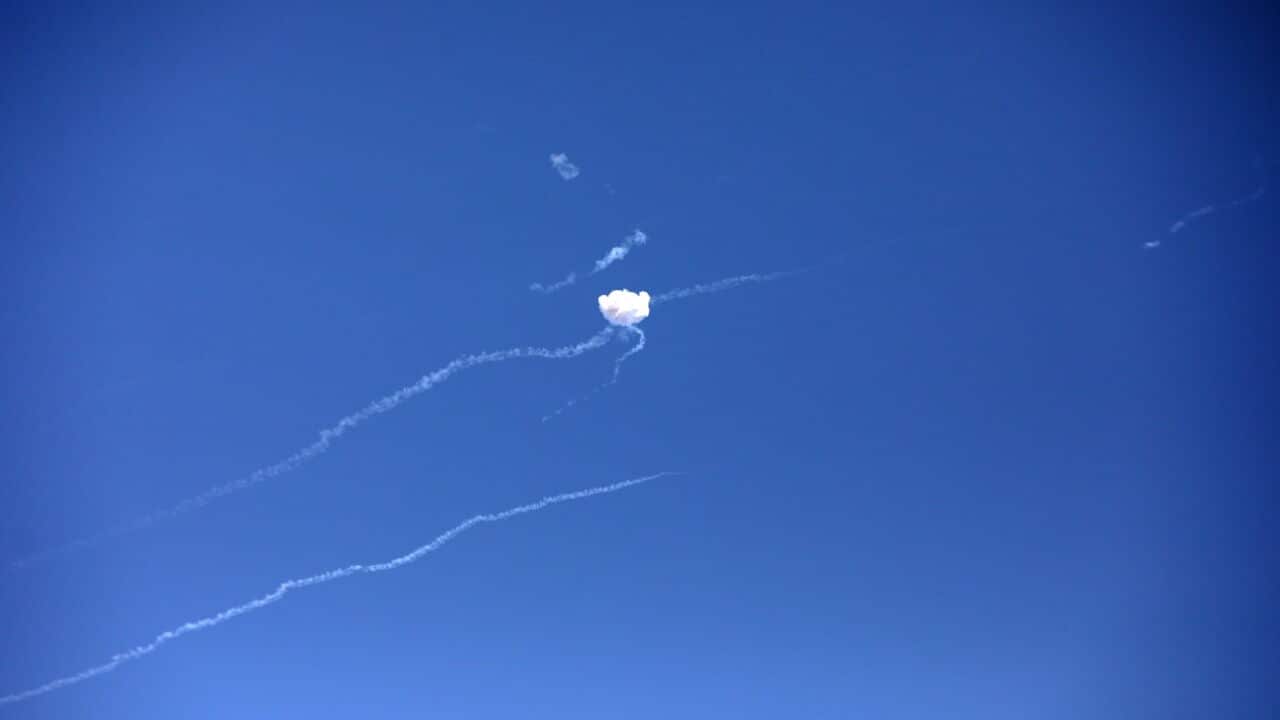

The United States and Iran have exchanged another wave of strikes, as a growing battle over the Strait of Hormuz pushes last month's diplomatic agreement closer to collapse. The Trump Administration insists commercial shipping will continue through the strategic waterway, while Tehran says it now controls who can pass.
Listen to Australian and world news, and follow trending topics with SBS News Podcasts.
TRANSCRIPT:
The United States has launched fresh strikes on Iran, after Tehran attacked a commercial cargo ship in the Strait of Hormuz.
Iran's Revolutionary Guard has accused the Cyprus-flagged GFS Galaxy of using an unauthorised route through the strategic waterway.
The vessel was badly damaged, forcing its crew to abandon ship.
Oman says 23 people have been rescued, while one sailor remains missing.
The US responded swiftly; striking Iranian missile, drone, naval and surveillance sites, prompting another round of Iranian missile and drone attacks on US facilities and allies across the Gulf.
U-S Ambassador to NATO Matthew Whitaker says commercial shipping through the Strait must be protected.
"Commercial shipping can't be terrorized in the Strait of Hormuz. And obviously the memorandum of understanding between the parties was always performance-based, and that President Trump, if shipping is attacked or if if the Iranians want to act belligerent, then he will respond with overwhelming force."
Iran says the United States is responsible for the latest escalation in the conflict.
The nation has again declared the Strait of Hormuz closed, insisting foreign vessels must comply with Iranian instructions before entering the waterway.
In Tehran, resident Majid Karimi says many Iranians believe the country has no choice but to retaliate.
"Look, when they hit you, you have to hit back. If you do not, it means you have lost, you have been defeated and you are not strong enough."
The Strait of Hormuz has become the centre of tense negotiations, since the US and Iran signed an interim deal to build toward a lasting peace in the region.
Around one-fifth of the world’s traded oil normally passes through the narrow waterway, along with significant volumes of liquefied natural gas.
Commercial shipping has fallen sharply as ship owners weigh the risks of entering the Gulf.
Washington says the Strait remains an international waterway.
Tehran argues it has the right to determine how ships move through it.
Another Tehran resident, Rahman Matlabzade, says the Strait should remain open, but under Iranian control.
"I think it would be better for it to remain open under our management. In other words, we should control it, but it should still remain open, and as Dr Qalibaf said, we should not turn the Strait against ourselves."
The dispute reflects how dramatically the conflict has changed.
What began as a campaign aimed at stopping Iran’s nuclear ambitions is increasingly becoming a battle over control of one of the world’s most strategically important waterways.
Aaron David Miller is a senior fellow at the Carnegie Endowment for International Peace and a former US State Department Middle East negotiator.
He says the Trump administration now finds itself spending heavily to restore access to the waterway.
"The objective of this war was essentially to prevent Iran from obtaining a nuclear weapon, and it is extraordinary that the focus is now on reopening, at some cost, billions of dollars to the American economy being expended on this military campaign, reopening something that was open the day before the war started."
The military confrontation is also putting growing pressure on the Memorandum of Understanding signed by Washington and Tehran last month.
The agreement was intended to keep the Strait open and create a 60-day window for negotiations towards a broader settlement.
Instead, both governments now accuse the other of violating its commitments.
Iran’s ambassador to the United Nations, Amir Saeid Iravani, says the United States has breached both international law and the agreement through its continued military action.
"The United States has once again violated its obligation by launching and continuing large scale military attacks against Iran's sovereignty and territorial integrity, including attacks on installations in the southern cities of Iran and several Iranian islands in the Persian Gulf. These renewed attacks constitute another flagrant violation of article two of the charter and material breach of paragraph one of the Islamabad Memorandum of Understanding."
Washington rejects that claim, arguing Iran broke the agreement first by attacking commercial shipping.
Matthew Whitaker says there may also be a lack of coordination between Iran’s military and those involved in negotiations.
"The Iranians need to get their house in order. That the folks that are shooting missiles and drones at ships need to make sure that they're coordinating with the people that are negotiating the peace deal, because my sense is that they're not. And I think ultimately it is in their best interest, to to continue to work on the deal that was outlined in the memorandum of understanding and that we continue to march forward to a, a lasting deal, that not only keeps the Strait of Hormuz open and toll-free, but also make sure that Iran, abandons its nuclear ambitions."
Iran insists it also remains committed to diplomacy, but only if the United States honours its side of the agreement.
Amir Saeid Iravani says Tehran will no longer consider itself bound by the deal if Washington continues its attacks.
"Iran remained committed to the faithful implementation of the memorandum of understanding, provided that the United States fully and faithfully complies with its own obligation. However, should the United States continue to violate its obligation under the MoU, Iran will no longer be bound to fulfill its obligation under the MoU."
Despite continuing mediation efforts by Oman and Qatar, neither side appears willing to back down.
And with each side accusing the other of violating last month’s agreement, the prospects for restoring both the ceasefire framework and meaningful negotiations appear increasingly uncertain.