Eleven days after an ice-rock avalanche triggered a deadly mudslide in Nepal, two more survivors have been found alive. It's a rare sign of hope in a disaster that has killed more than 1,300 people and left nearly 4,900 others missing, including 36 Australians.
Listen to Australian and world news and follow trending topics with SBS News Podcasts.
TRANSCRIPT
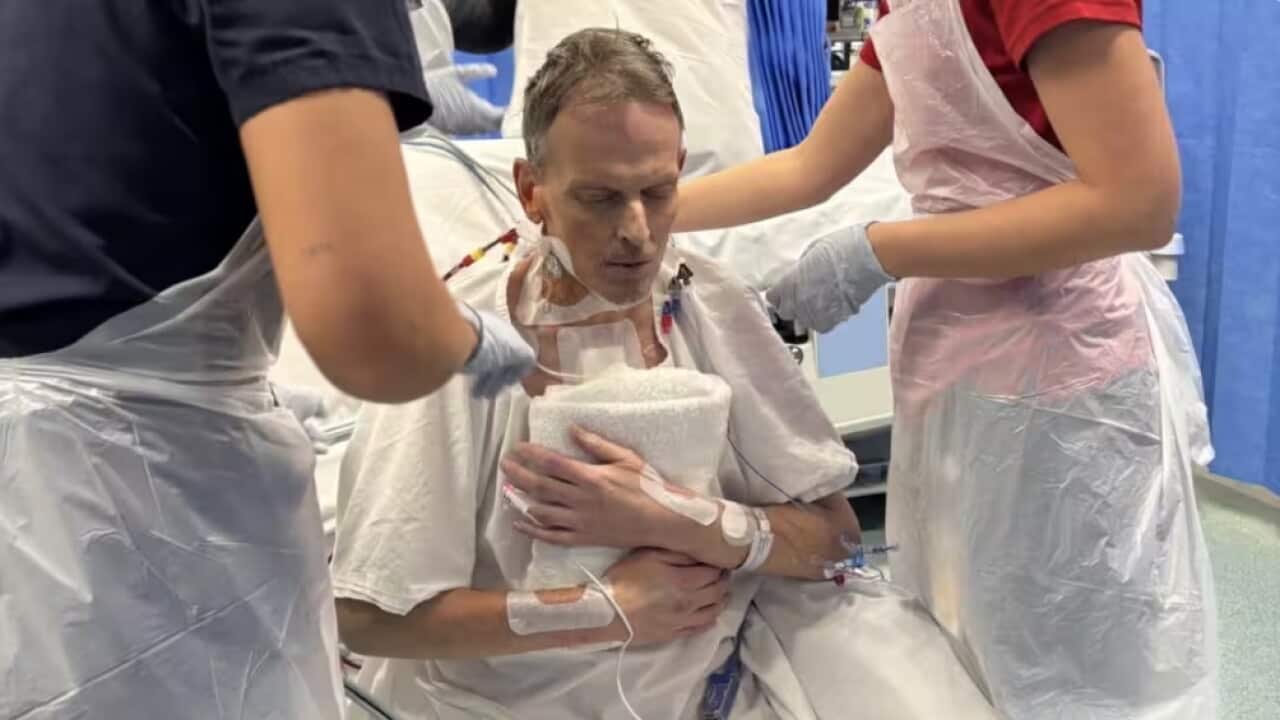
Lying in a hospital bed in a stable condition, Lu Haitao is feeling bewildered — and immensely thankful.
The Chinese worker was rescued after spending 10 days trapped inside a 225-metre hydropower tunnel following Nepal's devastating mudslide.
"A bit better, but I still feel dizzy sometimes, and my head feels heavy."
That's his voice, frail after days alone in the dark, as his body lies under blankets to ward off hypothermia.
He says he's feeling a little better, although he still experiences dizziness and a heavy head — and he wants to thank the rescuers who found him.
In a separate interview, Mr Haitao recalled his ordeal in the Trishuli hydropower project tunnel, and that when the rescuers' lights finally drew close, he couldn't believe it was real.
"I shouted many times. Every time I saw the lights, I would shout 'Hey!' really loudly ... They didn't hear me. But every time I saw the lights, I would shout with all my strength. When they came to rescue me today and found me, I could hardly believe it. Even when the lights were right in front of my eyes, I didn't shout at all. I felt like I had lost all hope."
Asked how Mr Haitao survived for so long, Director General of the Nepali Army Medical Services, Bhandari, put it down to luck, determination and circumstance.
"A lot of factors, you see. One is the moral support. Another is where he was. As for him, he managed to find something to hang on the upper part of the tunnel. So that was one good thing, and probably he had that. He didn't lose his confidence. So that's how we managed to save him."
Rescue efforts have increasingly focused on 12 hydropower projects across Nepal, where about 900 workers are missing and roughly 500 are believed to be trapped in various tunnels.
Two Nepali workers were also rescued from the Trishuli hydropower plant on Friday.
And on Saturday, rescue teams also discovered another survivor of the tragedy.
64-year-old woman Chandika Shrestha was found alive in the debris of her partially buried home in Nepal's Himalayan district of Nuwakot, about two-and-a-half hours north of Kathmandu.
She was airlifted to hospital for treatment.
Their tales of survival offer rare glimmers of hope amid a tragedy that has left more than 1,300 people dead and nearly 4,900 missing in Nepal.
In Tibet, Xinhua news agency reported on Friday there are at least 31 people dead with 531 still missing.
For families awaiting news of missing loved ones, each day brings fresh anxiety.
Authorities say locating foreign nationals remains a priority, with nearly 600 foreigners from more than 30 countries among those still missing.
As many as 36 Australians remain unaccounted for.
In Kathmandu, relatives are providing DNA samples to help identify victims, while a hospital wall of missing persons has become a desperate last resort for families seeking news of loved ones.
Vishal Vignesh has travelled from the United States in search of his parents and three other family members who were taking part in the Kailash Mansarovar pilgrimage.
"It is a catastrophic situation unfortunately. There are certain limitations that Nepal army has put on internationals and their ability to access the points. So we are not able to go to Raswagarhi at this point, which is my hope to at least go to some of the camps and try to see if we can get some semblance of their existence."
Identifying victims is proving difficult, with many bodies badly damaged or in an advanced state of decomposition. Morgues have been overwhelmed, forcing some remains to be temporarily buried.
As search and recovery efforts continue in northern Nepal and neighbouring Tibet, survivors are returning to ruined homes to rescue livestock, salvage belongings and come to terms with the scale of the catastrophe.
In her devastated Himalayan village of Devighat in Bidur municipality, Ambika Nepali has been trying to recover medication for her husband's heart condition. With police assistance, she was able to retrieve vital medical documents and prescriptions from their damaged home.
"We informed the police about our important documents and medical papers. They helped us by sending people to retrieve these belongings. We have only been able to take stuff from one room. We haven't been able to enter the remaining three rooms as the doors are completely blocked. Still, we have managed to recover some documents and gold items."
Volunteers and aid organisations are helping residents assess the damage.
Aid worker Pushpa Adhikari warns recovery will take years and requires sustained government support.
"It will take a long time to manage the damage because there is a lot of destruction here. It is not small. This is just one place where we are, but it has spread far and wide. Therefore, the government should make arrangements for housing for families who are homeless. Rooms should be arranged based on the number of members in the family. For example, a family of ten members should be provided with enough rooms accordingly."
But before large-scale rebuilding can begin, the government's immediate focus remains the same.
Finding those still alive — and recovering those who have died.