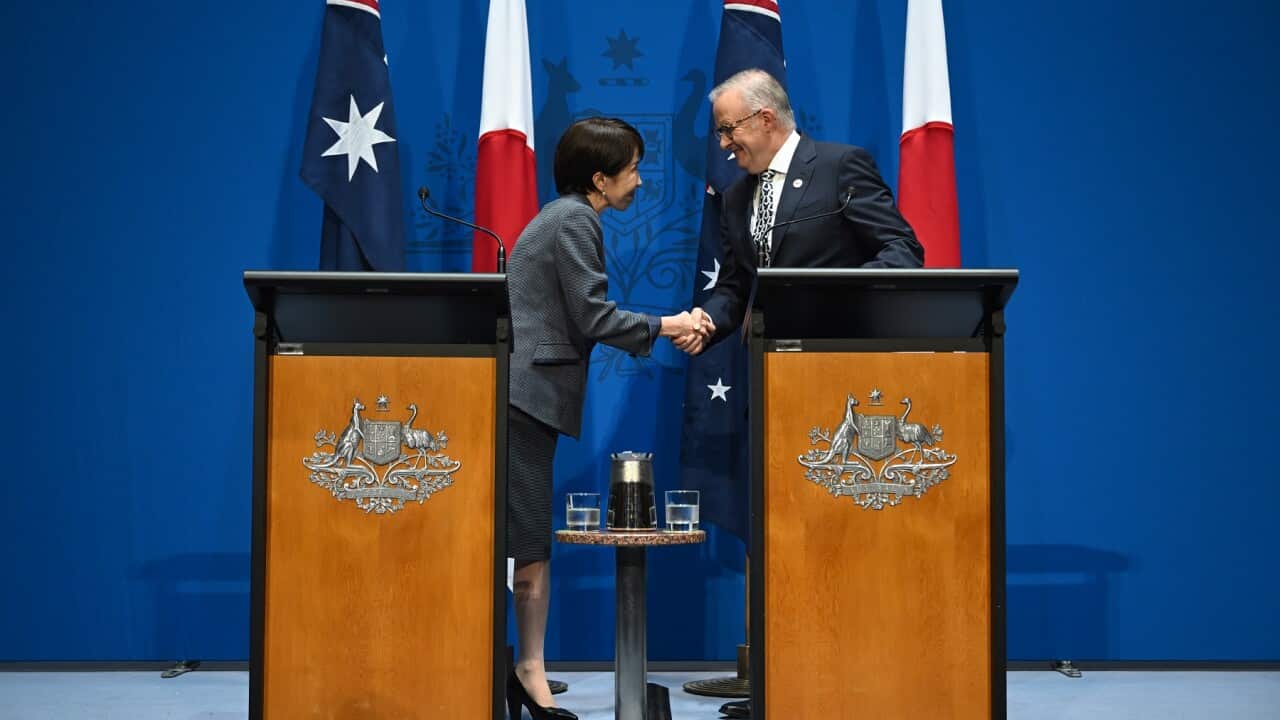

Australia and Japan have signed a suite of deals strengthening economic and security cooperation as Japan's 'iron lady' makes her first visit to Australia as leader. With global energy disruptions and a faltering rules-based world order, both leaders say a strengthened alliance between Australia and Japan is crucial for both countries.
Listen to Australian and world news and follow trending topics with SBS News Podcasts.
TRANSCRIPT
Japan's so-called 'iron lady' and first female Prime Minister, Sanae Takaichi, has visited Australia for the first time as leader.
The visit marks 50 years since Malcolm Fraser and Prime Minister Miki Takeo signed the historic Nara Treaty, establishing bilateral friendship and co-operation.
In the midst of a global energy shock and growing instability in the international rules-based order, Prime Minister Anthony Albanese says this visit will strengthen those ties.
“Our friendship has never been closer and in these uncertain times, friendships matter more than ever. The world has changed immensely since 1976, but the strength of Australia and Japan's friendship and the spirit of generosity and respect that our people share is stronger than it has ever been.”
The former heavy metal drummer turned world leader came bearing gifts for Prime Minister Albanese: two vinyls of Japanese metal and rock bands.
In return, Japan's Takaichi was gifted a signed AC/DC Drum skin, alongside a framed picture of the band's founder, Malcolm Young.
“We will continue our discussions including on issues like heavy metal music and other important matters of state.”
In a set of new deals, the two leaders announced deepening cooperation on defence, security, critical minerals, cybersecurity and trade.
An agreement on economic security will aim to strengthen supply chains for goods such as energy products, critical minerals and food.
Advancing bilateral cooperation, the deal requires both countries to consult with each other on economic security measures and risk mitigation.
“Firstly, the Joint Declaration on Economic Security Cooperation that we signed today will make us more resilient to economic shocks and uncertainty, enable us to further build trusted supply chains, accelerate development of critical technologies such as AI Quantum and biotechnology, and support regional economic resilience.”
Building on that, a deal on energy security saw both leaders pledge to ensure the flow of fuel and gas.
Japan is an important supplier of refined petroleum and diesel to Australia.
Australia-Japan Research Centre director Shiro Armstrong told SBS that Japan relies on Australia for energy products.
“It's got about 16 and a half percent energy self-sufficiency, and Australia is by far the largest supplier of energy. One third of Japan's energy needs comes from Australian gas and coal. So we play an important role in underwriting Japan's energy security, and that means we have to avoid creating uncertainty and remain a stable and secure supplier.”
The deal comes amid rising pressure on the Albanese government to implement a 25 per cent tax on gas exports.
Research from the Australia Institute shows the tax could boost the Australian economy by $17 billion each year.
However, opponents of the tax argue it risks weakening Australia's position as a reliable partner.
Shiro Armstrong says domestic policy must serve Australians, while still providing certainty to key partners in the region.
“But that doesn't mean we have to, we can't get domestic energy policy right. That's been uncertain for many years in Australia. But as we change our policies and get domestic energy policy right, we have to do so in a way that does not discriminate against our customers in Northeast Asia and provide certainty for them going forward. “
The visit also saw a commitment to strengthen defence and security cooperation.
Building on existing agreements, the joint statement prioritises the "testing of new equipment, advanced weapons and emerging technologies" in each other's territories.
Earlier this year, Australia and Japan signed a multi-billion-dollar contract for Australia's general class warships to be upgraded to the Japanese Mogami class frigate design.
Describing Japan and Australia as 'quasi-allies', Sanae Takaichi says the strengthened partnership is crucial to regional stability.
“Today, Anthony and I held the strategic discussions on issues beginning with China, Southeast Asia, Pacific Island countries, and responses to issues of nuclear and missiles and abductions of North Korea among others, which pertain to the Indo-Pacific situation, as well as the Middle East, including Iran. Amid the severe international environment, strengthening cooperation with our common ally, the United States is indispensable.”
While both Australia and Japan are historic allies of the United States, they are also deeply embedded with China through trade and geography.
As certainty around US alliances weakens and China's influence expands, Professor Armstrong says Japan and Australia are both determined to solidify their ties.
“The message to China, but also to the United States and the whole region, is that Australia and Japan, stand for the rules-based system and an open global economy and so the declarations on economic security, for example, are about bedding down that interest and cooperating more fully between the two countries at the highest level to help ensure the assumptions that we've worked on, that are being overturned about the rules-based system and protection of openness maintain , and we preserve the system we have while we work to create new rules, new standards that serve our interests going forward.”
A critical minerals deal was also signed, with Japan keen to diversify its metals supply chain away from China.
Six key projects were listed for investment, labelled as a core pillar of the relationship and addressing supply chain vulnerabilities.
Speaking to Sky News, Trade Minister Don Farrell says he will visit Japan in the coming weeks to consolidate the deals.
“I'm in fact, two weeks’ time I'll be up there in Japan continuing our discussions with Japan. You might recall after the Prime Minister's visit to Singapore, we met with our counterparts to put some flesh on the bone of these agreements. It's important that the document itself reflects what's agreed... Certainly, our discussions with, with Singapore has continued to result in us getting our fuel supplies. But also in the area of critical minerals, we really want greater investment from our allies in the region. There are wonderful opportunities in our critical mineral industry, and we want Japan to be engaged in that process.”
As a hardline conservative, Sanae Takaichi comes from a starkly different political background to Anthony Albanese.
But Professor Armstrong says that in a relationship as important as this one, those differences are put aside.
“The prime ministers, like Australian prime ministers and Japanese prime ministers over the years, have had productive relationships no matter where they come from on the political spectrum. That's almost irrelevant for the bilateral relationship. They share a deep interest in the bilateral relationship, Prime Minister Albanese and Prime Minister Takaichi, and the core interests of the stable regional order. So, I heard Prime Minister Takaichi refer to Prime Minister Albanese as Anthony, and I think they're building a close rapport. “