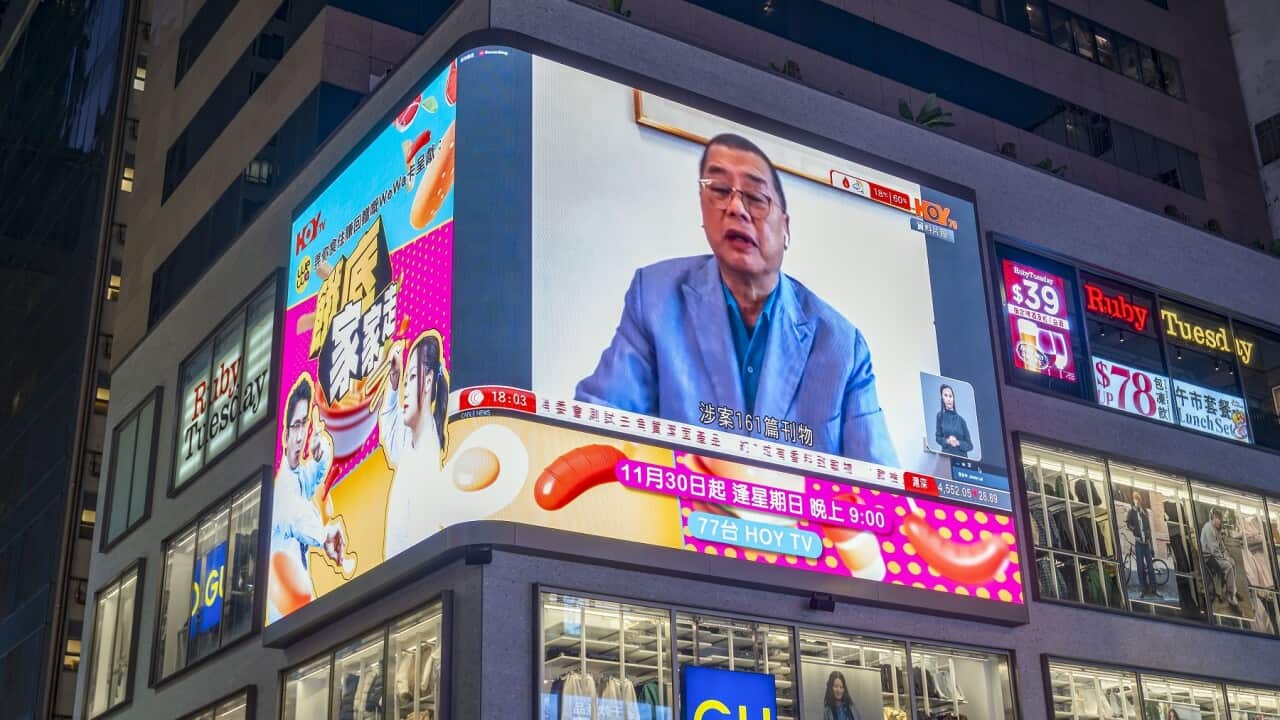

Hong Kong's most vocal China critic, media tycoon Jimmy Lai, has been sentenced to 20 years in prison, ending the city's largest national security case. Mr Lai's sentence on two counts of conspiracy to collude with foreign forces and one for publishing seditious materials ends a legal saga that has lasted nearly five years.
Listen to Australian and world news and follow trending topics with SBS News Podcasts.
TRANSCRIPT
Hong Kong media tycoon Jimmy Lai has been sentenced to 20 years in prison under the city’s national security law, the harshest punishment yet imposed since the legislation came into force in 2020.
The 78-year-old founder of the now-defunct Apple Daily was convicted of conspiring to collude with foreign forces and publishing seditious material, following a trial that began after his arrest during the pro-democracy crackdown that year.
Prosecutors say Mr Lai used his media platform and overseas contacts to undermine China’s sovereignty and destabilise Hong Kong.
China’s foreign ministry spokesman Lin Jian has defended the verdict, insisting it upholds the rule of law.
“First, I'd like to emphasise that Jimmy Lai is a Chinese citizen. As the principal architect and participant in a series of anti-China activities aimed at destabilising Hong Kong, his actions have severely undermined the fundamental principles of One Country, Two Systems, gravely endangered national security, and significantly harmed Hong Kong's prosperity, stability, and the well-being of its residents. He should be severely punished by law.”
Barrister Lawrence Ma Yan-kwok, who is the chairman of the Hong Kong Legal Exchange Foundation, rejects claims that controlling press freedom is the motivation behind the sentence.
He says freedom of expression still exists but with limits tied to national security.
Mr Yan-Kwok argues Mr Lai crossed that line.
“Jimmy Lai is different. He is so adamant. He's going to overthrow it, regardless of what the government does, what the good things its done, or whether things that the government has contributed to people and helping the community, that doesn't matter, as long as he doesn't like the politics of it. The Hong Kong government is born to be disliked, according to him, and he is there to overthrow it, and he made it pretty clear. So I mean, this is not press freedom. This is using the press as a sedition, subversion, succession tool to overthrow a government -- that is completely different from exercising a right conferred by the law.”
The barrister also believes that Hong Kong’s judiciary remains independent and free from political interference.
International human rights bodies strongly dispute that interpretation.
The United Nations has condemned the sentence and called for it to be overturned.
Speaking in Geneva, UN human rights spokesperson Jeremy Laurence says the verdict violates international law and criminalises protected freedoms - and targets legitimate journalism and dissent.
“Our Office has reviewed the verdict against Jimmy Lai and is concerned that it criminalises the exercise of freedom of association and expression, including media freedoms – rights which are protected under international human rights law. Furthermore, the verdict draws extensively on conduct that pre-dates the passing of the National Security Law in 2020. The verdict should be promptly quashed as incompatible with international law.”
Mr Lai, a British citizen, denies the charges, calling himself a political prisoner.
And for Mr Lai’s family, the legal concerns are overshadowed by fears for his health and survival.
Mr Lai’s son, Sebastien Lai, says the punishment is effectively a life sentence.
“This 20 years, it's a farce. It's essentially tantamount to a life sentence, or as Human Rights Watch calls it, a death sentence, because in the conditions that my father is being kept in, I don't know if he even has a tenth of that.”
Jimmy Lai’s sentencing marks a defining moment for Hong Kong.
To critics, it signals the collapse of press freedom once promised under One Country, Two Systems.
Human rights barrister Jonathan Price has said the sentence is not justified.
“The sentencing sends a crystal clear message that lawful dissent in Hong Kong will no longer be tolerated. 20 years is a very long time in anyone's life. Mr. Lai, as you know, is 78 years old, his health is rapidly failing. The situation could not be more urgent. We are encouraged to hear today, Yvette Cooper, the British Foreign Secretary reiterating the British government's view that this is a political persecution, it's been a political trial, these are political charges and it's a political conviction.”
But to Beijing, it proves no one stands above the law.
Lin Jian says it's proof that Hong Kong’s courts acted independently.
“Hong Kong is a society governed by the rule of law. Judicial authorities in HKSAR fulfill their duties, safeguard the authority of the law and defend national security in accordance with the law. This is justified, legitimate, lawful and beyond reproach. The central government firmly supports the HKSAR in safeguarding national security and punishing crimes that endanger national security in accordance with the law.”
But to his family, it is a race against time.
Jimmy's daughter Claire Lai says the decision ultimately lies in Beijing, not Hong Kong’s courts.
“The ultimate arbiter of my father’s cases and his freedom is in Beijing, not in Hong Kong. It's not, you know, this is something that has to be solved sovereign to sovereign. It isn't something that will be solved through the court system.”