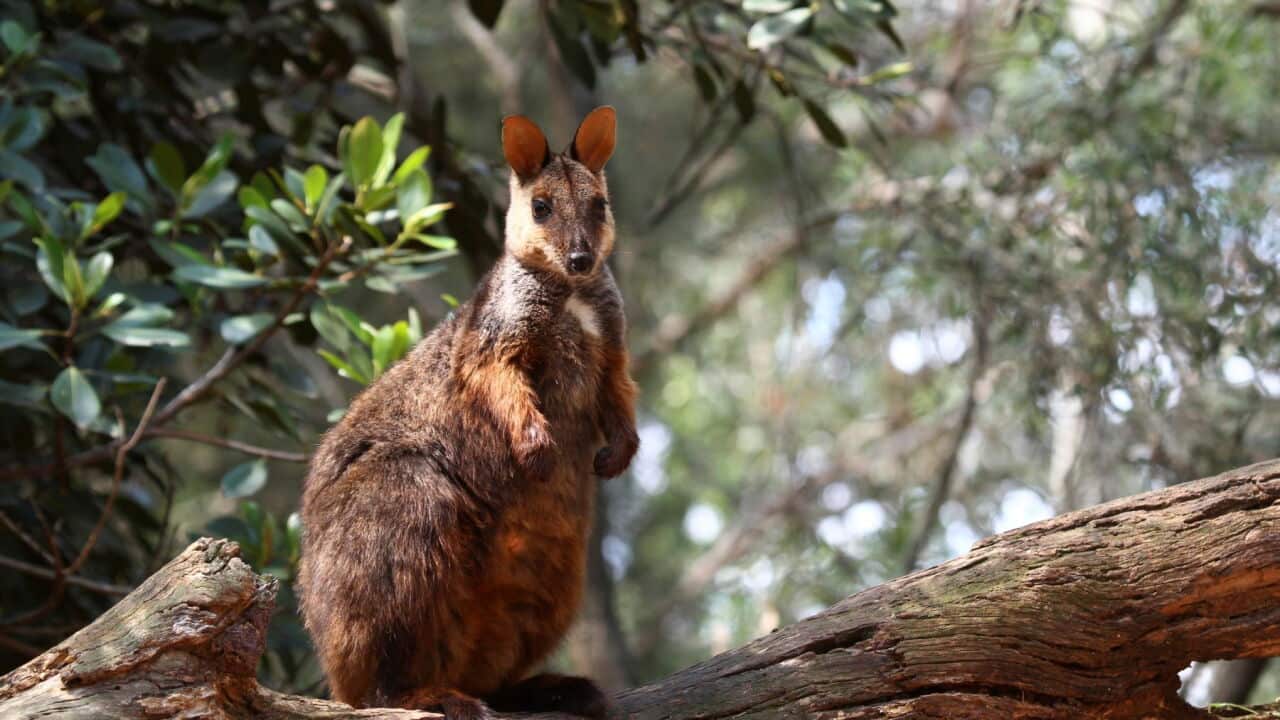

Everyone from rugby union supporters to wildlife and animal lovers has heard of the Australian wallaby. But it's perhaps less known that there are, in fact, many species of these cute marsupials, including some that are endangered. One of these is the brush-tailed rock-wallaby and scientists are now working on ways to protect the species.
Listen to Australian and world news, and follow trending topics with SBS News Podcasts.
TRANSCRIPT:
Unique to Australia, the brush-tailed rock-wallaby is not your usual, run-of-the-mill wallaby.
Blending perfectly with the natural colours of its habitat, it can be difficult to spot.
Senior Keeper at Taronga Zoo Tony Britt-Lewis says it’s not just their thicker and bushier tail that makes them unique.
"There are differences between brush-tailed rock-wallabies and your average wallaby. They're incredibly agile. They have slightly shorter feet than other macropods and very thick, thick rubbery pads to allow them to hop around on the rocky surfaces. They've got their tail is a little bit longer than your average wallaby and they use that for balance when they're hopping around. But the main thing is they are incredibly agile."
Experts like Catherine Herbert, who works in wildlife management at the University of Sydney, describe these marsupials as having “four wheel drive” tyres for feet, unlike other wallabies, who only have “road tyres”.
"So, whereas most other wallabies will tend to stay in kind of grassy areas or maybe some woodlands where there's a slight slope, these guys actively seek out these really rocky environments where they can hide in the crevices. They leave their young in the crevice when they get a bit older and then come out to forage late in the afternoon, early evening and overnight. Their nails are reduced, kind of like our fingernails, kind of sitting on the top of their foot and this really allows them to get grip in a three-dimensional environment, whereas most of the kangaroos and wallabies are really only operating in a two-dimensional terrestrial landscape.”
The species’ territory used to cover an uninterrupted piece of the east coast of Australia, from the southeast of Queensland all the way down to the top half of Victoria.
Now, their populations are fragmented, with only a few pockets remaining.
Overall, the brush-tailed rock-wallaby is under threat.
"Lower Queensland, that's where their numbers are highest. They're considered endangered in New South Wales. But then, when you get down to Victoria, critically endangered, there's less than 100 left. So, it really depends where you are, but overall, you would consider them endangered.”
Catherine Herbert and Tony Britt-Lewis both point to the same threats.
The main one being the introduction of invasive predators like the red fox, brought into the country by early European settlers.
Because wallabies didn’t evolve alongside red foxes, they don’t have the appropriate mechanisms to avoid becoming prey.
In the late 1800s and early 1900s, the species was heavily hunted, with estimates around half a million were killed within a 30 year period.
"While historically they could move between these escarpments, now with development, habitat change and the landscape of fear, if you like, in terms of the abundance of predators that are novel to them, that kind of movement between populations isn't occurring anymore and, so, what that means is if one small population goes extinct, there's kind of nowhere for that to be recolonised from and, so, you just slowly kind of get, it's like these lights going out where these populations just become extinct and without human intervention, there's not really, they're not going to come back.”
The captive brush-tailed rock-wallabies at Taronga Zoo in Sydney are part of a section called the Blue Mountains Bushwalk, where a lot of native birds fly around freely.
For visitors, the wallabies act as advocates for their rare species.
"So, at the moment here in Taronga, we've got a beautiful big exhibit for them, but we only have two. We aren't involved in the breeding program at the moment, but we have been in the past. But the two we have are Topaz and Marble and we have had a theme of naming our rock wallabies after various rocks of some sort or other. So, Topaz and Marble. Very similar to your wild rock wallaby in that they're quite shy, they're quite nervous, it's not easy to see them and particularly in a big and complex exhibit like this.”
Three hours away from Sydney, in the much bigger area of the Jenolan Caves, this community of wallabies is now thriving.
However, they were extinct here until the late 1990s when captive animals were reintroduced in the area.
"They reintroduced them here and they had historically been here, but they had been wiped out by introduced foxes and, so, it was a really great conservation story where they introduced 7 wallabies and now we're up over 300 wallabies in this particular population.”
The recovery plan has two parts: programmes that aim to conserve wild populations as well as captive breeding.
Because the young of rock wallabies are born in an underdeveloped state and continue their development outside the uterus in a pouch, scientists are using an innovative surrogacy programme.
They're taking brush-tailed rock-wallaby joeys and placing them in the pouch of a surrogate mother from another species, meaning the rock wallaby can then give birth again within around 30 days.
The process is then repeated multiple times, meaning the rate of breeding can be increased for a species that would normally only produce about one joey per year.
Catherine Herbert says this has managed to significantly improve the birth rate as well as giving hope for the long-term survival of the species.
"For some populations, there's been a lot of success just by controlling fox numbers. So, by doing really intensive fox management, the populations have recovered quite well and, so, that's probably the most effective conservation strategy in the wild and then there's a lot of captive breeding occurring and some really quite novel approaches to captive breeding and these animals that are bred in captivity are then used to supplement populations and occasionally to try and reintroduce brush-tailed rock-wallabies to areas where they've gone extinct.”