
The Reserve Bank has hiked interest rates by 25 basis points to 4.1 per cent. It's the second rise in a row - and there could be more to come.
Listen to Australian and world news and follow trending topics with SBS News Podcasts.
TRANSCRIPT
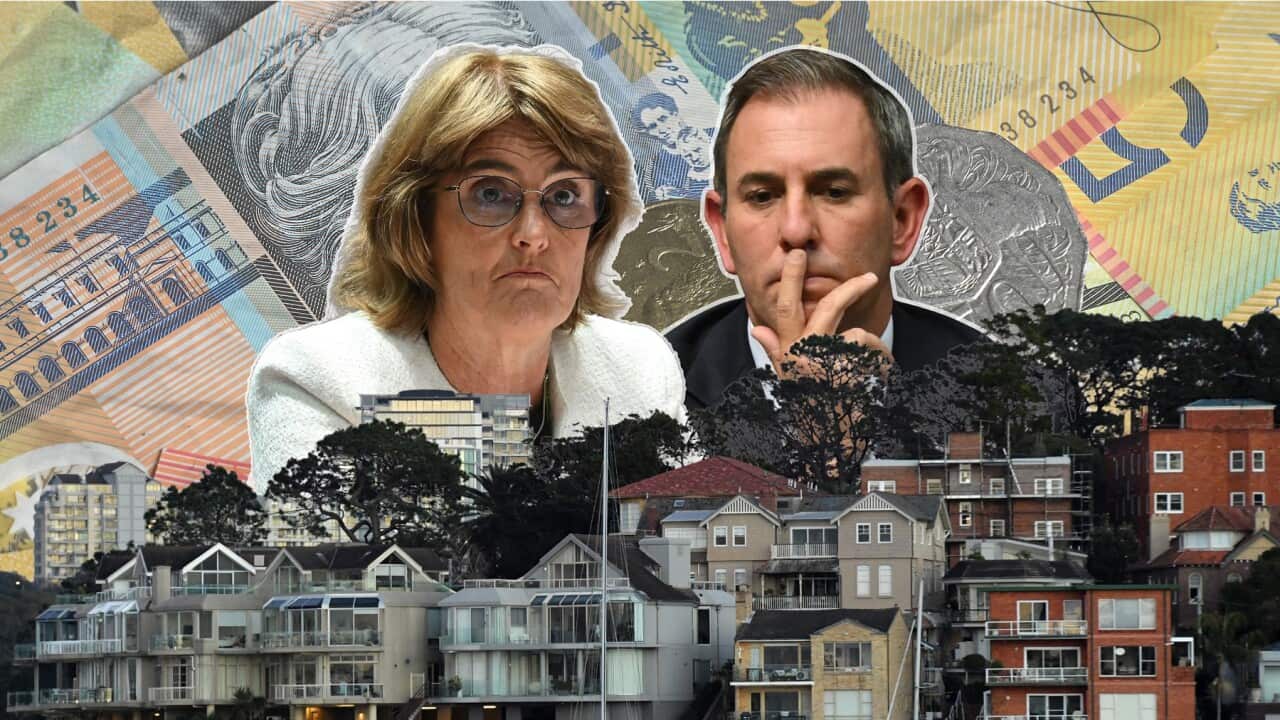
The Reserve Bank of Australia has hiked interest rates for the second consecutive month as war in the Middle East compounds inflation concerns.
The split five-four decision on Tuesday was the tightest since the central bank started publishing vote tallies, with the RBA's monetary policy board lifting the cash rate by 25 basis points to 4.1 per cent.
Treasurer Jim Chalmers says the decision reflects growing uncertainty in the global economy.
“This is obviously not the decision that lots of Australians were hoping for. It's not a surprising decision, but that doesn't make it any easier for millions of Australians with a mortgage.”
RBA Governor Michele Bullock says while rising petrol prices will add to inflation, they're not the reason for today's decision.
“The data we've seen since the February meeting has shown that the economy grew faster than its potential growth rate over the second half of last year, the labour market has tightened a little recently, rather than being stable, as we'd expected, and then underlying inflation remains high. Taken together, the data suggests there is slightly more excess demand in the economy than we thought in February, and inflationary pressures are therefore somewhat greater. This is before considering what higher energy prices arising from the conflict in the Middle East could mean for our economy.”
Headline inflation rose 3.8 per cent in the year to January, according to monthly data released by the Australian Bureau of Statistics, above the RBA's 2-3 per cent target band.
But a hike was not a foregone conclusion; Ms Bullock says the board had a robust conversation about the possibility of holding rates until May.
“This would have given us an opportunity to consider more data on inflation in the labour market, and it would also have perhaps provided a bit more clarity on the potential impact of the conflict in the Middle East, but the discussion was very much centered around the timing of a rate increase. All members agreed that another rate increase was needed to address domestic inflationary pressures. Ultimately, with inflation that is already too high, the balance of risk tilted to the upside in inflation. The board decided raising the cash rate was the right call.”
Ms Bullock says she can't say whether today's rate hike could be the first of many.
Shadow Treasurer Tim Wilson says the government should take responsibility.
“In response to today's announcement from the Reserve Bank, having their hand forced, what we need from the government, and from Jim Chalmers particularly, is some humility and acknowledgement of the responsibility the government has in causing this inflation crisis and the increase in interest rates.”
He argues a lack of spending restraint is the key cause of the central bank's decision.
“They continue to pour debt petrol on the inflation fire. There is denial about the contribution the federal government is making. There's a denial about the $100 billion more that Treasury estimates have outlined has been spent by the Commonwealth. There's a denial about the fact the Reserve Bank has called out that this is because of the inflation pressure, material inflation pressure from the from the last quarter of 2025.”
Dr Chalmers has consistently attributed inflationary figures to an increase in private demand, rather than public spending - and Governor Bullock declined to weigh in on which is to blame.
But the Treasurer does acknowledge the rate hike will be a challenge for many mortgage holders.
“At a time of great uncertainty, this will put additional pressure on people.”
... about $79 per $500,000 owing on a mortgage, he says.
“We're not just acknowledging those pressures, we're acting on them as well. We're working very hard on the issues in fuel markets and questions of resilience. More broadly, we're cutting taxes and rolling out costs of living help to take some of the pressure off people, where we can. We've strengthened the budget over the course of the last three and a half years and there will be more of that in May.”
Dr Chalmers has signalled Australians should be prepared for a belt tightening budget in May, while also maintaining the uncertain economic climate globally won't dissuade the government from pursuing major reforms.
The budget will be the first of this parliamentary term, and it's widely seen as the best opportunity in the election cycle to tackle tax reform.
But much will depend on the length of the war in the Middle East, and whether the Strait of Hormuz remains closed.
Ms Bullock acknowledges coming months could be tough.
“We do need to keep our eye focused on that ball. We don't want to have a recession, but if it's hard to get inflation down, then you know, we're going to have to deal with. “