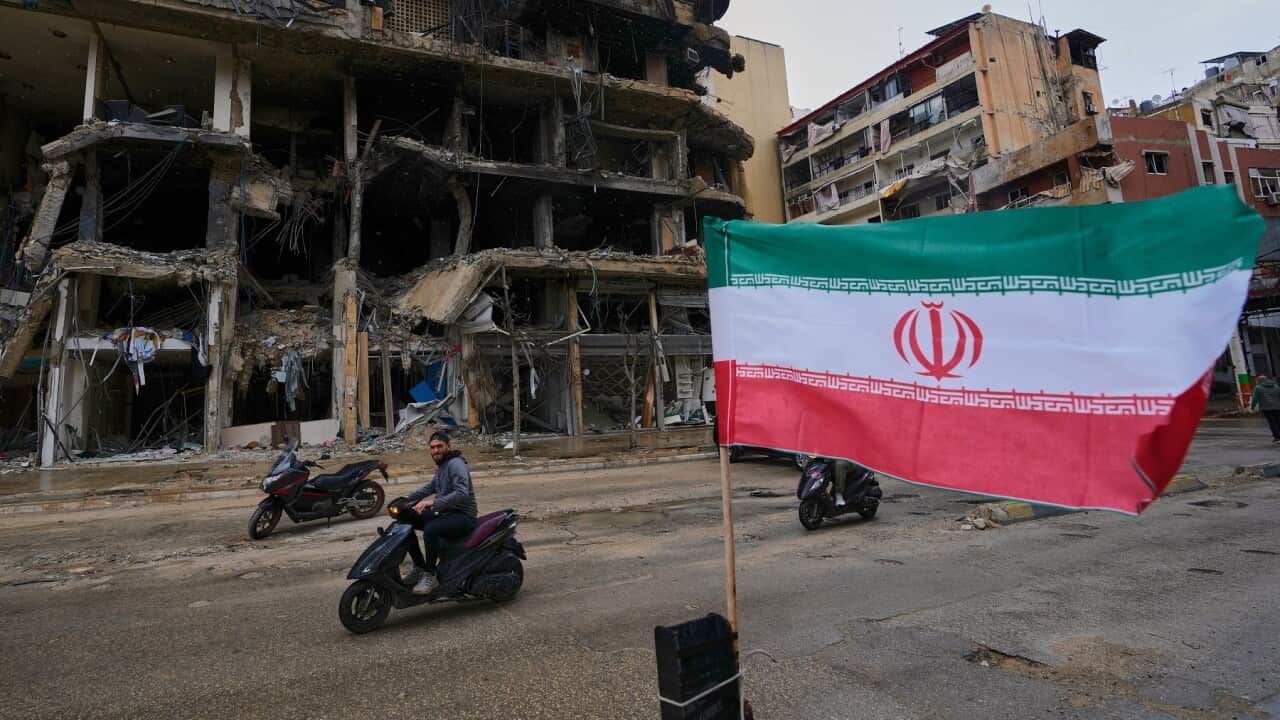

It's still unclear whether Iran will come to the table for talks with the United States on Tuesday, just as a two-week ceasefire is set to expire. Tehran continues to resist pressure from the United States and Israel to agree to their nuclear deal, while tensions escalate over ensuring safe passageway through critical global shipping route the Strait of Hormuz.
Listen to Australian and world news, and follow trending topics with SBS News Podcasts.
TRANSCRIPT:
As a two-week ceasefire between Iran and the US is set to expire, hopes of the two countries securing a deal are fading.
An Iranian official told Reuters that Iran is considering attending peace talks with the United States in Pakistan, following efforts by Pakistani officials to end a US blockade of Iran's ports - a major obstacle for Iran to rejoin peace efforts.
But the official stressed no decision has been made.
Iranian President Masoud Pezeshkian posted on X, directly condemning messaging from US officials.
"Honouring commitments is the basis of meaningful dialogue. Deep historical mistrust in Iran toward U.S. gov conduct remains, while unconstructive & contradictory signals from American officials carry a bitter message; they seek Iran's surrender. Iranians do not submit to force."
This mistrust hasn't been helped by a US attack on an Iranian cargo ship on the weekend, leading Iranian officials to threaten retaliation.
Parliamentary speaker Mohammad Baqer Qalibaf took to X, directly naming President Trump as he reiterated Tehran's unwillingness to respond to threats.
"Donald Trump, by imposing a blockade and violating the ceasefire, wants, in his view, to turn this negotiating table into a table of surrender or to justify renewed warmongering. We do not accept negotiations under the shadow of threats, and over the past two weeks we have prepared to unveil new cards on the battlefield."
But despite clear reservations from the Iranian side, President Trump's messaging remains defiant.
He repeated threats over the weekend to target key Iranian infrastructure if negotiations fail, threatening to strike bridges and power plants which experts say could amount to a violation of international law.
Taking to his social media account Truth Social, Trump is insisting he will reach an even better nuclear deal with Iran.
"The DEAL that we are making with Iran will be FAR BETTER than the JCPOA, commonly referred to as “The Iran Nuclear Deal,” penned by Barack Hussein Obama and Sleepy Joe Biden, one of the Worst Deals ever made having to do with the Security of our Country. It was a guaranteed Road to a Nuclear Weapon, which will not, and cannot, happen with the Deal we’re working on."
Trump went on to say that Israel did not pressure the US to start a war with Iran, adding the events of October 7 reiterated his view that Iran must never possess a nuclear weapon.
He also firmly denies he is under pressure to make a deal, referring to such reports as fake news, while insisting once again that "it will all happen relatively quickly".
But Iran are refusing to agree to the US and Israel's demands for Tehran to possess zero uranium enrichment, stressing that its enrichment efforts are for civilian purposes, and that it is a signatory to the 1970 Treaty on the Non-Proliferation of Nuclear Weapons.
The Strait of Hormuz presents another obstacle for the conflicting parties to reach an agreement.
Iran temporarily reopened the Strait over the weekend, before reversing their decision citing the United States' failure to lift its naval blockade on Iranian ports.
UN Spokesperson Stephanne Dujarric is calling for free maritime navigation to be respected by all parties.
REPORTER: “What is the Secretary-General's view of this so-called naval blockade by the United States?"
DUJARRIC: “Look, we've seen a lot of activity and frankly, a lot of confusion about the status of the Strait of Hormuz. What is clear for us is that the Secretary-General continues to be concerned by the restrictions that are put in place, as well as the maritime incidents that we've seen over the last 48 hours. Our position remains clear that we need to see full restoration of international navigational rights and freedom of navigation in the Strait of Hormuz, and that needs to be respected by all parties.”
The bombardment of Lebanon by Israel is also hampering peace prospects.
The US State Department has confirmed it will host a second round of talks between Israel and Lebanon on Thursday [[23 Apr]], following the announcement of a 10-day ceasefire agreement between Hezbollah and Israel last week.
But there are reports Israel is continuing to bombard villages in southern Lebanon, in a conflict where Israel has so far killed over 2000 people and displaced more than one million.