
Iran is threatening "long and painful strikes" on US regional positions if the United States conducts any new attacks on their soil. As a deadline fast approaches for US President Donald Trump to make the case for Congress to extend the war, there is uncertainty around the future of a nearly month-long ceasefire. The crucial global shipping route, the Strait of Hormuz, remains an epicentre for the war's stalemate.
Listen to Australian and world news and follow trending topics with SBS News Podcasts.
TRANSCRIPT:
Threats are being exchanged between the US and Iran, paralysing prospects for peace negotiations.
An extension of the United States' naval blockade - enough to break the silence of Iran's Supreme leader Mojtaba Khamenei.
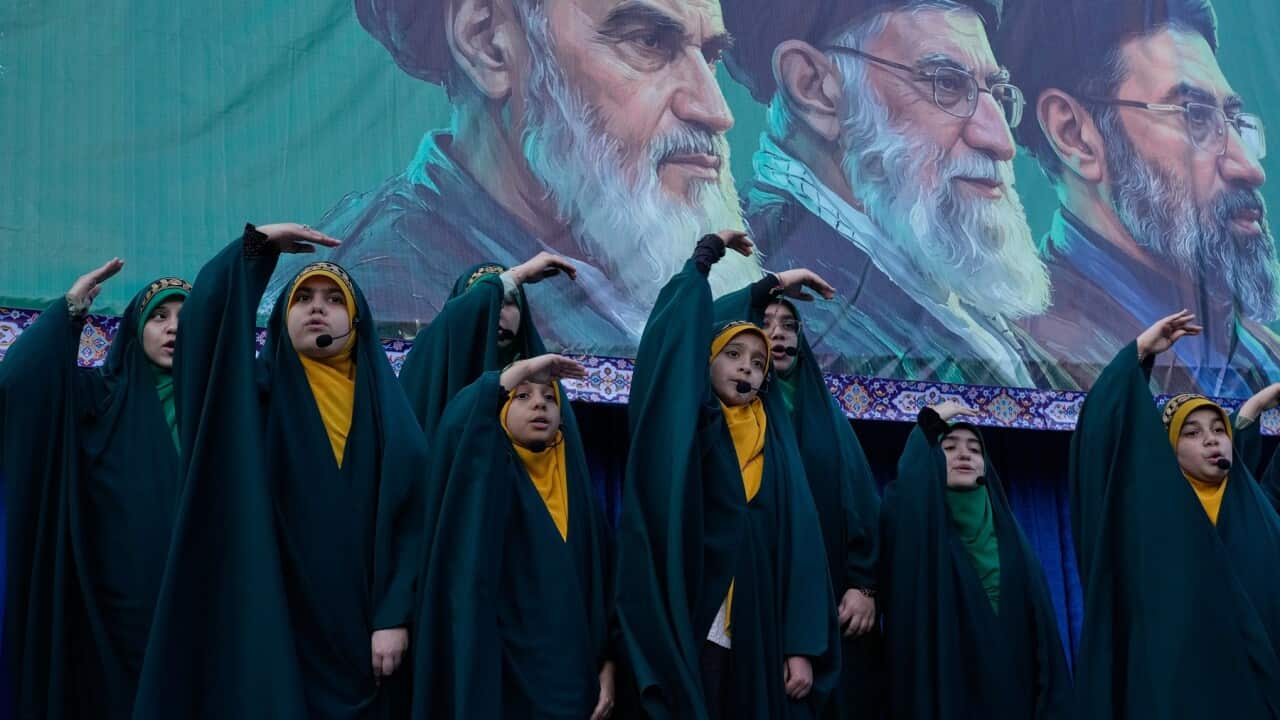
A lengthy statement broadcast to Iranian state TV, and attributed to Khamenei says Tehran would secure the Gulf region and eliminate what is described as “the enemy’s abuses of the waterway”.
"Today, two months after the largest military deployment and aggression by the world’s bullies in the region, and the United States’ disgraceful defeat in its plans, a new chapter is unfolding for the Persian Gulf and the Strait of Hormuz."
A senior official of Iran's Revolutionary Guards also saying any new US attack on Iran, even if limited, would usher in "long and painful strikes" on US regional positions.
While US President Donald Trump hasn't officially ruled out further attacks, it appears he is trying to economically deplete Iran through an ongoing naval blockade of Iranian ports.
As the deadline fast approaches for President Trump to make the case for Congress to extend the war, analysts expect a 30-day extension will be announced or the Friday [[1/5]] deadline will be disregarded altogether.
A US official told Reuters that there was a briefing scheduled for President Trump on Thursday [[30/4]] about strike options by the US military.
But late on Thursday [[30/4]], a senior official of the Trump administration said hostilities between the US and Iran had "terminated" since the extension of the two-week ceasefire announced on April 7.
The unpopularity of the war clear on the Democratic side as the US Defence Secretary Pete Hegseth continues to confront grilling around the economic cost and overall validity of the conflict - this time before the Senate Armed Services Committee:
WARREN: ''But someone is profiting off Trump's war. Insiders who know what's going on, who place bets on that inside information... Now, you've paid no attention to this. You haven't noticed. You haven't done anything about it?''
HEGSETH: ''What I'm saying is we're focused on our mission of executing for the American people. And what happens in markets is not, in betting markets is not something we're involved in.''
WARREN: ''Have you taken any steps to deal with insider trading out your office?''
HEGSETH: ''I mean, we would ensure at every level that inside information is properly safeguarded.''
WARREN: ''I take that as a no.''
WARREN: ''Well, obviously, you're not.''
HEGSETH: ‘So any insinuation that I've ever profited other than serving this nation, what hat I give what you give, what others give. I'm not looking for money. I don't do it for money. I don't do it for profit. I don't do it for stocks. And that's part of the reason I'm able to be effective in this job, because no one owns me. No one owns this department, no one owns this president. And we can execute for the American people. And we do.''
The heated exchange between Democratic Senator of Massachusetts Elizabeth Warren and Pete Hegseth led to the US Defence Secretary being forced to shutdown accusations he was profiting off the war.
But it wasn't simply personal accusations about war profit put to Mr Hegseth.
The committee raising questions yet again about the economic cost of the war - revealed by the Trump administration to be $25 billion [[USD]] so far - as well as their attacks on civilians.
Democratic Senator Kirsten Gillibrand put the question of the war's civilian cost to the Defence Secretary.
GILLIBRAND: ‘What is your response to targeting that has resulted in the destruction of schools, hospitals, civilian places? Why did you cut by 90 per cent the division that's supposed to help you not target civilians? And do you know the impact of a strategic failure at a war when you have so many civilian casualties? You may have tactically completed a mission well, but strategically it's not meeting your goals because of the harms to civilians. What's the cost of that?''
HEGSETH: ''No military, no country works harder at every echelon to ensure they protect civilian lives than the United States military.''
But while these domestic disputes play out, international attention remains on the Strait of Hormuz.
The key global shipping route has been virtually closed to around 20 per cent of the world's oil and gas supplies for over 2 months, sending shockwaves across the global economy as fuel prices and food costs rise.
UN Secretary General Antonio Guterres is pleading for the passageway to reopen, saying the global economy is being "strangled".
"My message to all parties is clear: Navigational rights and freedoms must be restored immediately, in line with the Security Council Resolution 2817. Open the Strait. Let all ships pass. Let the global economy breathe again."
The nuclear issue remains a key sticking point - as Iran refuses to oblige the Trump administration's demands to eradicate its uranium enrichment stockpiles, which Tehran insists are for civilian purposes rather than a nuclear weapon.
Despite this glaring obstacle, President Trump insists the economy would soon be repaired.
"The gas will go down. As soon as the war's over, it'll drop like a rock. There's so much out there, it's all over the place, sitting all over the oceans of the world. And it'll be, it'll go down. But what won't happen is if Iran had a nuclear weapon and used it, then the whole world is a different place."