
.Australian leaders have thrown their support behind the strikes on Iran amid reports Iran's supreme leader has been killed. For the second time in 12 months, the US and Israel have conducted co-ordinated strikes on Iran in what US President Donald Trump called a "massive and ongoing" operation to topple the Iranian administration.
Listen to Australian and world news and follow trending topics with SBS News Podcasts.
TRANSCRIPT
When Iranian artist Afarin Eghbal Afarin was a baby, she moved to London with her family following the 1979 Iranian Revolution.
Now, news of the United States and Israeli strikes on Iran have brought on bittersweet emotions: both fear, and a sense of relief.
"I'm here today. I'll be here tomorrow. I'm here every single week. I'm here to support the people of Iran. Freedom has never felt so close."
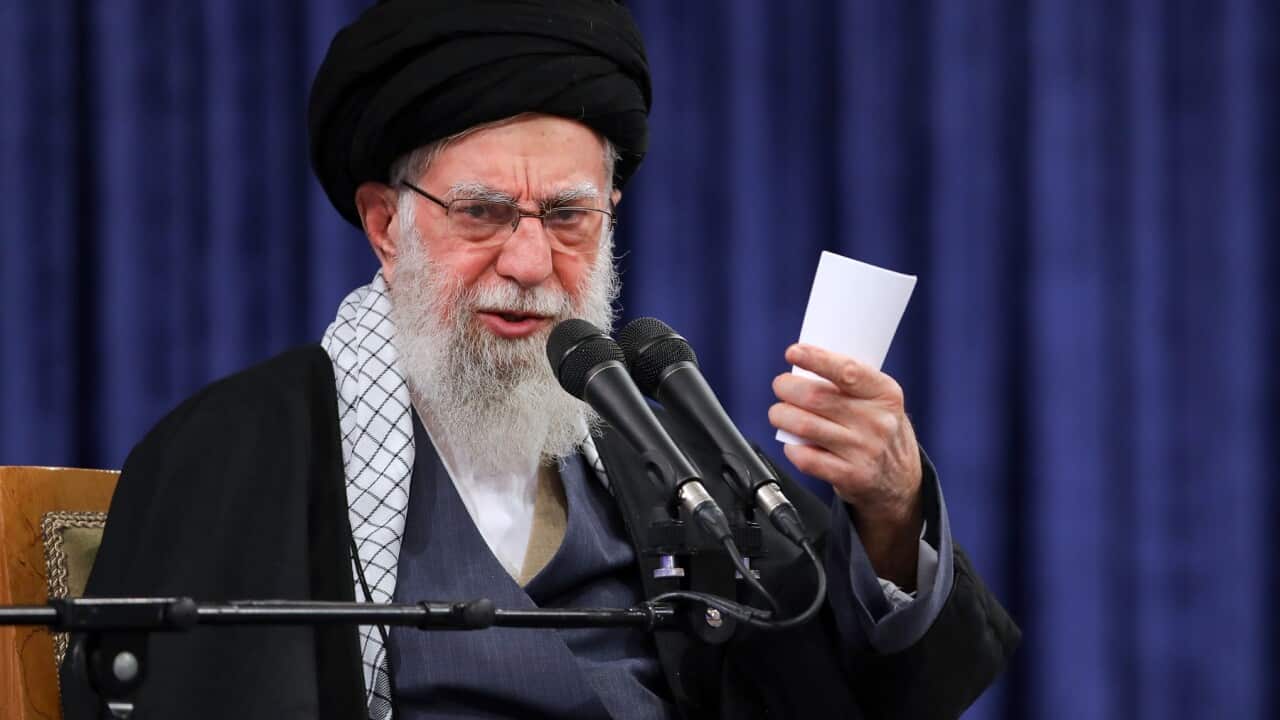
It's that sense of patriotism that Israeli Prime Minister Benjamin Netanyahu has been appealing to, amid reports the Ayatollah of Iran, Ali Khamenei has been killed in the attacks.
Those reports have now been confirmed by Iran, with the Mehr News Agency reporting 40 days of mourning have been announced to mark his assassination.
The public mood however is reportedly very different, with footage from social media showing people celebrating in the streets of the Iranian city of Kiraj after the news broke.
For the exiled son of the toppled Shah of Iran, Reza Pahlavi, the US-Israeli strikes on Iran mark a crucial turning point.
His chief of staff, Cameron Khansarinia, says these developments are the beginning of the end for the regime.
"If this campaign continues and further senior (Islamic Republic of Iran) regime officials are killed and the regime's repressive apparatus continues to be significantly weakened, then this will unquestionably be the end of the regime. If the regime can no longer hold on to power by brute force, if it can no longer repress the Iranian people, if its command and control structure all the way up to (Iranian Supreme Leader Ayatollah) Ali Khamenei is decimated, then the people will be able to take affairs into their own hands and topple this regime.
The reactions of the international community to the US Israeli strikes and the impact of retaliation by Iran is becoming clearer.
At an emergency meeting of the UN Security Council, called in the hours after the US Israeli strikes, Iranian diplomat Amir Saeid Iravani has said civilians have been killed and injured in the US-Israel strikes.
He has described the strikes as a violation of international law.
"As a result of this brutal armed attack, hundreds of civilians have been killed and injured. The invocation of pre-emptive attack claims of imminent threats or other unsubstantiated political claims cannot legitimise aggression. Such claims are unfounded legally, morally and politically. And they contradicted the clear principles of the charter of the United Nations."
United Nations chief Antonio Guterres appears to be worried about the conflict spreading throughout the region.
The Revolutionary Guard has launched a series of counterattacks after the initial Israeli US strikes, firing drones and missiles at Israel and strikes aimed at U.S. military installations in Bahrain, Kuwait and Qatar as well as the UAE.
Guterres' immediate concern is for the civilians.
"About 20 cities across Iran - including Tehran, Isfahan, Qom and Tabriz - have reportedly been attacked. Iran's airspace has been closed and the country is under a near total blackout. The attacks have reportedly caused significant civilian casualties. According to Iranian media, an airstrike killed 85 people and injured many more at a girls school in Minab."
Some in the international community have welcomed the strikes - including Ukraine's Foreign Minister, who has said Iran only had itself to blame for what has happened.
But other world leaders have come out in support of a return to the path of diplomacy.
James Kariuki is the head of the UK Mission to the UN, and current President of the Security Council.
"Iran must never be allowed to develop a nuclear weapon. That is why we, alongside our French and German partners, have continually supported efforts to reach a negotiated solution. We have always been clear that only a diplomatic solution can fully and sustainably address these threats."
In the United States, the political fallout is just beginning.
US Ambassador to the United Nations Mike Waltz has told the UN that Trump has done the right thing.
"This is a moment in history that requires moral clarity, and President Trump has met the moment."
He's also been backed by the Republican party.
Senate Intelligence Committee chairman Tom Cotton has pointed to multiple grievances against Iran, including the 1979 hostage crisis and the deadly Beirut bombing of 1983.
Trump has near total control of his Republican Party and dissent is rare.
But GOP Congressman Thomas Massie has broken ranks to say he is opposed to this war - and he's pushing for a vote on the unfolding crisis, along with Democrat Ro Khanna, who like the rest of his party says the US President is required to seek congressional authority for military action.
"The American people are tired of regime change wars that cost us billions of dollars and risk our lives. We don't want to be at war with a country of 90 million people in the Middle East. Every member of Congress must go on record today on how they will vote on Thomas Massie and I's war powers resolution."
Meanwhile, Australia has swung into action to manage the local impacts of the crisis.
A snap meeting of Australia's National Security Council has been held with senior government ministers.
Afterwards, the Prime Minister Anthony Albanese backed the earlier comments of Foreign Minister Penny Wong, saying Australia played no part in the strikes and had no prior knowledge of them.
He's also stood by his earlier support for the United States, saying Iran had to be dealt with.
"Ayatollah Khamenei was responsible for the regime's ballistic missile and nuclear program, support for armed proxies and its brutal acts of violence and intimidation against its own people. This claimed countless lives in Iran but also internationally. He was responsible for orchestrating attacks on Australian soil. His passing will not be mourned."
Australians in Iran are being advised to leave as soon as possible as the situation unfolds.
But Senator Wong says multiple regional airspaces are closed and some of the world's largest airlines have halted operations - which might make it a challenge to get people home.
This traveller has told SBS it has been chaotic, as airlines delay or cancel flights.
"No hotels left, or everyone was just sleeping on the floor, on chairs if you're lucky. All the shops were shut for food. My worst nightmare."
In Adelaide, Doctor Fariba Willison is among the Iranian Australians who say the local diaspora is anticipating major change.
She says no-one is expecting instant solutions - but they do anticipate a difficult transition.
"My sister rang and said my husband is in dialysis and I don't know if he can make it home. My daughter is on the way from school; I don't know if she's okay. And then she said, if I could look after her daughter who is in Australia just in case something happens to her. And I got so many messages from other mothers who had the same request. That please, look after our children if you are gone, because we are going through a big - I'm sorry - through a big process in Iran. But everybody is happy that it is happening."