
Israel says it will push up to 30 kilometres into southern Lebanon to establish a defensive buffer zone along the Litani River. Hezbollah is vowing to resist any advance and the United Nations warns the escalating conflict is deepening an already severe humanitarian crisis.
Listen to Australian and world news and follow trending topics with SBS News Podcasts.
TRANSCRIPT
Israel says it will push up to 30 kilometres into southern Lebanon, taking control of territory up to the Litani River.
Defence Minister Israel Katz says the move is aimed at stopping Hezbollah attacks on Israel’s north and that residents who have fled Lebanon's south, will not be allowed to return until security conditions are met.
"Hundreds of thousands of residents of southern Lebanon who evacuated north will not return south of the Litani River until security is guaranteed for residents of the north. All five bridges over the Litani that Hezbollah used to transport terrorists and weapons have been blown up, and the IDF will control the remaining bridges and the security zone up to the Litani."
Lebanese authorities say more than one million people have already been displaced by the fighting.
The United Nations says the escalation risks worsening an already severe humanitarian crisis.
Spokesperson for the Secretary-General, Stephane Dujarric, says there is no military solution and is calling on both sides to return to negotiations.
"This is part of the increased rhetoric that is very much concerning to us. I think this is the last thing we would want to see. This is the last thing the Lebanese people in the south would want to see. What we want, what we need is for Israel, for Hezbollah and all of the parties to fully implement Security Council Resolution 1701 as there is no military solution to this conflict."
He says civilians on both sides are already suffering and warns the situation could deteriorate further.
"Yes, we worry about the increased rhetoric that we're seeing. We worry about the continuing military activity that we're seeing. ... We don't need more fighting. We don't need more rhetoric. Already more than 1 million people are on the move in Lebanon. Israeli civilians on the southern side of the blue line have also been impacted. There needs to be a return to negotiations and there needs to be a return to the full implementation of Security Council 1701."
Hezbollah says it will continue to resist any Israeli advance.
Senior Hezbollah MP Hassan Fadlallah says the group will fight to prevent Israeli forces from taking control of southern Lebanon.
"This is part of Israel's historical objectives, as it has always sought to occupy the south of Litani area and annex it to the Zionist entity."
He adds that Hezbollah fighters are already engaged in combat and describes the situation as an existential threat to Lebanon.
"Now, we are facing Israeli aggression. We are in a defensive situation. The resistance fighters are battling in that area to prevent Israel from achieving this objective. This poses an existential threat to Lebanon as a state and to its geographically defined borders recognised internationally. Therefore, we have no choice but to confront this aggression and cling to the land."
The group began attacking Israel after Iran's Supreme Leader Ayatollah Ali Khamenei was killed during the initial US-Israeli strikes on Iran.
The fighting, which has continued unabated since, is having a direct impact on civilians on both sides of the border.
In northern Israel, a woman has been killed in a Hezbollah strike, the first Israeli death in this latest escalation, while two others were injured.
Residents of the northern Israeli town of Nesher say they are living under constant threat as sirens warn of incoming rockets and drones from both Lebanon and Iran.
"There was an alarm and me and my whole family went down with our neighbours to the bomb shelter. I have two girls, little girls and we sat down there for a few minutes and then there was a big explosion and I knew that it was here. It was horrible."
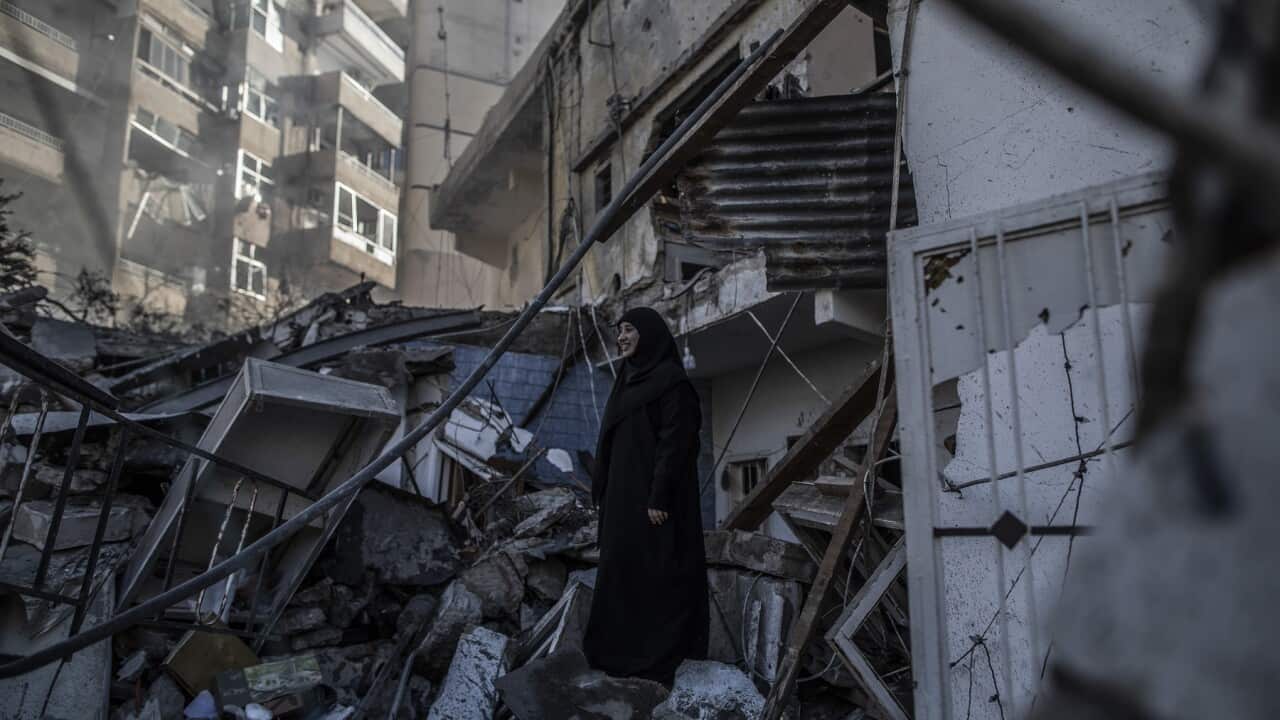
In Lebanon, Israeli strikes have hit villages in the south and parts of Beirut, with reports of civilian casualties, including children.
Uweidah Adibi says the local municipality was firing gunshots to wake people up to evacuate after Israel warned it would strike the area.
"We were asleep, then we woke up to the sound of gunfire. The municipality was firing shots to wake people up. We grabbed ourselves and went outside ... All the neighbours were saying ,'Avichai has threatened us, run away, he's going to strike here.' ... We checked the phone; he had sent the map saying it was here, but why? I don't know. ... We fled to the corniche, and I sat there on the corniche with the children."
Lebanese authorities say more than 1,000 people have been killed since the beginning of the latest hostilities.
Mr Katz alleges Hezbollah infrastructure is embedded within civilian areas and that Israeli forces are targeting those positions.
"The IDF is manoeuvring into Lebanese territory to seize a front line of defence, eliminating Hezbollah terrorists and destroying the terrorist infrastructures that were established there, and the houses in the Lebanese contact villages near the border, which serve as terrorist outposts for all intents and purposes, in accordance with the Rafah and Beit Hanoun models in Gaza - in order to create a defensive space and remove the threat from the communities."
Under international law, attacks on civilian infrastructure such as homes and bridges are generally prohibited.
French President Emmanuel Macron says expanding the conflict or occupying territory will not bring security.
"No occupation, no form of colonisation, neither here, nor in the West Bank, nor anywhere else, can guarantee the security of anyone."
He says Lebanon’s sovereignty must be respected.
So, as Israel says it is preparing to push deeper into southern Lebanon, Hezbollah says it will resist.
And again, the United Nations is calling for a return to negotiations, but no one is listening.