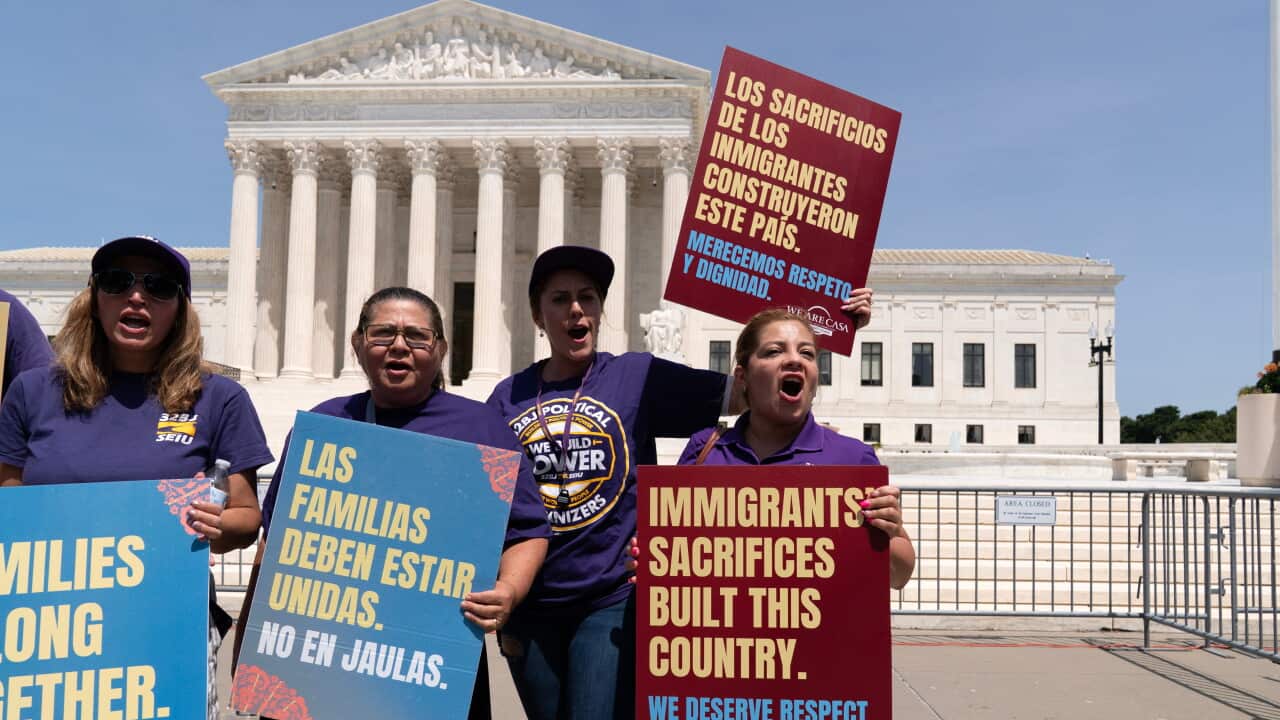

The US Supreme Court has handed President Donald Trump one of the biggest legal defeats of his second term, rejecting his bid to restrict birthright citizenship. The ruling preserves automatic citizenship for children born in the United States, including those whose parents are undocumented or in the country temporarily. But while the Court has ruled against the President’s executive order, the political fight over who gets to be American is far from over.
Listen to Australian and world news and follow trending topics with SBS News Podcasts.
TRANSCRIPT
For many migrant families in the US, the Supreme Court’s decision to uphold birthright citizenship isn’t just a constitutional ruling, it is deeply personal.
Thirteen-year-old Mia says the uncertainty surrounding immigration policy has shaped her childhood.
As a US citizen child, I should not have to be wondering if my parents will come back home. And since this president took office, I have even had to wonder if I would come home. Pregnant mothers are afraid of their babies not being able to have a home. Our families are worth fighting for and our communities are worth fighting for. And that's why I will keep fighting. Thank you."
The ruling has brought relief to many families living with immigration uncertainty.
Houston mother Aura Espinosa, who was brought to the US from Mexico as a child and has temporary protection from deportation, says the ruling gives her children something she never had - security.
“It's important for my kids to have a status because I don't want them to be going through with the immigration process that I have to go through since I was little, knowing that I was undocumented, that I was in a foreign country."
Birthright citizenship has been part of American law for more than 150 years.
Enshrined in the 14th Amendment, it guarantees citizenship to almost anyone born on US soil, with only narrow exceptions such as the children of diplomats.
That differs sharply from Australian immigration policy.
Unlike the United States, Australia ended automatic birthright citizenship in 1986.
Here, at least one parent must be an Australian citizen or permanent resident for a child born in Australia to automatically gain citizenship.
US President Donald Trump has long argued the American system is being exploited.
He says birthright citizenship encourages illegal migration and so-called “birth tourism”.
"That was meant for the babies of slaves. It wasn't meant for people trying to scam the system and come into the country on a vacation. This was in fact, it was the same date, the exact same date, the end of the Civil War. It was meant for the babies of slaves. And it's so clean and so obvious. But this lets us go there and finally win that case because hundreds of thousands of people are pouring into our country under birthright citizenship. And it wasn't meant for that."
House Speaker Mike Johnson echoed that argument.
"It is a serious problem we have - we have you know, it's become a tourism birthing tourism they call it, you know, a trend where people would just come and you just come onto the soil and have your child and then they're able to avail themselves of the welfare state and everything else. It's been abused."
Trump’s executive order would have denied automatic citizenship to babies born in the United States unless at least one parent was a citizen or permanent resident.
Civil liberties lawyers warned the consequences would be immediate and far-reaching.
"Swathes of American laws would be rendered senseless. Thousands of American babies will immediately lose their citizenship. And if you credit the government's theory, the citizenship of millions of Americans past, present and future could be called into question.''
Inside the courtroom, the practical implications of the policy came under intense scrutiny.
Supreme Court Justice Ketanji Brown Jackson pressed government lawyers on how the system would work in practice.
"How does this work? Are you suggesting that when a baby is born, people have to have documents, present documents? Is this happening in the delivery room? How are we determining when or whether a newborn child is a citizen of the United States, under your rule?"
"I think that's directly addressed in the SSA (Social Security Administration) guidance, that's cited in our brief, when SSA says is there's currently a system where, for example, Social Security numbers are generated based on birth certificate. They say this can still be for the vast majority of institutions, completely transparent. It will still be transparent."
"I'm just talking about the particulars..."
In the end, the Court ruled six-to-three against President Trump.
Five justices found the executive order violated the Constitution’s 14th Amendment.
A sixth agreed the order was unlawful, but on narrower legal grounds.
Democrats celebrated the ruling as a rebuke of presidential overreach.
Congresswoman Grace Meng delivered one of the strongest reactions.
"I have a message for President Trump. You may believe you are above the law, you are not. You may try to divide Americans based on race, religion, or their country of origin, and you will fail. You may try to redefine what it means to be an American, and you will fail. We are American. We belong here. And no wannabe king will ever take that away from us."
For some lawmakers, the issue was personal, too.
Congresswoman Delia Ramirez says birthright citizenship shaped her own identity.
"You know, what I want you to know? Is that I am the proud, proud daughter of Maria Elvira Ramirez Guerra, a Guatemalan immigrant who crossed the border pregnant with me. I am a citizen by birthright, what's more important is that I am an American, and every single person in this country, if you're born here, you're an American, period, no exceptions. Am I right?"
Legal experts say the ruling reaffirms a constitutional principle that had been settled for generations.
Elora Mukherjee describes the decision as a major setback for the Trump administration.
"What strikes me is that a fringe and radical rereading of the 14th amendment, which just a decade ago was not taken seriously by courts, was not taken seriously by legal scholars, was not taken seriously by the public at large, has somehow made it to the U.S. Supreme Court, and that radical and fringe rereading of the 14th amendment has been adopted by three justices, and that is shocking."
But Trump has already vowed to continue the fight, urging Republicans to pursue legislation through Congress.
California Senator Alex Padilla says the political battle is far from finished.
"We know Donald Trump's not going to stop. His attacks will keep coming. He'll work on another executive order or try to get the Republicans in Congress to pass another bill or he'll do something else to try to minimise who gets to be an American, who gets to be a citizen. And so our work to resist will continue."