
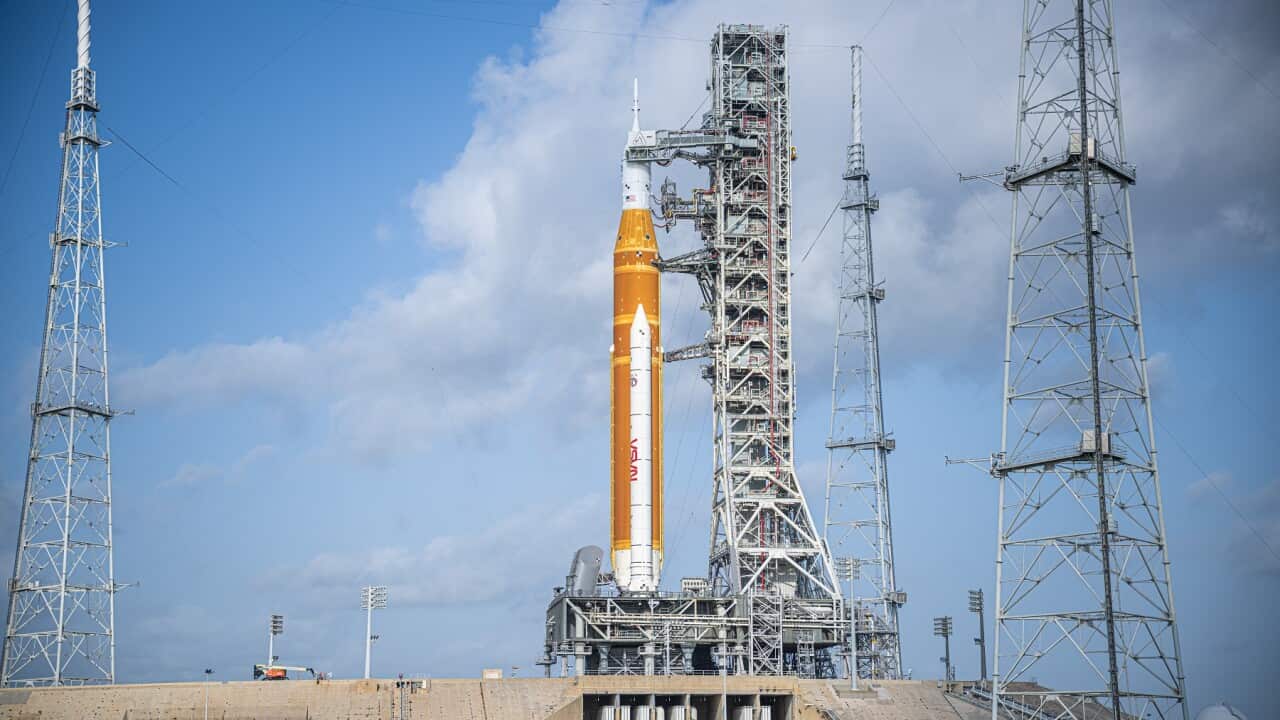

Mankind is returning to the moon for the first time since the 1970s. A crew of four have spent more than two years training for the roughly 10‑day mission, which will send the crew on a high‑speed loop around the Moon before returning to Earth.
Listen to Australian and world news and follow trending topics with SBS News Podcasts.
TRANSCRIPT
MISSION CONTROL: "OK Neil, we can see you coming down the ladder now."
ARMSTRONG: "OK, I just checked getting back up to that first step. It's not even collapsed too far. It's one small step for man, one giant leap for mankind.”
Neil Armstrong was the first man to set foot on the surface of the moon as part of the Apollo 11 mission in July, 1969.
More than five decades later, a new manned moon mission is planned.
The four astronauts selected for NASA’s Artemis II mission say they are ready to head to the Moon; and mission commander Reid Wiseman says they are prepared for last‑minute challenges that could delay the launch.
"Just to remind everyone, this is a test flight. This is the first time we're going to try this. This is the first time we're loading humans on board. And I will tell you, the four of us, we are ready to go. The team is ready to go, and the vehicle is ready to go. But not for one second do we have an expectation that we are going. We will go when this vehicle tells us it's ready and when the team is ready to go. So, we might go out to the pad, and we might have to try again a few more times. And we are 100 per cent ready for that."
Commander Wiseman and his three crewmates — Victor Glover, Christina Koch and Canadian Space Agency astronaut Jeremy Hansen — have entered pre‑flight quarantine ahead of their scheduled launch aboard NASA’s towering Space Launch System rocket.
The launch is scheduled for April 1st, US time.
The crew has spent more than two years training for the mission since being named in 2023.
They will ride inside the Orion crew capsule, designed to carry humans into deep space.
Christina Koch will be the first woman to take part in a moon mission.
"Really, the question is, not should we go, but should we lead or should we follow? That's how I see it, because many countries have recognised the value that there is in exploring further into the solar system, to the Moon and on to Mars. They recognise that not only can we gain all these extremely tangible benefits, but that we have the opportunity to answer the question that could be the question of our lifetime, which is, are we alone? When we go out and meet people, people ask that all the time. Have you seen evidence of this? What can we learn? And the fact is that answering that question starts at the Moon."
She says the opportunities to increase our knowledge of the universe and how it was formed are immeasurable.
"The moon is a witness plate to our entire solar system's formation. It's a stepping stone to Mars, where we might have the most likelihood of finding evidence of past life. But it's also a Rosetta Stone for how other solar systems form, all the billions of other solar systems in our galaxy. Where we've seen from some of our other telescopes like Kepler that there are planets orbiting other suns. All of this starts to unlock when you go to the Moon. And for me, that's one of the most important scientific reasons to go."
The roughly 10‑day mission will send the crew on a high‑speed loop around the Moon before returning to Earth.
CSIRO, Australia's national science agency, together with the Australian National University will provide tracking expertise through antennas and facilities operating across Australia, including NASA's Canberra Deep Space Communications Complex.
Astronaut and Australian of the Year Katherine Bennell-Pegg says it's a mission that Australians can look at with pride.
"So I hope all of us in Australia will take a moment to step outside and look up at the moon knowing that humans are out there once more and that Australia isn't observing. We're building on our legacy from the Apollo era to provide mission critical support."
All of the crew members - except Jeremy Hansen - have previously flown in space.
Commander Wiseman says the team is prepared for all eventualities.
"The biggest thing that we try to remind ourselves every single time we fly, we say no fast hands in the cockpit. You do not want to do anything too quick in this vehicle. You need to take your time. You need to process everything. Almost always, it pays bigger dividends to move forward than to go backward. So, no fast hands in the cockpit. We're going to go slow, and we have the ultimate trust in each other. And that's how we will get through this."
Artemis II will be the first crewed mission of NASA’s multi‑billion‑dollar Artemis program.
While it will not attempt a Moon landing, it will send astronauts farther from Earth than any previous human spaceflight, testing Orion’s life‑support systems, navigation, communications and heat shield.
Mission pilot Victor Glover says launch day itself is going to be a high pressure situation.
"There is not a lot of time for personal rituals, I would say, but before I fly an airplane, I generally say a very short prayer. And then I try to send my family a note to tell them that I love them. And so, one of the neat things about this tradition we started is our families are outside the building when we walk out. And so that is the moment that I'm going to get to tell them I love them instead of sending a text message or a phone call. I get to tell them I love them. And then I'll still say my prayer before we all get into the vehicle. And then that way I can focus on that timeline and making sure that the launch control team is not waiting on us, the crew."
For Canadian Jeremy Hansen, there is a deeper meaning to the mission.
"But the other thing we've focused on quite a bit as a crew is just listening to other people's perspectives on the Moon and how different cultures look at the moon. And when we go back, honouring just how humanity - we all share the same Moon in the sky - but honouring humans around the world and how they revere the moon, that's really important to us."
The mission has been delayed several times already due to problems with the spacecraft that arose during testing.
NASA has picked other possible dates in April - and later this year, if the launch has to be put on ice again.