
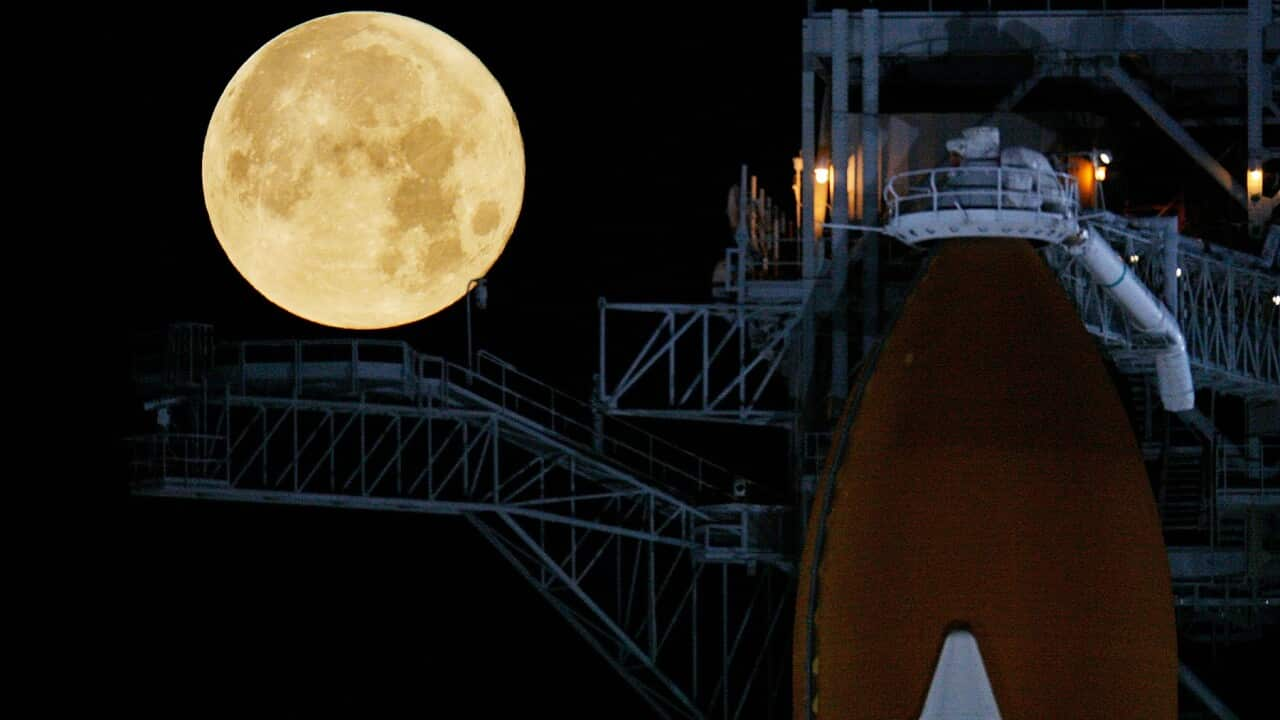

It's been a week since the crew of Artemis II (2) dropped back to earth after a record-breaking mission, but concrete steps are already being taken to achieve the next phase of NASA's lunar goals. The Michoud Assembly Facility in New Orleans has rolled out the largest section of NASA's Space Launch System rocket, which will launch a second crewed mission known as Artemis III (3).
Listen to Australian and world news, and follow trending topics with SBS News Podcasts.
TRANSCRIPT:
Since their successful flyby of the moon, members of the Artemis II crew have been re-adjusting to life on earth.
As scientists analyse the data and the photographs they brought back from the mission, Commander Reid Wiseman says he and his three fellow astronauts have had to focus on themselves.
Commander Wiseman says each of the four must undergo rehabilitation and medical evaluations as they readjust to Earth's gravity.
"It's very hard to fully grasp what we just went through. And in these short, you just said it's been a week since we've been back, but it's a week of medical testing, physical testing, doctors, science objectives."
As that unfolds, attention is also turning already to the next Artemis mission: Artemis III.
There are many parts to the rocket that will take the next crew skywards, including what is known as a core stage which stores the propellant to power the astronauts into space.
The core stage for the mission's rocket is more than 64 metres tall [[64.6m, 212 feet]], has four RS-25 engines and provides more than 3.6 million kilograms of thrust.
NASA Chief Engineer Terry Prickett says it is the only rocket capable of sending supplies and astronauts to the moon in a single launch.
"Oh it's very exciting. You know, this is just the next big milestone, you know, in our big picture goal of returning humans to the surface of the moon. You know, getting core stage 3 out the door and preparing for Artemis III is a huge step in that direction."
Four-fifths of the core stage for the Artemis III mission has now been rolled out of the Michoud Assembly Facility in New Orleans.
Space Launch System Production Manager, Chandler Scheuermann, says it's been loaded onto NASA's Pegasus barge for delivery to the Kennedy Space Center in Florida.
"This represents the next iteration of the Artemis missions that we have planned to get our boots on the ground back to the lunar surface. And so it's a very special day for all of us here in southeast Louisiana and I know we're all very proud to send it off."
The Artemis III launch is scheduled in 2027 and will test docking on the moon.
Acting associate administrator, Lori Glaze, says the crew on board will check the capabilities that need to be in place to actually land a separate crew on the Moon's surface.
NASA Astronaut Nichole Ayers says the mission will build on what is already known.
"We have had people living and working on the International Space Station for 25 years. This year is our 25th anniversary. We are taking all of the lessons learned from space station, all of the science that we have, how to put humans in space for long duration space flights, how do we reclaim the water and how do we do the food so that we can get to the moon and on to Mars? We're going to take all of those lessons learned from space station and move them into Artemis. So there's a lot going on. It's an exciting time in human spaceflight and we're going to fall back on, you know, almost over half a century of all of the lessons learned and we're going to keep going, get to the moon and get to Mars."
After the testing involved in Artemis III is complete, NASA will then move on to Artemis IV (4), which will feature a crewed lunar landing.
Reid Wiseman says the crews for both stages will be carefully chosen.
"Artemis III is gonna be a totally different mission, so. I think what you want out of Artemis III is you want some good technical leads that can go solve really complicated challenges in Earth orbit. I don't think we need, I mean, I got to be careful with my words. We just need the right set of people and we will pick the right set of people and I know they're going to be the most technically competent folks that we have in our office. And then Artemis IV, like just God help them, it's going to be crazy."