
Iranian-Australians are expressing mixed emotions over the US-Israeli strikes in Iran and the killing of Supreme Leader Ayatollah Ali Khamenei. While many hope his death will lead to a free Iran, others say they don't believe that Donald Trump and Benjamin Netanyahu have good intentions.
Listen to Australian and world news and follow trending topics with SBS News Podcasts.
TRANSCRIPT
As US-Israeli air strikes began raining down on Iran, Iranian-Australian Fariba Willison got a call from her sister in Tehran.
“Yesterday, my sister rang and said my husband is in dialysis, and I don't know if he can make it home. My daughter is on on the way from school. I don't know if she's okay. And then she said, if I could look after a daughter who is in Australia, just in case something happens to her.”
The Adelaide surgeon is one of more than 80,000 Iranian-born residents in Australia.
As news broke of strikes throughout the country and of the killing of Iranian Supreme Leader Ayatollah Ali Khamenei, emotions in the community were mixed.
With the strikes killing civilians and prompting retaliatory action throughout the region, Fariba Willison told SBS that she fears for the safety of the people.
“It is a mixed bag of emotions. I am upset for my people that they have to go through such a difficult time, but I am at the same time, I am very happy and celebrating because it is happening and it is like a surgical procedure. You know you are upset that the patient has to go under anaesthesia, the knife comes out, you have to cut the cancer and everything out before the patient is better. So I feel that my country is going through a big surgery.”
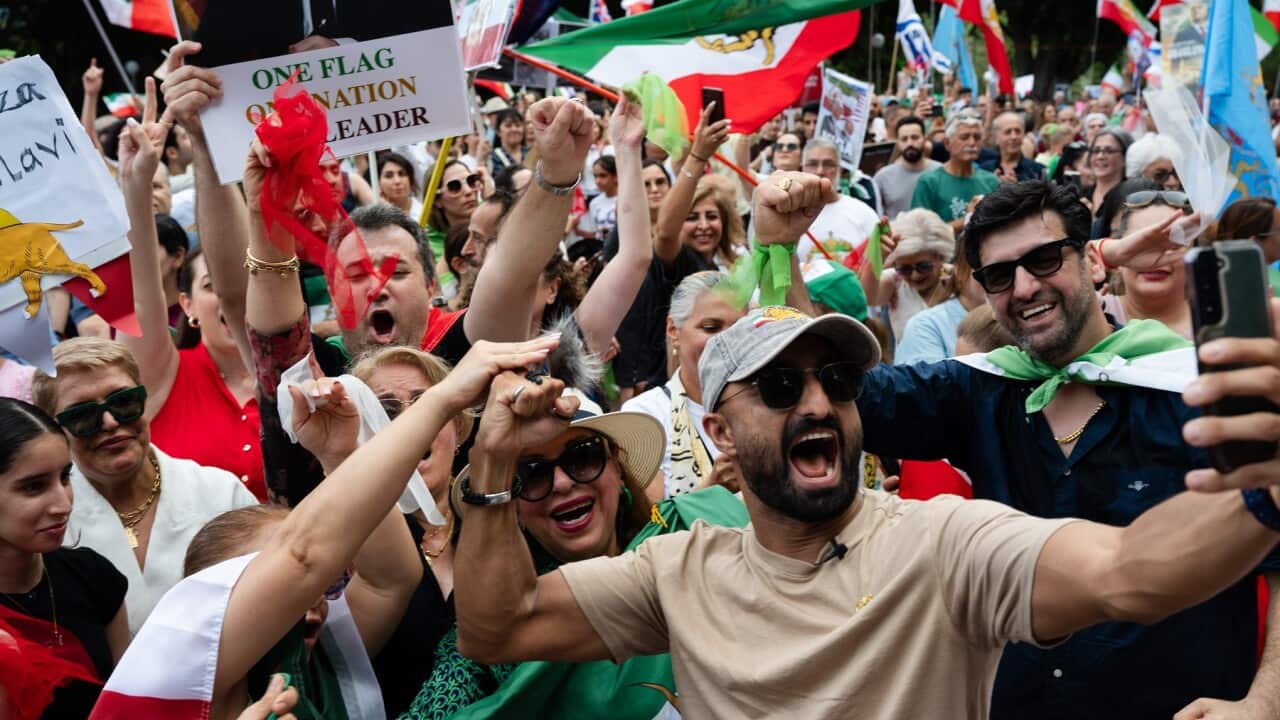
Throughout Australia, many members of the Iranian diaspora took to the streets to celebrate the news.
After the Iranian Revolution in 1979 saw the Islamic Regime take control of the country, Iran's diaspora abroad has grown.
With more than 4 million Iranians estimated to be living abroad, many were forced to leave amid crippling economic difficulties and political and religious repression.
In Canberra, Iranian Australians say the strikes are the beginning of the end for the regime.
Rallying outside the former Iranian embassy, some say they hope to see Iran led by Reza Pahlavi, the son of the ousted Shah.
“I cannot wait to enter a free Iran, under the leadership of King Reza Pahlavi, until there is you know, a democracy, whether we can vote and the people of Iran are free to vote. He's just going in for a transitional period... It's so sad to see that the people of Iran are celebrating a war that's happening in their country but this is how they're feeling. They are just satisfied that, hopefully, the regime will change.”
With Donald Trump saying attacks on Iran will continue until all of the United States' goals are achieved, others in Canberra say they're worried for family back home.
“Yes, I've got aunties and uncles and cousins, and I think they're fine. There's usually a blackout in Iran, and events like this occur, so you don't know, I guess what's happening there, so that there is something in the back of your mind that you kind of like, they are okay and all that. But yeah hopefully as I said, it all works out.”
It remains unclear whether the death of Khamenei, the regime's leader since 1989, will mean the start of something new, or much of the same for Iranians.
In the streets of Sydney, home to the largest Iranian diaspora in Australia, members of the community say the people of Iran deserve democracy.
“I hope, I hope that we have got a government chosen by the people, from the people, and they can manage the country as a democratic country like everywhere else, but I don't know what 's going to happen.”
While there has been a strong push for regime change from Iranians both inside and outside Iran, some members of the community say the United States and Israel are not the ones to do it.
Following Donald Trump's political decapitation of Nicolas Maduro's regime in Venezuela, many were left disappointed when the United States allowed his party to remain in power.
As a result, questions have been raised about Donald Trump's ability, or genuine interest, in restoring democracy.
In Sydney, this demonstrator said US and Israeli attacks aren't the way to free Iran.
“I do want to see something done about the Iranian regime, but not by Netanyahu and Trump. The people of Iran will decide their fate as they were after they were massacred. Thousands of them were massacred by the Islamic Republic on the streets. There were all sorts of actions, demonstrations, people were gathering on the streets, schools and all that, and the American bombs are going to put an end to that.”
Others, however, say the people of Iran could not have removed Khamenei without external support.
“We needed that military support from external, we could not do it from within. Only within a month ago, they have killed 100,000 people. Innocent are killed. They go on the street they thought they can change this regime, but they could not do it.”
The President of the Australian Iranian Community Organisation, Siamak Ghahreman, says while the majority of the community welcomes the Ayatollah's death, some would have preferred him to face trial.
“This was the second best thing that could happen. We are hoping that by getting rid of Khamenei, we are close to getting rid of the regime as a whole.”
Community spokesperson Doctor Ali Zahedi says he hopes there is enough momentum to ensure freedoms in Iran can be reclaimed.
“The information that is coming shows that the people are very, very happy that they can talk, they can move around, and they can ask for what they want publicly. They have come to the streets. They are celebrating somehow, and they hope that the IRGC agents and the security forces of the regime won't be able or will be dismantled soon, won't be able to harm them anymore.”
After 47 years of clerical rule, human rights lawyers and members of the diaspora are now calling for continued international pressure to help dismantle the regime.
While hopes of returning to a free Iran seemed an impossibility for so long, Dr Zahedi says the people of Iran must now be given the chance determine their own future.
“The mood is very positive. It's one of the biggest changes in the past forty-seven years that this regime has been in power, and we think that the changes will be good. We are hopeful that international forces will respect the human rights in Iran, will respect the minimization of the harm to the people and the rights of people to determine their future.”