
.US President Donald Trump has used the World Economic Forum in Davos to push a new security framework for the Arctic, and signal what he says is momentum towards ending the war in Ukraine. The week has also exposed deep divisions among allies over Greenland and Europe’s role in global security.
Listen to Australian and world news and follow trending topics with SBS News Podcasts.
TRANSCRIPT
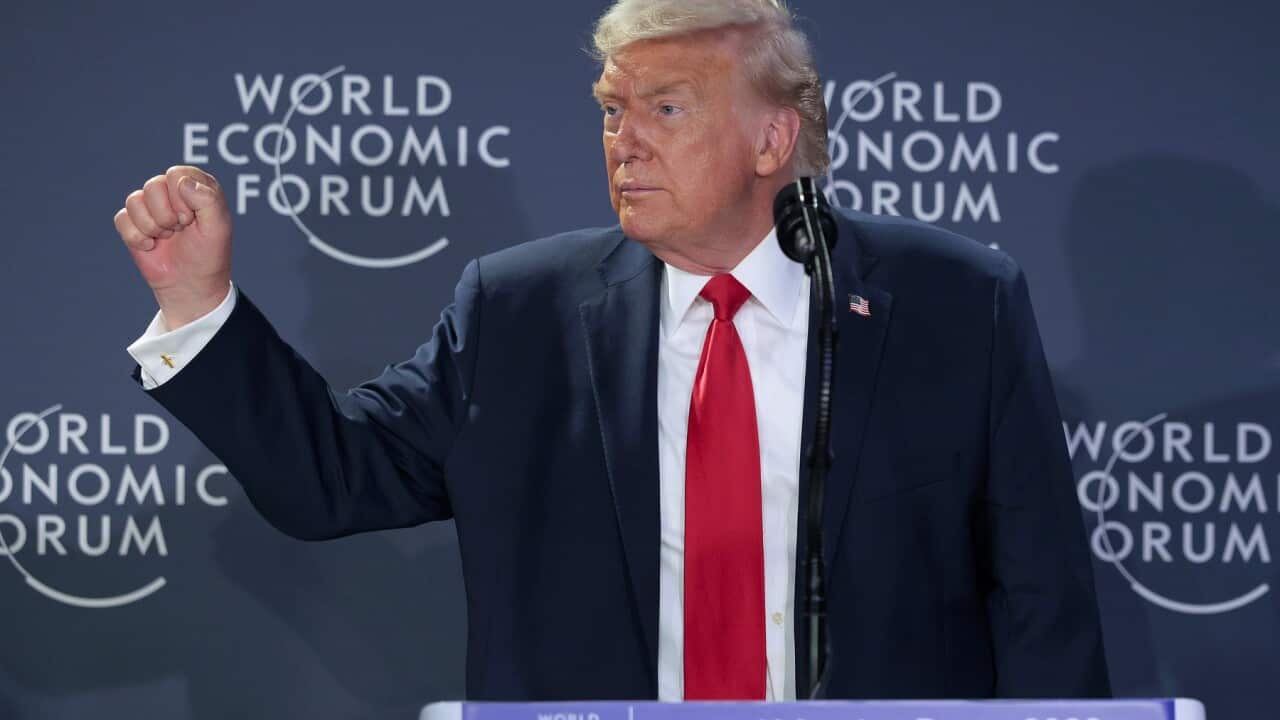
As Europe breathes a sigh of relief after President Donald Trump announced at Davos a dramatic reversal over Greenland, the US president is now claiming victory.
He has scrapped threatened tariffs on eight European nations and says a new framework deal with NATO will give the U-S sweeping military access to the Arctic region.
In a Fox Business interview, Mr Trump said the agreement would give the U-S what he called total access to Greenland, including the ability to deploy part of his proposed multibillion-dollar missile defence system, known as the Golden Dome.
“We will have everything we want, we're getting everything we want at no cost."
ANCHOR: "So, the Golden Dome will be on Greenland?"
TRUMP: "A piece of it, yes, and it's a very important part because everything comes over Greenland. If the bad guys start shooting, it comes over Greenland. So we knock it down. It's pretty infallible, it's amazing. ... Now we have unbelievable technology, I mean, virtually 100 per cent. "
ANCHOR: "So what are we talking about? An acquisition of Greenland? Are you going to pay for it?"
TRUMP: "We're talking abou- it's really being negotiated now, the details of it, but essentially it's total access. It's, there's no end, there's no time limit.”
NATO Secretary-General Mark Rutte explained on Fox News his focus with US President Donald Trump was on regional security, not sovereignty.
“That issue did not come up any more in my conversations tonight with the president. He’s very much focused on what we need to do to make sure that a huge Arctic region, whee change is taking place at the moment, where the Chinese and Russians are more and more active, how we can protect it.”
A day later in Davos, Mr Rutte said NATO was already moving from diplomacy to military planning.
“Collectively as NATO, we have to step up here, including the US. Now, of course, our military will start the planning, but that is something which we are good at. I mean, NATO for 76 years has done this stuff.”
Germany’s Chancellor, Friedrich Merz, welcomed what he called a shift in tone from the US, while drawing a firm line on European sovereignty.
“The aim of these talks is to agree for closer cooperation amongst allies in the High North and beyond. It is good news that we are making steps into that right direction. I welcome President Trump's remarks from last night. This is the right way to go. This is the right way because any threat to acquire European territory by force would be unacceptable.”
Finland’s President, Alexander Stubb, praised NATO’s role in easing tensions after days of sharp rhetoric.
“If someone would have told me 72 hours ago that we would get a good off-ramp and a process, I would have been absolutely sceptical. But Mark Rutte and many of the allies were able to get that through.”
Ukrainian President Volodymyr Zelenskyy has taken a more critical view, warning that Europe risks looking divided in the face of US pressure.
“Everyone turned attention to Greenland, and it's clear most leaders simply are not sure what to do about it. And it seems like everyone is just waiting for America to cool down on this topic, hoping it will pass away. But what if it will not? What then?”
President Zelenskyy arrived in Switzerland with one clear condition: progress on U-S security guarantees and funding for Ukraine’s post-war recovery.
President Trump said a deal was close as his envoys prepared to meet Russian officials in Moscow.
“I'm meeting with Ukraine, as you know, today, and with the President, and we'll be discussing it. We're meeting with President Putin today or tomorrow. And some people are going over. I think they're getting close. A lot of people are being killed. We've got to get it done. If we don't get that done, it would be a disgrace.”
After their meeting, Mr Zelensyy described talks as productive, particularly on air defence.
He later confirmed a draft agreement on US security guarantees was ready, though the most sensitive issue - territory in eastern Ukraine - remains unresolved.
“We speak about one issue, which is the most difficult, which we have not solved and I think that trilateral meetings maybe will show each other variants, it's all about the eastern part of our country, it's all about the land. This is the issue which we have not solved yet.”
In his address to the forum, the Ukrainian president returned to a familiar message: Europe must strengthen its own defences.
“Just last year here in Davos, I ended my speech with the words: ‘Europe needs to know how to defend itself.’ A year has passed and nothing has changed. We are still in a situation where I must say the same words but why? The answer is not just about the threats that exist or may appear. Each year brings something new for Europe and for the world.”
From Washington to the Arctic, and from Kyiv to Davos, President Trump has reshaped the week’s agenda, drawing both cautious support and sharp criticism from allies.
And as negotiations continue behind closed doors, the coming days may reveal whether the deals translate into lasting security on the ground.