
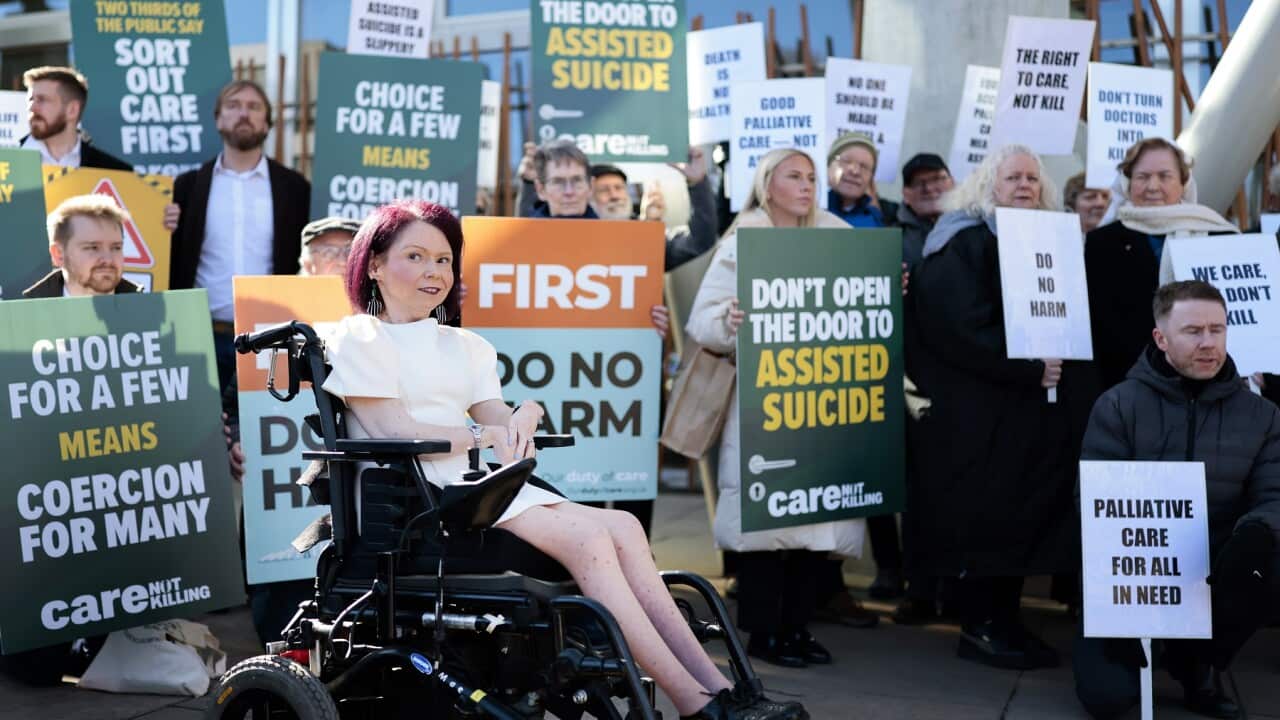

A WARNING THAT THIS STORY MAY BE DISTRESSING FOR SOME LISTENERS: Scotland's Parliament has rejected legislation that would have made Scotland the first part of the United Kingdom to allow terminally ill adults to end their lives. Members of the Edinburgh-based legislature voted 69 to 57 against a bill that would have let people in Scotland with six months or less to live seek help to end their life. The Scottish vote is part of a wider debate across the UK.
Listen to Australian and world news, and follow trending topics with SBS News Podcasts.
TRANSCRIPT:
"As someone with incurable cancer I live every single day thinking about the end of my life, and often that's about how I'm going to end it myself."
That's Kristy, an Englishwoman with terminal breast cancer.
She was telling the BBC last year about the most consequential decision she is facing in her life, and her desire to end it on her terms.
Polls consistently show about 80 percent of British people support the legalisation of assisted dying, sometimes known as euthanasia - but despite the support, changing the law in Britain and its related self-governing Crown Dependencies is proving difficult.
The English parliament's lower house narrowly approved an assisted dying bill by just 23 votes in 2025 - which delighted supporters like this un-named activist:
"This is a real vote for compassion. And it means nobody else has to suffer at the end of their lives. Nobody else has to go abroad for a dignified death. This is, I can't put it into words.”
The legislation is now before the House of Lords - but its passage is anything but certain.
There are hundreds of amendments now attached to the bill, but only a limited amount of time left to debate them.
Supporters - including Labour MPs - have urged the Prime Minister to do something to avoid the bill not being passed because of these constraints.
Prime Minister Keir Starmer has remained neutral on the matter in debate in Parliament.
"It's a matter of conscience. It's for parliament to decide the passage of the legislation and any changes. Scrutiny is a matter for the other place. We have a responsibility to make sure any legislation is workable, effective, and enforceable."
That approach has pleased some, who have called on the government to address palliative care systems before introducing assisted dying processes.
They argue the National Health Service is already stretched and would not be able to cope with the numbers of people wanting to end their own lives.
But it's infuriated others.
Media reports in the UK suggest at least 100 Labour MPs want Starmer to stop the assisted dying bill from falling over in the House of Lords.
Dame Esther Rantzen, who supports assisted dying and has stage four lung cancer herself, has told BBC Newsnight that the addition of the amendments was a deliberate strategy.
"There are lobby groups - very small lobby groups - who are determined to sabotage it. However it came to the House of Lords, that's what they would do, they would block it. Some for religious reasons because they belong to a faith that prohibits assisted dying and they want to impose that on those of us who don't share that faith. Some because they are so committed to palliative care. And some because I think wrongly, they think as disabled activists that it would apply to disabled people - which it wouldn't."
There are barriers elsewhere in the UK too.
Jersey is also waiting after a vote in favour of assisted dying in February.
A proposed law change in favour of assisted dying in the Isle of Man has been waiting a year for Royal Assent, the final step before a bill can become law.
And this was the vote in Scotland just this week.
"In the name of Liam Macarthur, is 'yes' 57, 'no' 69. There was one abstention. The motion is therefore not agreed and the Assisted Dying bill for terminally adults Scotland bill falls."
The vote came after an emotional debate that lasted around three hours and saw MPs tear up and applaud as they expressed their views on the issue.
Leader of Scottish Labour Anas Sanwar has told Sky News he believes the result was the right outcome, arguing - as other opponents have done - that he fears vulnerable people could be put at risk under this kind of legal framework.
"I didn't feel as if there were adequate safeguards. I do have a fear around the risk of coercion. And so I feel that the parliament has ultimately made the right decision."
Listeners seeking support and information can contact Lifeline 24 hours a day online and on 13 11 14. Other services include Beyond Blue and Kids Helpline (for people aged five to 25) on 1800 55 1800.
The Australian Centre for Grief and Bereavement can be contacted on 1800 642 066.