
Seven cases of the deadly hantavirus have now been identified in a suspected outbreak on a luxury cruise ship off West Africa. The outbreak has caused global concern, as the disease is considered rare among humans. What is happening with the ship, and what does hantavirus actually entail?
Listen to Australian and world news and follow trending topics with SBS News Podcasts.
TRANSCRIPT
US travel blogger, Jake Rosmarin, is currently stranded on board a luxury cruise ship off West Africa.
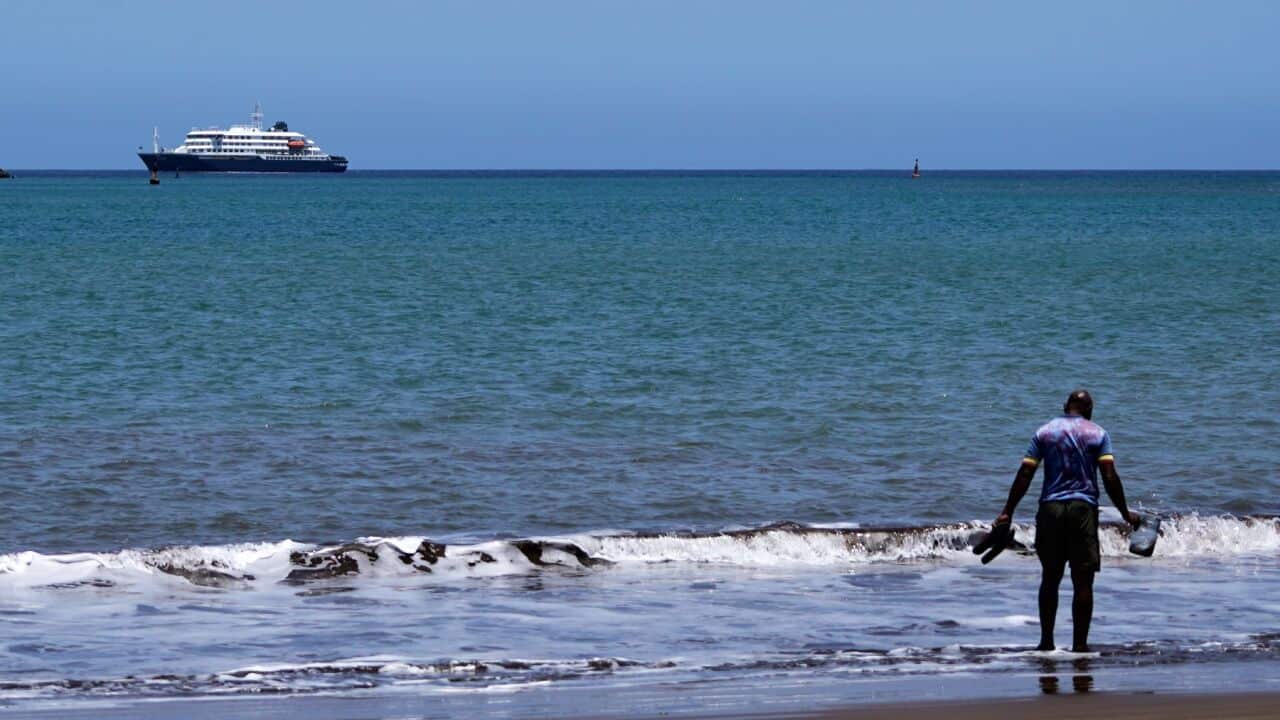
The ship is at the centre of a hantavirus outbreak, with seven cases now identified and three people dead.
"There’s a lot of uncertainty, and that’s the hardest part. All we want right now is to feel safe, to have clarity and to get home."
The MV Hondius is docked off Cape Verde, after being forced to halt its polar voyage from Argentina to Antarctica.
The World Health Organisation's representative for Cape Verde, Ann Lindstrand, says testing is also in progress to determine if the strain of hantavirus known for more human-to-human transmission is the one that was on the ship.
She says local authorities are handling the arrangements.
“It's been very tricky for Cape Verdean authorities. What they have to deal with is a public health event. And of course, they have been thinking about the protection of the population here in Cape Verde. And then, of course they've been very careful to also give the needed medical assistance to the patients on board.”
But what is hantavirus exactly?
Hantaviruses are strains of a virus primarily carried by rodents, such as rats and mice, but that can be transmitted to humans with certain strains.
Executive director of South Africa's National Institute of Communicable Diseases, Nazir Ismail, says exposure typically occurs in specific environments.
“Just also to be clear that, usually the hantaviruses most often are not usually spread human to human, most of the viruses. I'll clarify now, so most of the viruses are normally transmitted through rodent droppings and it's usually in specific kinds of environments. There is a less common variant that occurs in South America that is associated with human-to-human transmission. And based on the Argentinian history et cetera, and the travel history of these individuals, we’ll still do the confirmation to see whether it is a South American variant.”
Between 1993 and 2023, there were 890 cases in the United States.
It's the illness that claimed the live of Gene Hackman's wife, Betsy Arakawa in February 2025.
In Australia, no known human cases have been reported.
Professor of Infectious Diseases and Global Health at the University of Sydney, Dr Meru Sheel says as the situation on the cruise ship continues to be monitored, lessons from the COVID-19 pandemic response may be useful while navigating the outbreak.
“I think there's benefits of the pandemic and the pandemic treaty for the general public and the awareness that globally there is an emphasis on a coordinated response and facilitated information sharing across countries and participation from many sectors like the cruise ship industry from different governments and WHO. And there'll be what we call a one health element, where we'll be looking at environmental exposures. And I think that's all great secondary benefits, I guess, of the pandemic that we are trying to do better at controlling, at minimising the damage and the impacts of any kind of outbreak.”
As it's not a very common infection, Dr Sheel says that's why it can be quite severe when people do fall ill.
The risk of the viruses can be reduced by minimising contact with rodents, wiping down surfaces, checking for droppings, ensuring bags of food are sealed, and having traps in place, if necessary.
The Chief of Special Pathogens at the Public Health Agency of Canada, David Safronetz, says that at this time, no specific medical interventions exist.
“Unfortunately, there are no specific vaccines for antiviral diseases. There are no specific antivirals to treat the disease in humans with. Treatment primarily is supportive care. So early identification of cases, seeking medical attention and getting into facilities that are capable of assisting, for example, in this case with the respiratory distress portion of the disease, that's really critical.”
Meanwhile, Jake Rosmarin says while the waiting is difficult, being at the centre of a media storm is also tough.
He says the passengers and crew have a particular message.
“If you're seeing coverage of this, just remember that there are real people behind it and that this isn't something happening somewhere far away. It's happening to us right now.”