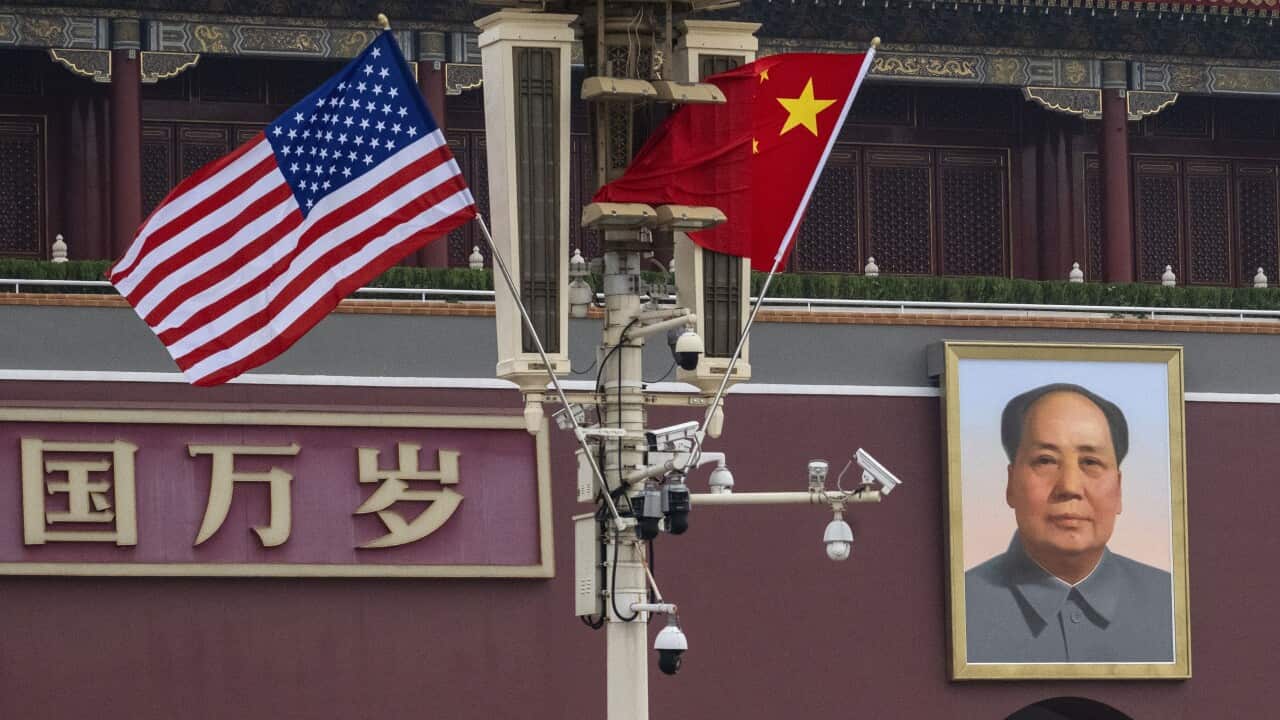

US President Donald Trump has met with Chinese president Xi Jinping in Beijing, after receiving a warm welcome at the Great Wall of China. Trade tariffs and the war in the Middle East were high on the agenda.
Listen to Australian and world news, and follow trending topics with SBS News Podcasts.
TRANSCRIPT
As night fell at an airport in Beijing, US President Donald Trump's Air Force One landed in China for the first time in nine years.
Waiting for Mr Trump at the airport was China's vice president Han Zheng and a team of ceremonial guards, standing on both sides of a red carpet rolled out for the US President.
A crowd of welcoming team shouting "Welcome" at the airport
The red carpet was rolled out again when the world watched Mr Xi shake hands with Mr Trump outside the Great Hall of China, and the pair entered the building for bilateral talks.
In their opening remarks, Both Mr Xi and Mr Trump stress the importance of the US-China relationship.
The highly anticipated visit has also attracted lots of attention inside China, from citizens searching up on which hotel Mr Trump would reside, to Chinese exporters hoping the meeting could ease their financial stress hit by the new trade disputes between the Trump administration and Beijing.
In Wenzhou, a city in Southeast China known for light manufacturing, Zhihua Lin is the vice general manager of a shoe factory that trades with the U-S.
"It was a stressful time. Things were very unpredictable. Not just for us, but for the trading companies and the US clients too. Everyone was anxious."
For Mr Lin, the meeting between the two leaders is a sign of hope.
“I'm actually looking forward to it. Him coming to China is in itself a sign that things might look up."
The Trump administration announced that 17 top U-S company executives would join the trip with Mr Trump, and Nvidia's chief executive, Jensen Huang, was added into the list the last minute.
Known for producing chips that drive the global A-I boom, Nvidia has been pursuing more access to China's market, but has been caught in the A-I race and trade disputes between Washington and Beijing.
Jarred Mondschein, Director of Research at the United States Studies Centre at the University of Sydney, says the pre-visit arrangements reveal Trump's prioritisation on keeping the trade balance with China.
"Now, there's no question that President Trump cares about that and the trade balance in China buying more goods. So, the question is, at what cost? And I think that's why there's some concern in the United States and in Taiwan, and amongst US allies and partners that perhaps President Trump is getting a bargain with China that very well may not be in their long-term interests."
The U-S had also signalled it would pressure China to take a more active role in the war in the Middle East.
This week the U-S Department of the Treasury announced sanctions on 12 designated individuals and entities for their roles enabling the Islamic Revolutionary Guard Corps' sale and shipment of Iranian oil to China.
In an interview with Fox News while flying to China, the US Secretary of State Marco Rubio said it's in China's interests that it condemns Iran over the blockade of the Strait of Hormuz.
"The Chinese have ships stuck in the Persian Gulf, because setting up a system that says we're going to let certain ships through but others not, it's easier said than done. And you saw a Chinese, not Chinese flag vessel, but it was a Chinese cargo, got hit over the weekend. I'm sure Iran didn't do it deliberately. But they did it. It happened. And so that's why these Chinese ships are stuck in there."
Dr Edward Chan, postdoctoral fellow of China Studies at the Australian National University, says China would also want to talk about the war, but may go further than the conflict itself.
"Primarily not just the conflict itself, (but) about the energy transition, also oil prices going up at the moment, which China is pretty concerned, a lot of its energy export come from the Middle East."
Jarred Mondschein from the United States Studies Centre says Australia should closely watch how the US deals with China.
"I think Australia will be watching to see what sort of concessions the Trump administration gives to China. The US is more indispensable in Asia, and US allies and partners in Asia are very reliant on the US. And so, if there's any sort of backtracking on that, that makes it harder for US allies and partners to enact any counter pressure on China successfully."