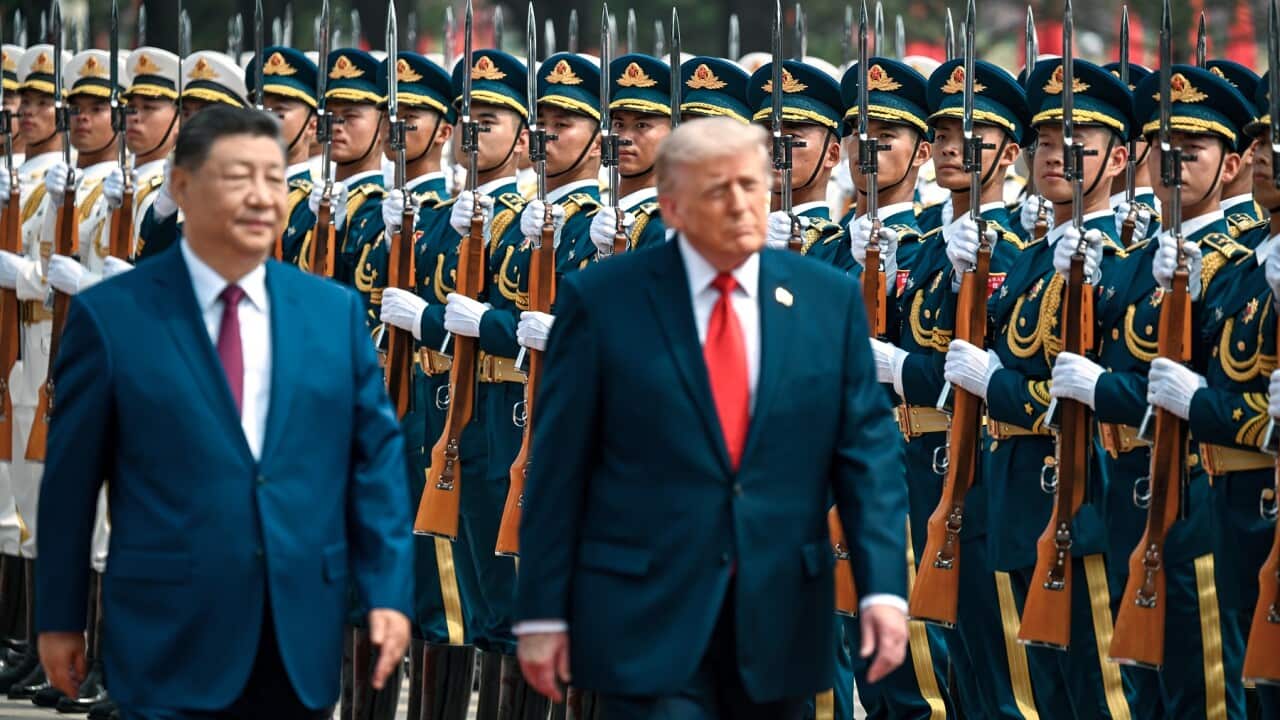

US President Donald Trump says China has offered to help calm conflict between the US and Iran, after high-stakes talks with President Xi Jinping in Beijing that focused heavily on the war in the Middle East, the Strait of Hormuz and growing fears of global economic fallout. The visit also exposed the delicate balancing act facing both powers, with Taiwan, trade and military tensions still threatening to destabilise the relationship between Washington and Beijing.
Listen to Australian and world news, and follow trending topics with SBS News Podcasts.
TRANSCRIPT
US President Donald Trump arrived in Beijing needing China’s help, even if he would never publicly admit it.
With the war on Iran dragging on under a fragile ceasefire, oil markets volatile and tensions still simmering around the Strait of Hormuz, the White House knows Beijing may be one of the few capitals with real influence in Tehran.
And behind closed doors inside the Great Hall of the People, Iran quickly became the central focus of talks between the two leaders.
Donald Trump says President Xi offered to help calm the crisis and thereby, reopen the Strait of Hormuz.
“President Xi would like to see a deal made. He would, he would like to see deal made. And he did offer, he said, if I can be of any help at all, I would like to be of help. But he said, ‘I would love to be of help. If I could be of any help whatsoever,’ he’d like to see the Hormuz Strait open.”
The Strait of Hormuz carries about a fifth of the world’s oil supply, and its disruption has affected global energy markets.
China does have a major stake in keeping the waterway open; it is after all, the country that purchases the most oil from Iran.
But while China wants the waterway open to protect its own energy interests, Washington was also seeking guarantees Beijing would not further strengthen Iran militarily.
Speaking to Fox News, President Trump says his Chinese counterpart did make one significant commitment - that China would not send military equipment to Iran.
“He said he's not going to give military equipment. That's a big statement. He said that today. That's big statement. He said that strongly. But at the same time, he said, you know, they buy a lot of their oil there and they'd like to keep doing that.”
US Secretary of State Marco Rubio later suggested the talks produced at least one rare point of agreement between Washington and Beijing: that Iran should not militarise the Strait of Hormuz.
“The Chinese side said they are not in favour of militarising the Straits of Hormuz, and they're not in favour of a tolling system. And that's our position. We don't, we will never support an Iranian tolling system in the Straits of Hormuz, nor do we think they have a right to put mines in international waters. And so it's good that we have alliance or at least agreement on that point.”
Mr Rubio says China also repeated its long-standing position that Iran should not possess nuclear weapons.
“Iran is signatory to the nonproliferation treaty. And so therefore they should not have a nuclear weapon. And they reiterated that point again today.”
As Mr Trump and President Xi met in Beijing, the Iran conflict was also overshadowing a BRICS foreign ministers’ summit in New Delhi, where rising oil prices and fears of wider economic fallout dominated discussions.
Iranian Foreign Minister Abbas Araghchi held talks with Russian Foreign Minister Sergei Lavrov on the sidelines.
But while Iran dominated the agenda, another issue lingered beneath the surface in Beijing: Taiwan.
China’s official summary says President Xi warned Mr Trump that Taiwan remains the most sensitive issue in the China-U-S relationship, and that mishandling it could risk confrontation.
Still, publicly, the Chinese leader struck a more measured tone.
At a state banquet inside the Great Hall of the People, President Xi framed the relationship as one too important to fail.
"We both agree that the China-U.S. relationship is currently the most important bilateral relationship in the world today. We must make it work, and never mess it up. Both China and the United States stand to gain from cooperation and lose from confrontation. Our two countries should be partners rather than rivals. We agreed to build a constructive China-U.S. relationship of strategic stability to promote the steady, sound, and sustainable development of China-U.S. relations, and bring more peace, prosperity and progress to the world."
Beneath the carefully choreographed and diplomatic language, tensions remain high.
China continues to increase military pressure around Taiwan, while Washington remains legally committed to helping the island defend itself.
Mr Rubio says the United States has not changed its position.
"Any forced change in the status quo and the situation that's there now would be bad for both countries. One of the things the Chinese emphasized, which we agree is strategic stability in our relationship, a constructive relationship, but also one that establishes strategic stability so that we don't have misunderstandings that could lead to broader conflict."
Despite the disagreements, both Washington and Beijing spent the visit trying to show the relationship remains manageable and that competition between the United States and China does not have to become a conflict.
And next ?
A tea reception before the US president returns to Washington.