

.
Listen to Australian and world news and follow trending topics with SBS News Podcasts.
TRANSCRIPT
It's all systems go at the Pacific Islands Forum Fisheries Agency in Solomon Islands.
Around a long table, fisheries, maritime and law enforcement personnel from 10 Pacific countries - including support from Australia, New Zealand, France and the US- have congregated to protect the lifeblood of this region.
This is Allan Rahari, the Interim Deputy Director General of the Pacific Islands Forum Fisheries Agency and the Director of Fisheries Operations.
“The tuna fisheries in the region is a backbone to a lot of our Pacific Island countries. In fact, for some of our Pacific Island countries, tuna revenue generated from the tuna is the only economic return for them to support schools and hospitals.”
In a bid to stop overfishing - the Forum Fisheries Agency coordinates multiple sting operations annually.
This Operation is titled Tui Moana.
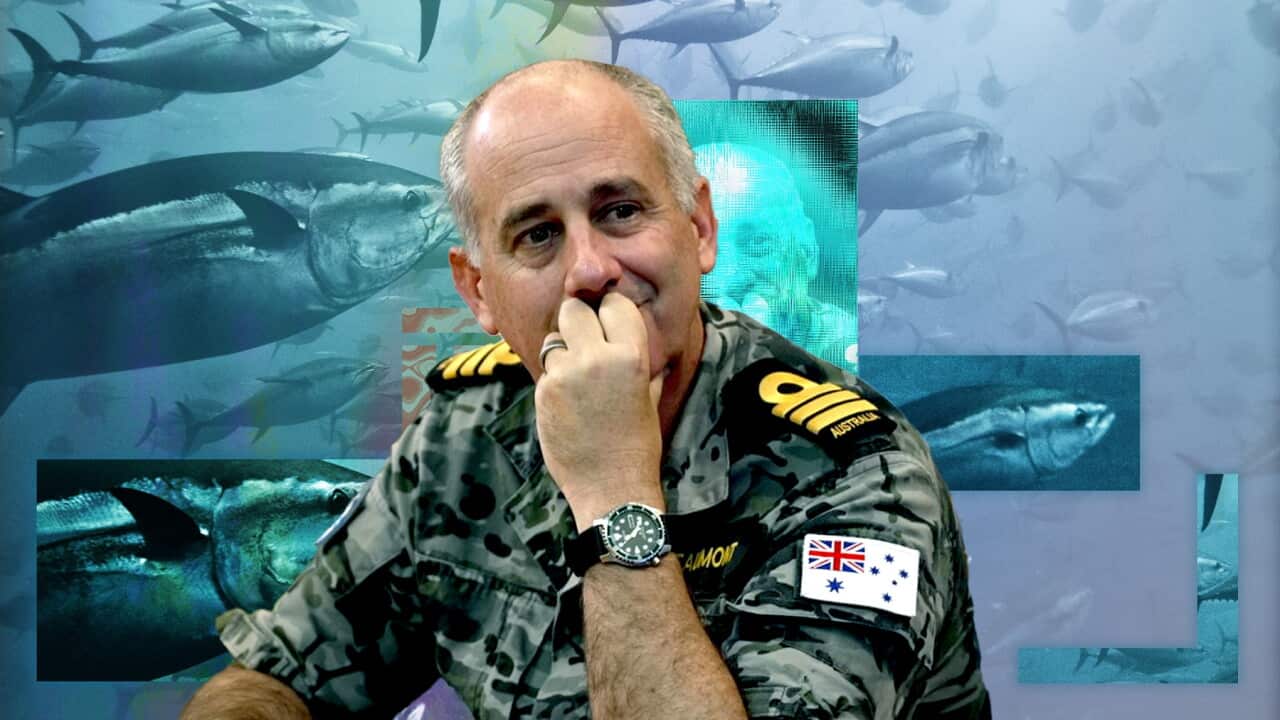
Commander Khan Beaumont is an officer in the Royal Australian Navy serving as a Surveillance Operations Officer with the Pacific Islands Forum Fisheries Agency in Solomon Islands.
“What we try and look for is vessels that are operating outside the normal fishing patterns who are trying to disguise who they are ... There's also activities where it happens with the registered fleet whereby they misreport their catch. So we match up catch and log declared logs when they come offshore to see if there's any discrepancies. And we also pay very particular attention to transshipments on the high seas.”
This Operation casts a wide net - providing information to island nations about activity in their Exclusive Economic Zones - areas of the Pacific in which marine resources are managed by sovereign entities.
“Some countries have catch limits. Other countries it's just per license. One member state, you pay a set license fee and you can catch as much fish as you want. The tuna fishery alone is worth 1.5 billion US to our membership and of course the fishery of that value obviously attracts nefarious actors. Approximately 300 million US disappears in illegal activity each year.”
Some operators changing out the vessel's flag to evade regulations or obscure ownership.
“Quite often you'll see vessels will jump flags to flags that have weak enforcement of national law because it's only the flag state of the vessel that can ultimately hold that vessel to account.”
Satellite monitoring is a major tool used to help identify illegal operators.
Squadron leader Ashley Wilson is the Royal New Zealand Air Force's Forum Fisheries Agency planning and liaison officer.
ASH: "The Pacific Ocean is massive, 30 and a half million square kilometers. So without space-based technology, it would be like trying to find a needle in haystack.
So we're seeing the big picture, where the concentration of fishing effort is going. To be licensed to fish they are using vessel monitoring systems to transmit.The satellite surveillance then allows us to see who's not transmitting. What vessels can we see out on the water that are dark effectively. So those are the ones that we really focus on."
REPORTER: “Are you seeing any patterns in illegal fishing?”
ASH: “Fishers may fish within an economic exclusion zone, within a country's boundaries, and then we see them migrate out to these high seas pocket areas to transship their catch and that becomes an indicator to us of uneconomic behavior. They don't sit within an exclusion zone of any particular country, governance in those areas is weaker and that's where the unauthorized, unregulated catch is lost.”
This information is then sent to the tarmac, where two aircraft owned by the Fisheries Forum Agency are rearing to be deployed.
Steve Masika is the aerial surveillance planning officer for the Pacific Islands Forum Fisheries Agency
STEVE: "Aerial surveillance, I see that as a force multiplier. You have surface assets that are out there, they have limited range. There are specific areas in the Pacific, where more illegal fishing is happening and that is bordering with Indonesia, Philippines and that area and some boats, no markings at all. They are flying no flags, no call sign, we could really say it's a stateless boat.
REPORTER: What red flags are you looking out for?
STEVE: "That 's a big one. Compliance issues with markings on boats, sometimes we see by-catch. Say for example, we're flying over a boat, have a shot on the deck and we see shark fins drying on deck. It could be a perfectly legal thing that they're doing, but there are rules around harvesting of sharks."
As part of Operation Tui Moana, Australian defence force personnel were also stationed in Cook Islands and Tonga, providing patrol boats and also Spartan aircraft to assist with conducting surveillance.
This is Bryce Geoghegan, Flight Lieutenant for the Australian Defence Force.
“It's about building those relationships with our partner nations in the Pacific. And just ensuring that we can assist with stability and providing that extra reach. It seems to be working as great deterrence.”
Operation Tui Moana concluded at the end of May,
Successfully identifying four vessels of interest, resulting in two apprehensions linked to suspected fisheries-related offences.
This story was produced with support by the Pulitzer Centre.