
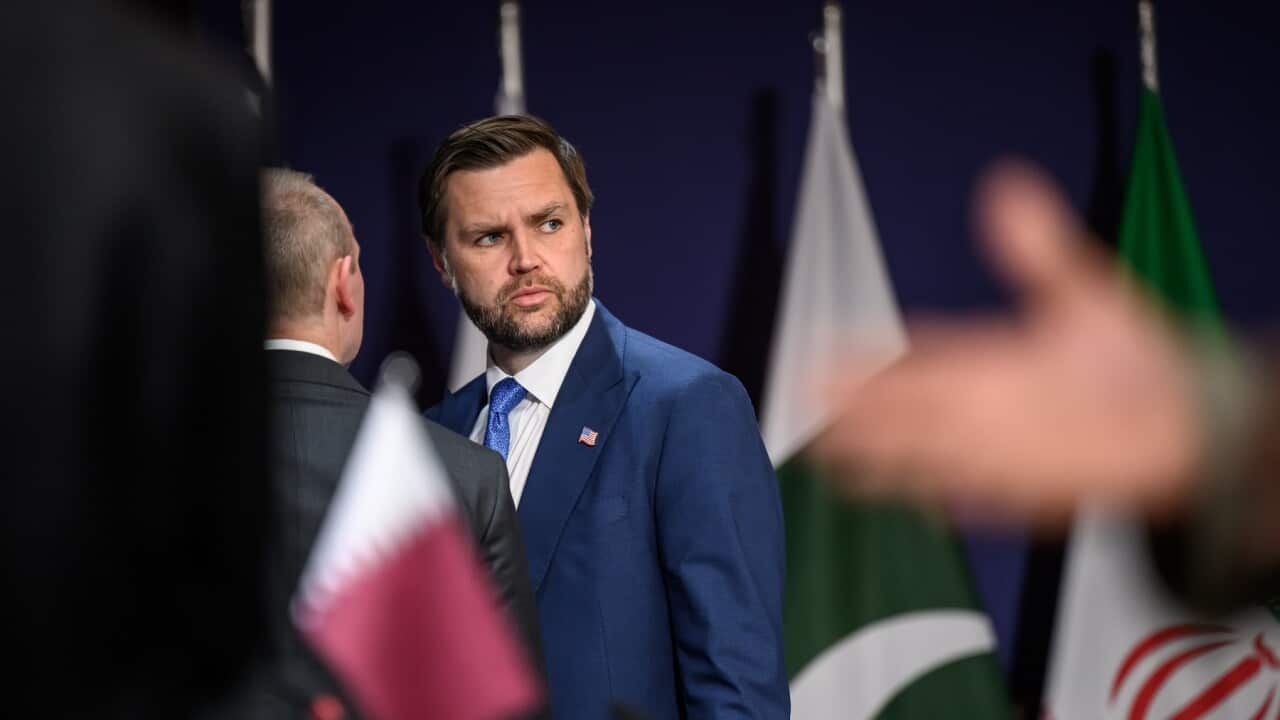

Iran and the United States are giving conflicting accounts over whether the Strait of Hormuz remains open. Negotiators for both countries have concluded the first round of talks in Switzerland, with reports Iranian diplomats exited discussions early over a threat made by US President Donald Trump.
Listen to Australian and world news and follow trending topics with SBS News Podcasts.
TRANSCRIPT
It's one of the world's most important shipping routes, but there is currently no consensus on whether the Strait of Hormuz is open to naval traffic.
Iranian Foreign Ministry spokesman, Esmail Baghaei announced on the weekend the passage is shut, telling Iranian state media the decision is due to ongoing violence in Lebanon.
"The commitments are very clear an end to the war on all fronts including in Lebanon. We have honoured our commitments, have failed. This constitutes a clear violation of the ceasefire memorandum."
That was before the Iranian and American negotiators met in the first of a series of talks, aimed at ending conflict that began with US and Israeli strikes on Tehran this year.
The White House has since moved to quash concerns about the Strait's closure.
US Energy Secretary Chris Wright says 67 ships moved through the strait on Saturday, compared with 55 the day before, adding that oil and fuel traffic is now close to pre-conflict levels.
"Traffic is flowing through the straits quite nicely now. That's because of a US military presence. Iranians still have not de-mined the central shipping channel, but the US opened a separate channel down south and we've been we've been escorting ships through that for several weeks now."
Commercially available shipping data, however, is at odds with the statement.
Only one tanker crossed the waterway with its location-signalling transponders on after Iran's announcement, compared with dozens of ships in recent days.
Iran's Fars news agency cited a military source as saying on Sunday that no new permits were being issued for ships to cross until further notice.
The back and forth statements come after the first round of talks between the United States and Iran wrapped up in Switzerland.
Both parties are stuck on various terms, including sanctions relief, releasing Iran’s frozen assets and security concerns around Lebanon and the Strait
A halt to fighting between Israel and Iran-backed Hezbollah fighters is a key condition of the interim peace-agreement signed last week.
In the wake of the talks , Hossein Ghorbanzadeh, a member of Iran's negotiating delegation, says the issue dominated the discussion.
"The issue of Lebanon received more emphasis than anything else. Naturally, if with regard to Lebanon - which is one of the principal fronts where the end of the war must be declared - this does not happen, then the subsequent issues will certainly not be negotiated."
Lebanese state media reported Israeli strikes killed at least five people in the country's south on Saturday.
Hezbollah’s Secretary General, Naim Kassem has urged the Lebanese government to advocate for itself while Iran is negotiating with the US.
“Go and fix out your situation with Iran, you political authority. Fix your relationship with Iran. Even the United States is fixing its situation with Iran. All Arab countries are adjusting their relations with Iran. What are you? What kind of people are you? You are still standing aside, behind the rest, Why? Sort it out. Catch up at the right time, because this is a source of strength for you. No one will take anything away from your path.”
The Lebanese Health Authority has reported almost four thousand people have been killed since March, in Israel's ongoing assault in the south.
More than 1.2 million people have been displaced.
Narimen Hachemi, who has fled her home in Majdal Zoun, expressed faith in the Iranian regime to resolve the conflict.
“This time, God willing, yes the ceasefire will hold. God willing, this time. We do not believe Israel no, we believe our fighters, and the battlefield surely, thanks to our young men and thanks to Iran. Their word is a word, God willing.”
Iran has warned Washington will be responsible for any breach of the agreement, while Israel says it is not a party to the deal.
Israeli Prime Minister Benjamin Netanyahu, has made it clear that he will not withdraw troops from what he describes as a security zone in southern Lebanon, where Israel's military is fighting Hezbollah cells.
Speaking at a policy summit in Jerusalem, Mr Netanyahu also doubled down on his promise to stop Iran ever having nuclear arms.
He says diplomacy will not change Israel’s bottom line.
“No matter what happens in the talks, with an agreement, without an agreement. I pledge to you that Iran, as long as I'm Prime Minister, will never have a nuclear weapon. Never. As long as I am the Prime Minister of Israel, I will not let that happen.”
The first round of talks between the United States and Iran closed abruptly and early in Lucerne.
Sources close to the Iranian negotiating team have told Iran's semi-official Tasnim news agency that Iranian diplomats walked out of the talks in protest over comments made by US President Donald Trump.
While not present for discussions in Switzerland, President Trump posted remarks to his social media platform,Truth Social, during the meeting, writing;
"Iran must immediately stop their highly paid proxies in Lebanon from causing trouble. If they don’t, we’ll hit Iran very hard again, just like we did last week, only harder!"
Fox News later reported that Trump had gone further in an interview, saying he had told Iranian officials if they closed the strait, "you won't have a country", threatening to take over the waterway.
Iran's parliamentary Speaker Mohammad Bagher Ghalibaf responded on social media, striking a more diplomatic tone.
He wrote on X, that the Iranian armed forces remained ready to respond in other ways, writing;
"We do not take these statements seriously, but it would nevertheless be advisable for them to show more restraint."
US Vice President JD Vance says Washington is seeking a reset in relations with Tehran if Iran abandons its nuclear ambitions and support for regional instability.
"This is a historic meeting. Never before, outside of Islamabad and here—so outside the last few months—never before has the Iranian and American leadership met at such a high level. What the President has asked us to do is turn over a new leaf, to transform our relationship with the people of Iran, and to extend an outstretched hand that says to the people of Iran that if your leadership is willing to give up being a driver of regional instability, if they are willing to give up nuclear weapons ambitions for the long term, then the United States is willing to fundamentally transform our relationship with that country."
Ultimately, both sides agreed to continue technical negotiations.