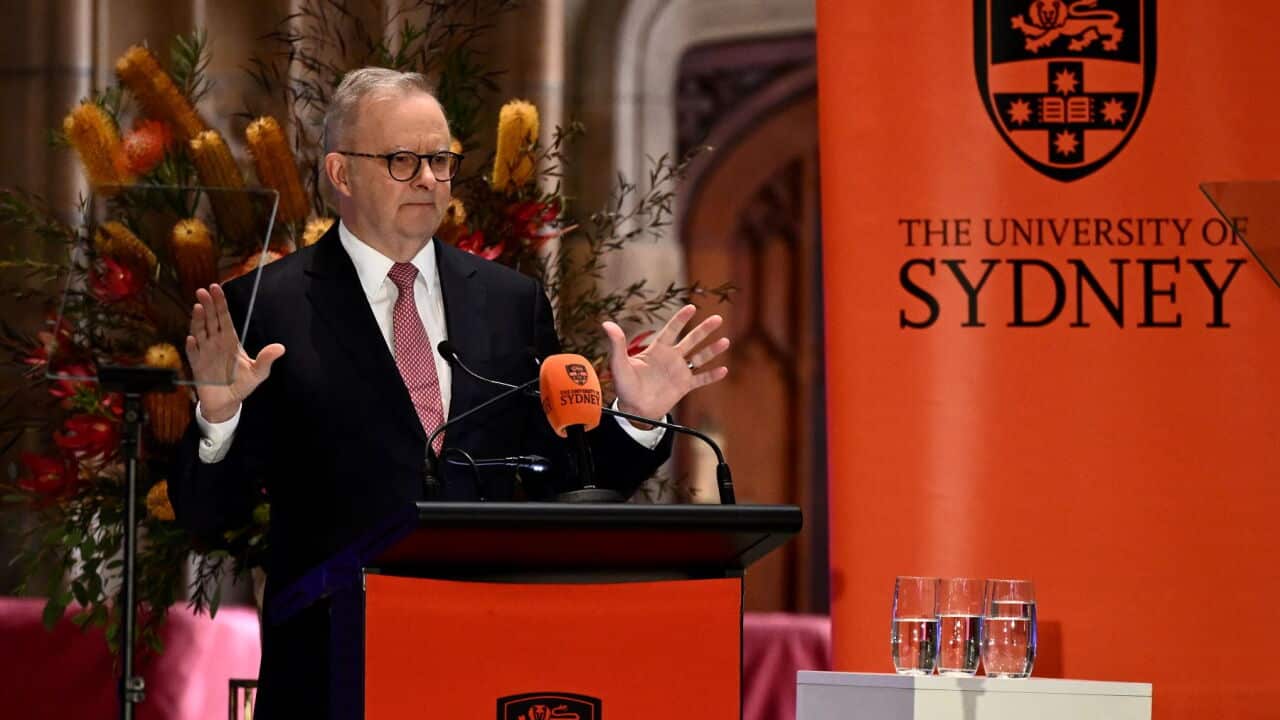

In a major speech, the Prime Minister has outlined plans for a set of new national standards for artificial intelligence. The federal government will establish an Office of Artificial Intelligence as part of the new national framework. Anthony Albanese says Australia can encourage investment while managing risk to capitalise on the technology.
Listen to Australian and world news, and follow trending topics with SBS News Podcasts.
TRANSCRIPT:
"This is our time to decide what AI looks like in Australia."
That's Prime minister Anthony Albanese, announcing a new national framework for regulating AI.
He says it's part of a push to capitalise on the technology while managing the risks it brings.
"It is not a question of if or when AI will transform our economy. We're past that. The question that matters, the choice that we have, is how: how we apply our enduring values of fairness and opportunity to make this technology work for us, for workers and communities, for our economy and our environment, for our creative industries and media?"
The PM has highlighted Medicare, superannuation, and the government's social media ban as proof that the country can manage AI in a uniquely Australian way.
He says the government is focused on shaping the future, rather than letting the future shape us - and that the government's new national framework will ensure flexibility as AI evolves.
"To seize and shape and share the generational opportunity that AI represents, our government will establish a set of Australian standards for AI. In March this year, we announced a set of expectations for large AI data centres. This will bring them into one regulatory framework: clear, consistent, and mandatory."
Australia has become a hub for AI data centres, but state and territory approaches to investment and regulation have become increasingly divergent.
Mr Albanese says the federal government's policy aims to harmonise this national patchwork.
"I will seek agreement on this approach from premiers and chief ministers at the national cabinet meeting I'm convening next month. We will aim to bring the legislation to parliament and carry it early next year. We will consult closely with industry and our trading partners to design a framework for faster decision making, better supporting infrastructure, and genuine community engagement."
The new standards will cover location, energy and water requirements.
Companies will be required to underwrite new power supply, and to be net-generators, so they give back to the grid rather than driving up prices, and support more renewable energy.
"Australia is the sunniest continent on Earth, but we're also the driest, which is why our rules will require data centres to minimise their water use, to maximise their energy efficiency, and pay for any additional water infrastructure that is required."
The PM says every country in the world is grappling with these issues right now.
"Australia will be the first country in the world to bring these issues into a single national framework, and getting this right will enhance our appeal to international investors by delivering greater clarity and speed for approvals and a streamlined process for verifying compliance."
The government will also establish a Office for Artificial Intelligence within the Department of Prime Minister and Cabinet.
"It will work closely with the Minister for Industry and Innovation, Tim Ayres, and the Assistant Minister for Science, Technology, and the Digital Economy, Andrew Charlton, to coordinate the design of our new Australian standards, and to bring together the work that ministers right across the government are undertaking."
Digital Rights Watch has welcomed the announcement, saying policy making has been spread across many departments, and a more coordinated approach is required.
Australia's political leaders have been more circumspect.
David Shoebridge is the Greens' spokesperson on Digital Rights and IT.
"The idea that a single office inside the Prime Minister's Department is the answer to AI regulation, I think, fundamentally misunderstands what Australians are asking for. What the prime minister has offered today is a single door in his office, no additional statutory powers, no additional resources, but a door that the big tech industry can knock on to get what they want. That is not going to deliver the protections Australians have been asking for."
He says clear, legislated protections are needed, and people are right to be worried about data centres, highlighting concerns around sovereignty, the environment, creative IP and jobs.
"Australia needs a moratorium, a clear moratorium on new data centres, a clear moratorium on further contracts with foreign tech companies with government, until we have real legislative protections in place."
Ahead of the speech, opposition leader Angus Taylor dismissed plans for a new AI office, suggesting the government's approach will put a handbrake on the economy.
He says AI presents an extraordinary opportunity to boost prosperity, living standards, productivity and jobs.
"The only jobs this prime minister is going to create with AI is in his own office. We don't make the most of AI through more bureaucracy. We make sure we deploy it for our benefit as a country, making sure our national security is strengthened, making sure our creators can continue to create, knowing that they have secure intellectual property rights."
Treasury documents released under freedom of information show that Anthropic, one of world's largest AI companies, has requested more clarity on copyright laws.
Creatives have been campaigning for stronger rights, arguing their intellectual property is being stolen during the data scraping process used to train AI.
Anthony Albanese has promised the strongest possible protections will be in place.
"Let me make this crystal clear: not everything produced in Australia is up for grabs, not at all. Australian writers, musicians, artists, and journalists must retain ownership and control of their work. Our laws will spell that out, plain as day."