
Missiles over Jerusalem, fires at a major Gulf airport, and warnings that one strike on a key Iranian island could trigger a wider war. As the US signals the conflict with Iran may end within weeks, the fighting itself is telling a different story.
Listen to Australian and world news and follow trending topics with SBS News Podcasts.
TRANSCRIPT
Missiles over Jerusalem, fires at a major Gulf airport, and warnings that one strike on a key Iranian island could trigger a wider war.
As the US signals the conflict with Iran may end within weeks, the fighting itself is telling a different story.
US President Donald Trump says the campaign has dealt a decisive blow to Iran, but also suggests the war is entering a new phase.
"They have no navy left. They have no air force left. They have no anti-aircraft equipment left, no radar left, no leaders left. The leaders are all gone. Nobody knows who to talk to. But we're actually talking to the right people and they want to make a deal so badly. You have no idea how badly they want to make a deal.”
At the White House, his Press Secretary, Karoline Leavitt, says the administration still expects a short timeline.
"Again, as I've said, we've always estimated approximately four to six weeks, so you could do the math on that. ... We do look forward, I know the president looks forward to going to China on May 14th and 15th."
She also warns that reports of negotiations should be treated cautiously.
"Nothing should be deemed official until it is announced formally by the White House. I would not get ahead of our skis on reporting about any talks this week and until you hear directly from us."
But international officials say the situation is becoming more dangerous, particularly for civilians.
The UN’s High Commissioner for Human Rights, Volker Turk, says the conflict is spreading and civilians are bearing the brunt.
"More than three weeks after the United States and Israel launched strikes on Iran, the conflict is spreading and intensifying in the region and beyond, with civilians bearing the brunt."
He also warns the wider region is being affected.
"The situation is extremely dangerous and unpredictable, and has created chaos across the region, affecting Bahrain, Kuwait, Oman, Qatar, Saudi Arabia, the United Arab Emirates, Jordan, and beyond."
Meanwhile, diplomatic efforts are continuing, but remain uncertain.
Egyptian Foreign Minister Badr Abdelatty says Cairo is ready to host talks.
"We are, of course, prepared to host any meetings as long as they serve the path of de-escalation and calm in the region. As I mentioned, we consult with regional parties, with the Gulf states, Pakistan, and Turkey on a daily basis, as well as with the United States. We convey messages to the other side. If we are asked to host meetings, we have no objection and would welcome it, as long as it leads to calming tensions and de-escalation."
He says a US proposal has been passed to Iran and is under review.
"There was a draft plan from the American side, which was conveyed to the Iranian side and is currently being reviewed. As I mentioned, we hope that there will be direct negotiations between the two sides. We are making every possible effort through all channels of communication available to us to work on making this endeavour succeed."
However, Gulf states are warning the stakes are rising.
Qatar’s Foreign Ministry spokesman, Majed Al-Ansari, says attacks on energy infrastructure could have serious consequences for the region.
"This was communicated very clearly to all our partners around the world, including the United States. And I think, of course, there is a very clear impact that when such a damage happens to the energy sector and the region as a whole. We've said from day one, and we've condemned any attack on energy infrastructure in the region as a very dangerous precedent that would have very dangerous repercussions."
He says Qatar supports negotiations and is ready to assist.
"Qatar is not involved in these talks. Our views about any talks, if they exist, are consistent with our very principled position that all conflicts will end on the negotiation table. And we support all of these efforts. I'm not privy to the details of the current negotiations, but we stand ready to help, of course, if there is any role for Qatar."
But Iran says those efforts do not amount to negotiations.
Iranian military spokesman Ebrahim Zolfaqari rejects the idea talks are underway.
"Has the level of your internal discord reached the point where you are negotiating with yourselves? There will be neither any sign of your investments in the region, nor will you see previous energy and oil prices, until you understand this: stability in the region is guaranteed by the powerful hand of our armed forces. Stability comes through power. We state explicitly: Until such time as it is our will, no situation will return to its previous state. That will arise only when the very idea of taking action against the Iranian nation is completely erased from your corrupt minds."
Iran is also setting out what it sees as a red line.
Iranian defence officials warn any attack on their coast or strategic islands would trigger a major escalation.
Officials say that includes Kharg Island, Iran’s main oil export hub.
The island handles most of Iran’s oil exports and sits near the Strait of Hormuz, through which around one fifth of the world’s oil passes.
At the same time, Israel is expanding its campaign in Lebanon.
Prime Minister Benjamin Netanyahu says operations in southern Lebanon are widening as part of the broader war.
"We are expanding this security zone (in southern Lebanon) to remove the threat of anti-tank missiles from our communities and our territory. We are simply creating a larger buffer zone."
He says the Lebanon front is directly linked to the conflict with Iran.
"Now, the issue of dismantling Hezbollah is before us. This matter is also connected to the overall campaign with Iran, which is still ongoing, contrary to what is reported in the media. However, we are determined to do everything to fundamentally change the situation in Lebanon."
Mr Turk, the UN’s High Commissioner for Human Rights, says Lebanon is facing a growing humanitarian crisis.
"Civilians in Lebanon are caught up in a human rights and humanitarian disaster. Government figures detail more than one thousand people killed by Israeli military strikes in the past three weeks, including 79 women, 118 children and 40 medical workers. I am deeply concerned by attacks that have hit apartment buildings, killing entire families in some cases."
The fighting is also continuing across the region.
Missiles have been seen over Israel, with sirens sounding in Jerusalem.
In Tel Aviv, workers are clearing rubble after overnight strikes.
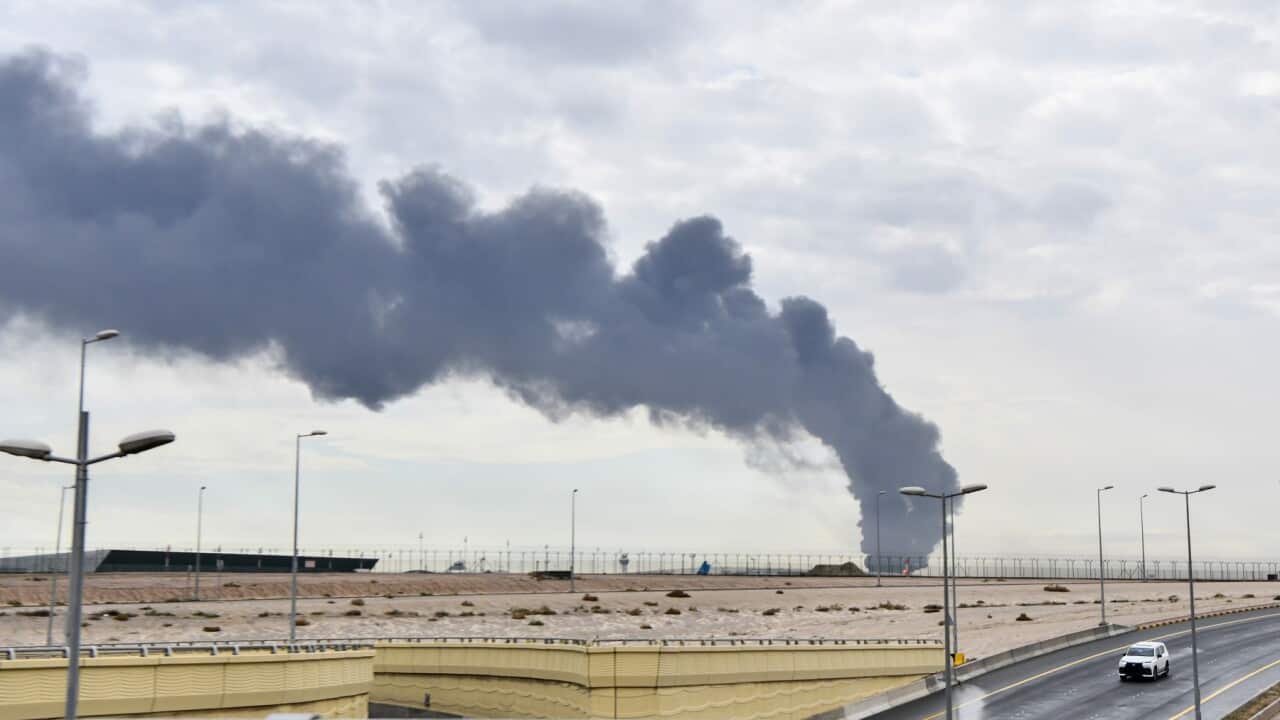
A drone attack has hit a fuel tank at Kuwait International Airport.
And in Iraq, an airstrike has killed seven soldiers and wounded thirteen others.
For civilians, the impact is ongoing.
In Tehran, this resident describes the toll.
"War is damaging for everyone. We, and everyone else, are all being harmed. There is fear. It is holding back business. All of this has happened, and we too are being affected. But we have to move in a direction that is in the interest of our country. That is where we can say that there should be a ceasefire."
For now, the US is pointing to a timeline, Egypt is offering talks, Lebanon is facing a growing humanitarian crisis.
And for now, bombs are speaking louder than diplomats.