
World leaders have gathered in New York for the United Nations General Assembly, with wars in the Middle East and Ukraine dominating the annual meeting. Last year, Donald Trump caused a stir with a combative speech, saying that countries were "going to hell" for, among other things, climate policy and mass migration. This year, U-S President Donald Trump has used his address to the gathering to warn he could "annihilate" Iran if Tehran refuses to reach a peace deal with him. SBS reporter Deborah Groake has the story.
Listen to Australian and world news and follow trending topics with SBS News Podcasts.
TRANSCRIPT
New York is famously said to be the city that never sleeps.
And this week, for Mayor Zohran Mamdani it's become the centre of the diplomatic universe with heightened security as world leaders convene in the city for the United Nations General Assembly's annual meeting.
"New Yorkers can expect to see a visible increase in officers deployed across our city, as well as a heightened police presence surrounding the United Nations building.”
The new president of the General Assembly is Khalilur Rahman, and he's declared at the official opening that he's assuming his responsibility at a consequential moment.
"Conflicts continue to inflict immense human suffering. Development gains remain feeble and fragile. Climate impacts are intensifying."
Chief among those challenges is the conflict in the Middle East, where Iran and the US are at its centre.
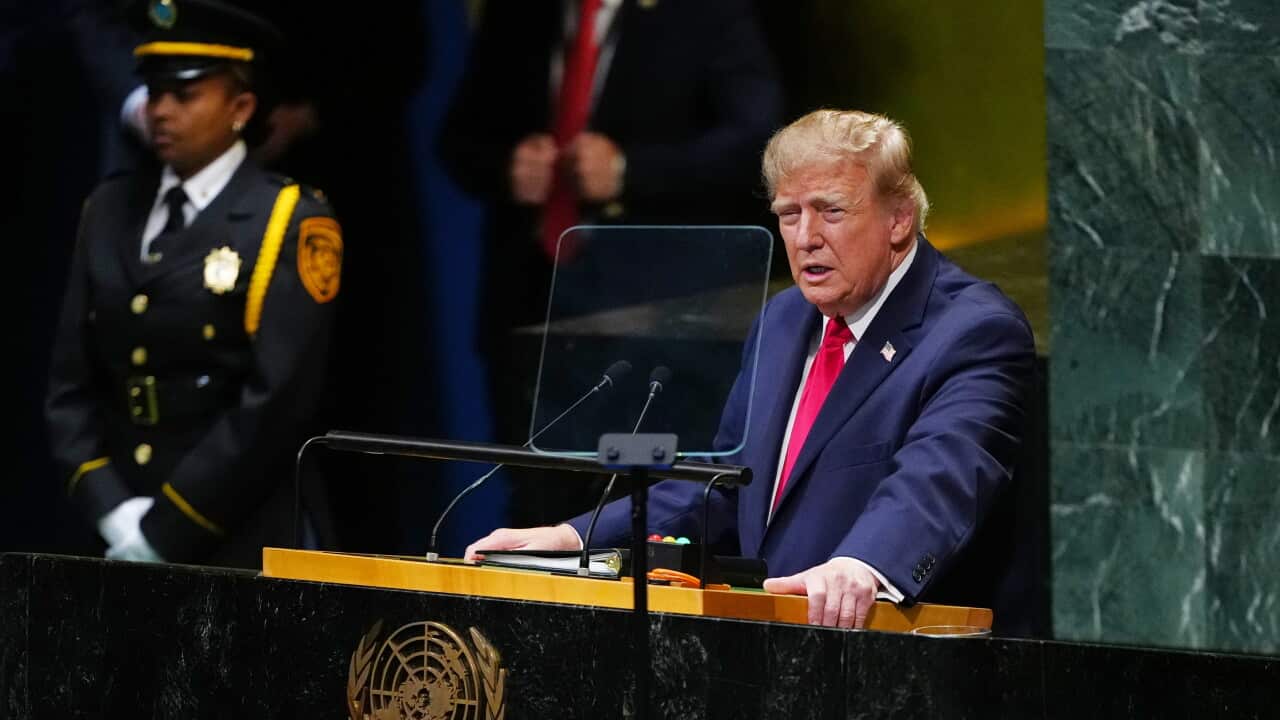
And it's been the focus of U-S President's Donald Trump's speech to the Assembly.
Last year, Donald Trump caused a stir with a combative speech that said some countries were "going to hell" for, among other things, climate policy and mass migration - and which was characterized by extraordinary accusations of UN sabotage after an escalator in New York briefly stopped working and the teleprompter glitched.
In 2026, SBS Chief Political Correspondent Anna Henderson says the US President's presentation has gone very differently.
"The US President didn't have any problems with stalling escalators or teleprompters at this year's UN General Assembly. He stuck to the script, but it was a blunt and deeply unsettling message. He looked down at representatives from about 130 countries, including Australia, and defended the strikes on Iran that have led to the clogged Strait of Hormuz, and have driven up oil prices and inflation across the globe."
Donald Trump says Washington and Tehran are moving toward a settlement on Iran, while a senior Iranian official has said Tehran could reopen the Strait of Hormuz within days if the U-S eased military pressure and lifted its blockade on Iranian ports.
Trump's speech however focused on threatening to destroy the Republic if they didn't do things his way.
“But I have a big decision to make - will a deal be made with Iran that lets them rebuild and create a far greater country than it ever was before? Maybe one of the greatest in the Middle East or even the world. Or do I annihilate the Islamic Republic and do it quickly, never giving them a chance to kill and destroy people and countries again?
And he has offered little comfort to leaders facing domestic pain over the spike in oil prices that the economic consequences are close to abating.
“The terrorist regime is behaving badly, not because they are strong and confident, but because they are weak and desperate. If we stand united, we will soon see a world free of the last 51-year menace of Iranian terror, and oil prices will come plummeting down even lower than they were.”
Iran was not the only major element in Trump's address, artificial intelligence also took a prominent position.
AI companies themselves are increasingly asking for global coordination on A-I safety, with OpenAI's Sam Altman set to address the UN Security Council on Wednesday.
Secretary-General Antonio Gutteres has pushed back against the idea of the world's superpowers going it alone on the technology.
The US President has promised that the United States will encourage AI, not rein it in.
"The very same people who said we'll all be dead in 12 years because of global warming... these are the same people that are now saying that AI is going to kill us all, that robots are going to attack us, and that everything is going to be a total disaster. Same group of people."
In the same speech, Trump has had some harsh words for the members of the International Criminal Court.
He's demanded they resign.
"We will never allow U.S. service members or anyone else to be investigated or given show trials by an anti-American tribunal with no jurisdiction over us. They're an evil group of people."
Trump also some harsh words for the waiting media, days after he banned three outlets from the White House.
"I'm surprised that CNN is here covering me. You shouldn’t be here. You should not be here covering me. You said you weren’t going to cover me."
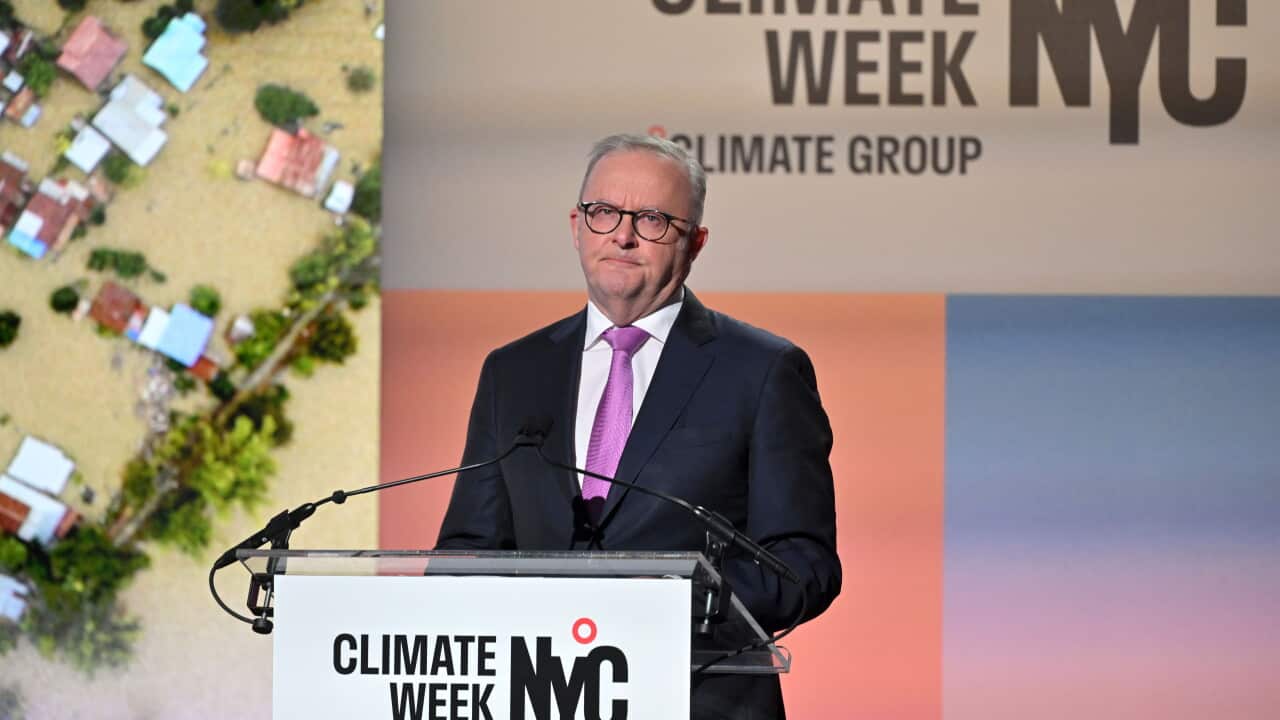
For Anthony Albanese and the UK's Andy Burnham however, there was no sign of tension as they met with each other on the sidelines of the General Assembly.
Mr Albanese and Burnham say they share common values.
Albanese: "We have a Westminster parliamentary system, that we inherited. And so much of our traditions come from your (British) traditions.
Burnham: "There's a great cooperation coming through defense, through AUKUS (Australia, the U.K. and the U.S). Of course."
That cooperation on defence extends to Ukraine, Australia already committing millions in military support for Kyiv, while the UK PM has promised to lobby Donald Trump to press for a Ukraine-Russia energy ceasefire.
The US leader announced last week that Ukraine and Russia had agreed not to strike energy targets, but any semblance of a truce disappeared when Russia hit petrol stations in Kyiv the following day and Ukraine bombed a Russian oil refinery.
Still, Ukrainian President Voldymyr Zelenskyy has seen his own meeting with Trump as a chance to appeal to the US to help bring the war with Russia to a conclusion.
Zelenskyy: "I hope that we will end this war and President Trump will help us end this war. And I think that we need to do it as quick as possible before winter. Better before winter."
Trump: "Big thing before winter."
Trump has now returned to Washington DC.
But before he left, he met with the leaders of Denmark and Greenland, signing an accord that was designed to increase US military presence on the island.
The nations have been in talks for about the past year after Trump frequently said he wanted to acquire Greenland, calling it crucial for national security.
Denmark’s Prime Minister Mette Frederiksen hopes the accord will limit opportunities for other geopolitical adversaries.
"Mr President, you have been very clear. You don't want adversaries to come too close. I fully agree, and with this deal, they are not. We are making sure that they will not be allowed to get any control or significant influence in Greenland."