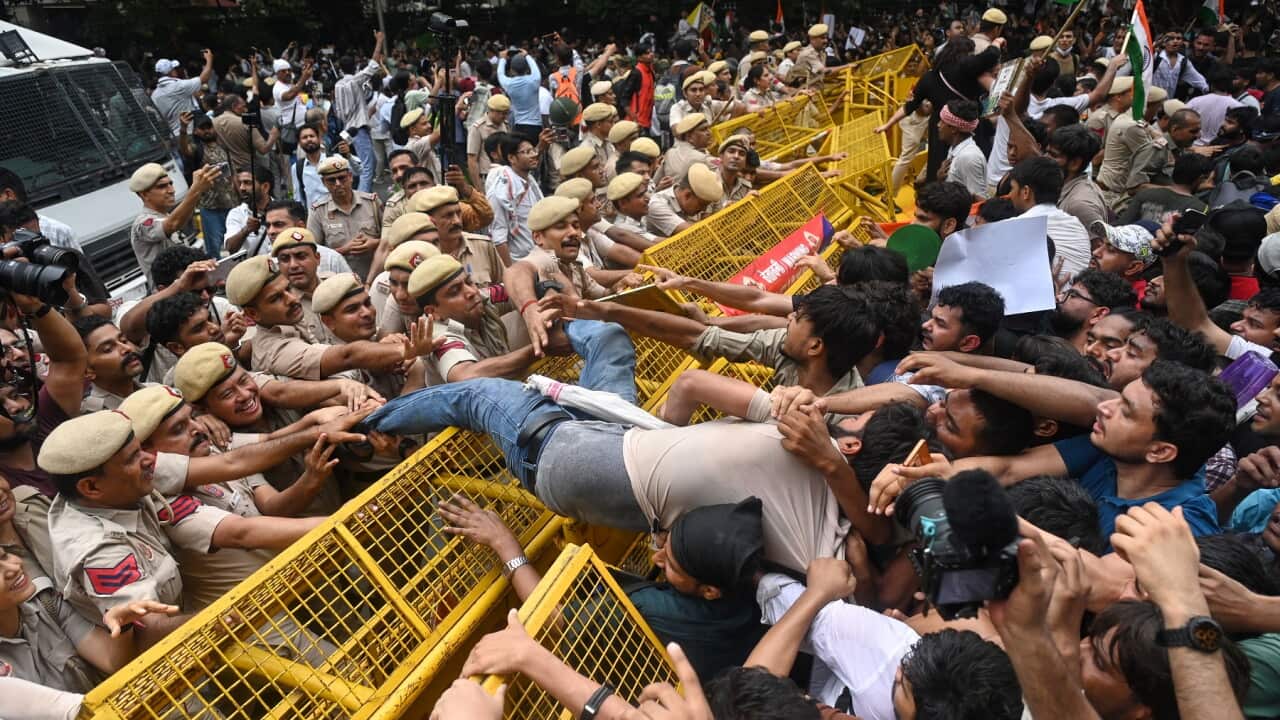

In one of the largest displays of public dissent against the Modi government, tens of thousands of protesters have descended on India's parliament to demand the education minister resign. Led by the rapidly growing youth-led "Cockroach" movement, demonstrators are calling for changes to what they say is a corrupt and broken education and employment system.
Listen to Australian and world news and follow trending topics with SBS News Podcasts.
TRANSCRIPT
Deploying tear gas and cane charges, police in India have cracked down on youth-led protesters demanding an end to corruption in education.
Founded just a few months ago, the youth-movement has quickly become one of the largest displays of public dissent against the Indian government in years.
Back in May, when 30-year-old Abhijeet Dipke responded to India's chief justice minister calling the country's unemployed youth "cockroaches", he thought he was making a passing joke.
Months later, the Indian national, who recently graduated from university in the United States, is leading thousands of protesters in a march on India's parliament.
“The government was thinking that maybe if they ignore us, these are kids, they will go back home. But I think we have proved that we are here for the long battle and we are not going to go back home and we're going to keep fighting on the battle.”
According to a recent study, almost 40 per cent of India’s graduates below the age of 25 are unemployed.
In May, when the chief justice minister referred to India's unemployed youth as 'cockroaches' and 'parasites', Abhijeet Dipke put out a call online.
He told Indian newspaper The Hindu that it all started with a joke.
“So, hurt by that, I made a tweet on Twitter. 'What if all cockroaches come together?' Now this was just one line written in anger because we wanted to express our opinion. So I got a pretty good response from the Gen Z on that like I got five to 600 replies on that from the younger generation who who were saying yes we should all come together and express our dissent.”
Overwhelmed by responses, Dipke created a page for a satirical political party called the Cockroach Janta Party, soon gaining over 22 million social media followers.
Gaining rapid support, the movement stems from widespread dissatisfaction with the state of education in the country.
In early June, a series of exam leaks that forced millions to retake a gruelling medical entrance exam sparked the movement's first offline protests.
Linked to several suicides and seen as a sign of entrenched corruption in the education system, thousands poured onto the streets of Delhi to demand the resignation of education minister Dharmendra Pradhan.
“The education minister must resign. The education minister must resign, five students have committed suicide.”
With more spent annually on private tuition in India than the entire education budget, the C-J-P has given a voice to broader concerns about corruption in education and employment.
After a second major protest in June, the movement was joined by prominent educator and activist Sonam Wangchuk, who vowed to take a hunger strike until the education minister resigned.
Sonam Wangchuk has now been on hunger strike for over three weeks.
“It's to demand accountability, which is important in any government. If not fasting, what? Riots in the streets? That's what we don't want to do. So, this is a peaceful way to take your voice to the government. And we hope that government is sensible enough to reward peaceful ways rather than wait for not-so-peaceful ways.”
The most recent wave of protests was sparked when police forcibly removed Wangchuk from his protest site and took him to hospital.
Continuing the strike from his hospital bed, Wangchuk urged supporters of the movement to continue their protests.
A member of the All India Students' Federation, this student was among tens of thousands who marched on India's parliament on the opening of their monsoon session.
“We condemn the continuous actions of the union government, BJP government, continuous actions against the students on the peaceful protest which was held in Jantar Mantar in Delhi. In that, Sonam Wangchuk who underwent to the protest, peaceful protest…he was forcefully removed from the protest place and was admitted to the hospital.”
Defying police bans, over 20,000 people had gathered for the demonstrations by early afternoon.
But, speaking publicly ahead of the parliament session on Monday, Indian Prime Minister Narendra Modi did not mention the protesters.
However, Health Minister J.P Nadda has reportedly asked for time to discuss the movement's demands within the government.
26-year-old protester Sneha Eppili says it's time for the government to take accountability.
“I voted for this government, so I think it’s accountable to answer our questions. That's the basic human right that I deserve, and I think I’m liable for whatever is happening because I voted this government and hence, I’m here to ask for answers.”
CJP demands include the release of Wangchuk, the resignation of the education minister, and compensation of 10 million rupees for each student who died by suicide following the exam leak.
According to media reports, around 12 people have taken their own lives as a result of the leak.
Shubham, who joined the movement recently, says he hopes for a better future for his nephew.
“I have a nephew, he is seven years old. He had a birthday last day only and I am concerned about his future. I hadn’t joined CJP protest at all from the past few days but today I had to. I had to come for his future I believe.”
The CJP also reports that internet and phone services were cut in parts of New Delhi during the protest, as police attempted to disperse demonstrators.
Footage from the protest shows police deploying tear gas and cane charges, with dozens of protesters and police reportedly injured.
Mohammad Khushnoor Alam says police are attacking people for speaking out.
HINDI THEN ENGLISH VO: “I am feeling a burning sensation on my hand, my eyes are swelling. Democracy is dead. The country is moving towards dictatorship. One minister is refusing to resign. When students fail in exams, they are failed.”
Rejecting the footage, authorities have denied the use of force against protesters and say the demonstration is being 'handled professionally'.
Delhi Police Public Relations Officer Rajeev Ranjan says police are calling on demonstrators to comply with the ban.
“Delhi police appeals to all protesters to maintain peace, exercise restraint, and cooperate with the police in ensuring peace and public order. All participants are requested to conduct themselves in a peaceful manner, refrain from indulging in any unlawful or violent activities, and comply with the lawful directions issued by police officers or personnel deployed on duty. The public is advised not to believe or circulate rumours, misinformation, or unverified content through any platform.”
Protests have also been held in Bangalore, Goa and Mumbai, where witnesses say police detained demonstrators and took them away in vans.
Abhijeet Dipke, who ended his hunger strike at the request of Sonam Wangchuk, says the protest will go on.
HINDI THEN ENGLISH VO: “Today what the Delhi police has done, the way they have beaten students, the way they have hit on the students’ heads, it is very shameful. Due to this, the country’s reputation is being damaged worldwide and we all know why Delhi police did all this because they received orders from Narendra Modi and Amit Shah. Delhi Police have hit on the head of a 15-year old girl; their male officers have kicked her in the chest. A male police officer has hit on the head of the 15-year old. Due to this, with extreme sadness, I inform you all that Sonam Sir (Indian activist Sonam Wangchuk) has announced that he will continue his hunger strike.”