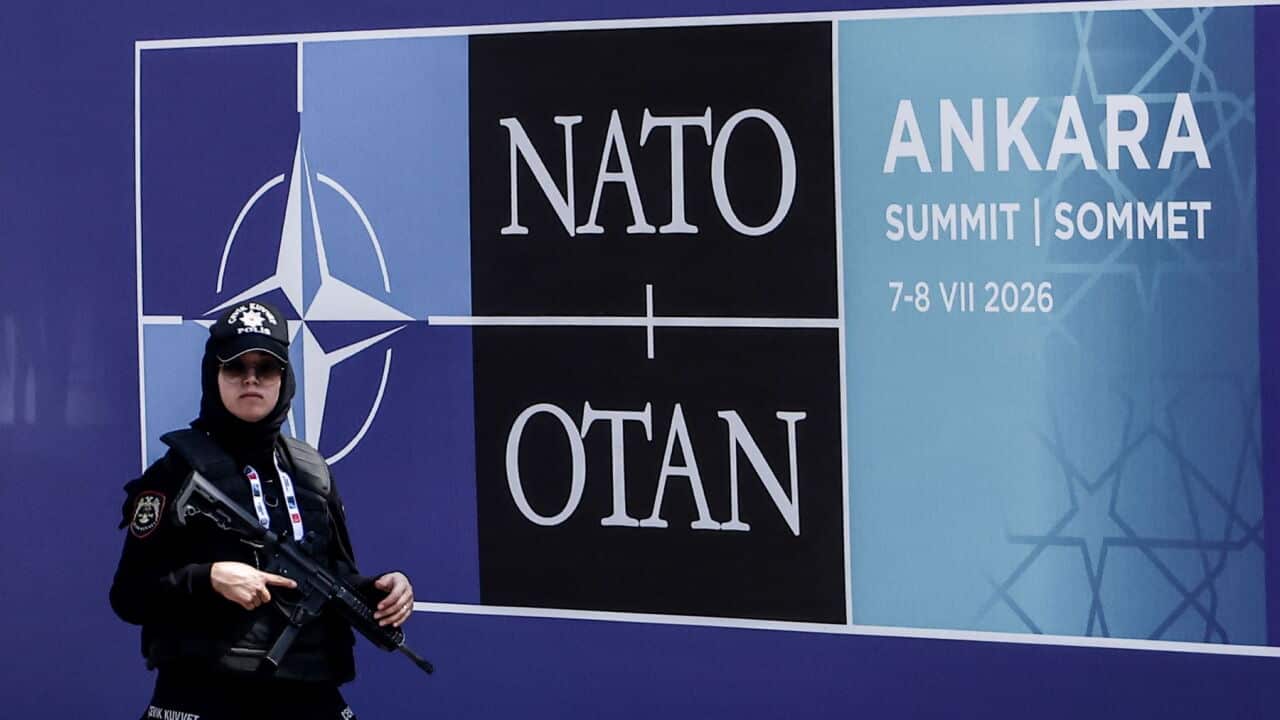

NATO leaders are meeting in Turkiye for a summit overshadowed by US President Donald Trump's demands to do less, while Europe does more. Following major Russian attacks on Ukraine and missile tests from China, European allies are under pressure to heed US demands and bolster their defences.
Listen to Australian and world news and follow trending topics with SBS News Podcasts.
TRANSCRIPT
NATO leaders have gathered in the Turkish capital of Ankara for the 2026 summit of the bloc.
And they've wasted little time in making some important announcements, unveiling a series of arms deals worth tens of billions of dollars, among them an agreement for Swedish manufacturer Saab to supply up to 10 new GlobalEye surveillance aircraft for a 10-nation consortium. a
NATO secretary-general Mark Rutte says NATO countries will also develop sophisticated capabilities rapidly.
“We are building robust counter-drone defences to detect, identify and neutralise drones. That's how it protects our 1 billion people against a full range of drone threats. And today, we are launching the NATO Drone Edge initiative. Through this initiative, allies are investing over $40 billion to enhance drone capabilities over the next five years.”
Mark Rutte says the projects are money well spent.
“We cannot continue as we did being over-reliant on the United States. We need this much stronger Europe in a stronger NATO, and we can only get there when we work together seamlessly as one, using and leveraging each other's strengths. And that's what we are doing.”
The 2026 NATO summit comes after a difficult year for the alliance, with cracks exposed by the Iran war and US President Donald Trump's disappointment in fellow members.
The Secretary-General says the alliance, which has underpinned Western security since the end of World War Two, is now confronted with a necessary change where Europe must take greater responsibility for its own defense, and no longer rely so heavily on the United States for its security.
He says the current world climate demands it.
“We cannot be naive about China, you know this. And this is why we have this close cooperation, because the theatres are getting more and more intertwined and connected. What happens in the Pacific is relevant to what is happening in the Transatlantic. And we see it also in the war with Ukraine, where China, North Korea and Iran are key enablers of Russia's unprovoked war of aggression against Ukraine.”
Ukrainian leader Volodymyr Zelenskyy is still keen to rely on the US however, as much as possible.
Ukraine has expanded the domestic production of arms since Trump came into office, yet the war-torn country still relies on US support for air defence systems.
He will meet with Trump on the sidelines of the meeting today, where he is expected to push for further support.
“While this war continues, please help us get more air defence missiles. This is our top priority right now. We are capable of doing everything else ourselves. But when it comes to air defence, we need our partners determination. Please let more determination and more decisions for air defence be one of the key outcomes of this NATO summit in Ankara.”
But while the European NATO members have mostly embraced the idea of reducing their reliance on the US, President Donald Trump still made his presence felt after his arrival in Ankara.
Speaking to POLITICO, Mark Rutte has argued that Trump was right to demand more spending from NATO, and to push them to modernise.
Trump himself says he spoke to Russian President Vladimir Putin and Ukrainian President Volodymyr Zelenskyy before the summit about ending the war that started in February 2022 when Russia invaded its neighbour.
And he has once again pushed the idea of the US taking control of Greenland, an idea that last year drew strong criticism from NATO allies, and deepened tensions in the alliance.
“Greenland doesn't help Denmark. Denmark doesn't spend money to really help Greenland. But it's an important part for the United States. And it's surrounded by China ships and Russian ships. And that's not going to happen - the ships, it's not going to happen - it was Greenland that in my, and it continues to be. That should be controlled by the United States, not by Denmark. And when they wouldn't go along with it, and with all the money we spend to help them with Russia, we don't have to spend any money. We could remove all of our soldiers out of Europe.”
Another source of tension between the US and other NATO members has been the war in Iran, which Donald Trump has repeatedly criticised allies for not doing enough to support.
While reiterating that he did not need or even want their help, the US President says he was still let down.
“We help them, but I'm not sure that they'd be there for us. And Italy turned us down, and Germany turned us down, and France turned us down - and that's OK. But, you know, why are we spending hundreds of billions of dollars, and they're not there for us? We've always been there for them.”
Trump had warmer words for Turkiye, announcing that the United States would lift sanctions on that country which were imposed in 2020 after Ankara purchased Russian air defence missiles.
In another major gesture, the US leader has also expressed a willingness to sell F-35 fighter jets to Ankara.
“It's a decision we're going to make. We have a very good relationship. I would think that many people, I can tell you, many people including the people sitting right here thinks, you know, why wouldn't we do that? We have better relationship with Turkey, and Turkey's been in many ways much more loyal than other countries that we think would be loyal. So, yeah, something certainly we would consider. It's a great plan. It's the best, currently the best plane by far. And it's certainly something we will consider.”
This announcement has been opposed by Israel, which has experienced longstanding tensions with Turkiye over matters including Gaza and post-Assad Syria.
Just days before the NATO summit, Turkish Foreign Minister Hakan Fidan made calls for international sanctions on Israel and described the country as an "unbearable burden".
Israeli Prime Minister Benjamin Netanyahu has told Fox News the decision to sell F-35 jets to Turkiye would disrupt Israeli military superiority.
“I don't think they should be given F-35 or the engines for their for their fighter jets, because that'll upset the power balance in the Middle East, which is ultimately guaranteed by Israeli air superiority.”