
The war in Ukraine is intersecting with rising instability in the Middle East and pressure on global energy supplies. President Volodymyr Zelenskyy is in London, warning modern warfare is rapidly evolving and pushing for deeper defence cooperation. At the same time, the EU is moving to resolve an oil dispute threatening support for Kyiv.
Listen to Australian and world news and follow trending topics with SBS News Podcasts.
TRANSCRIPT
Ukrainian President Volodymyr Zelenskyy, on a visit to the United Kingdom, tells the British Parliament that the war in Ukraine is reshaping the nature of modern conflict, and that the widespread use of low-cost drones is transforming battlefields.
He says Ukrainian experts are already assisting partners in the Middle East, where similar threats are emerging.
“Right now, there are 201 Ukrainians in the Middle East and Gulf region, and another 34 are ready to deploy. These are military experts, experts who know how to help, how to defend against Shahed drones. Our teams are already in the Emirates, Qatar, Saudi Arabia and on the way to Kuwait.”
He warns that Russia’s invasion has accelerated the global spread of drone warfare, making it cheaper, more accessible and more dangerous.
"Without his war against Ukraine, the world might have avoided mass drone warfare, cheap and deadly for many, many years. And if together with partners in the Middle East, we build a system like Ukraine, they will be able to track attacks from Iran or from the Houthis in real time, analyse them, keep improving their defence, giving people critical infrastructure and trade routes, real security.”
Mr Zelenskyy also pushed back against Russian claims about battlefield progress, insisting Ukraine continues to hold key territory and make gains.
“Russia may try to mislead satellites or adjust reports in the highest offices around the world. But if this iPad shows that Kupiansk - this is our big city in Kharkiv region - Kupiansk is under our control, then it is true. If it shows that in the past 30 days we have regained more territory than Russia has taken, then it is true.”
His message was clear, that Ukraine’s war is no longer just a regional conflict, but a testing ground for technologies and tactics now spreading globally.
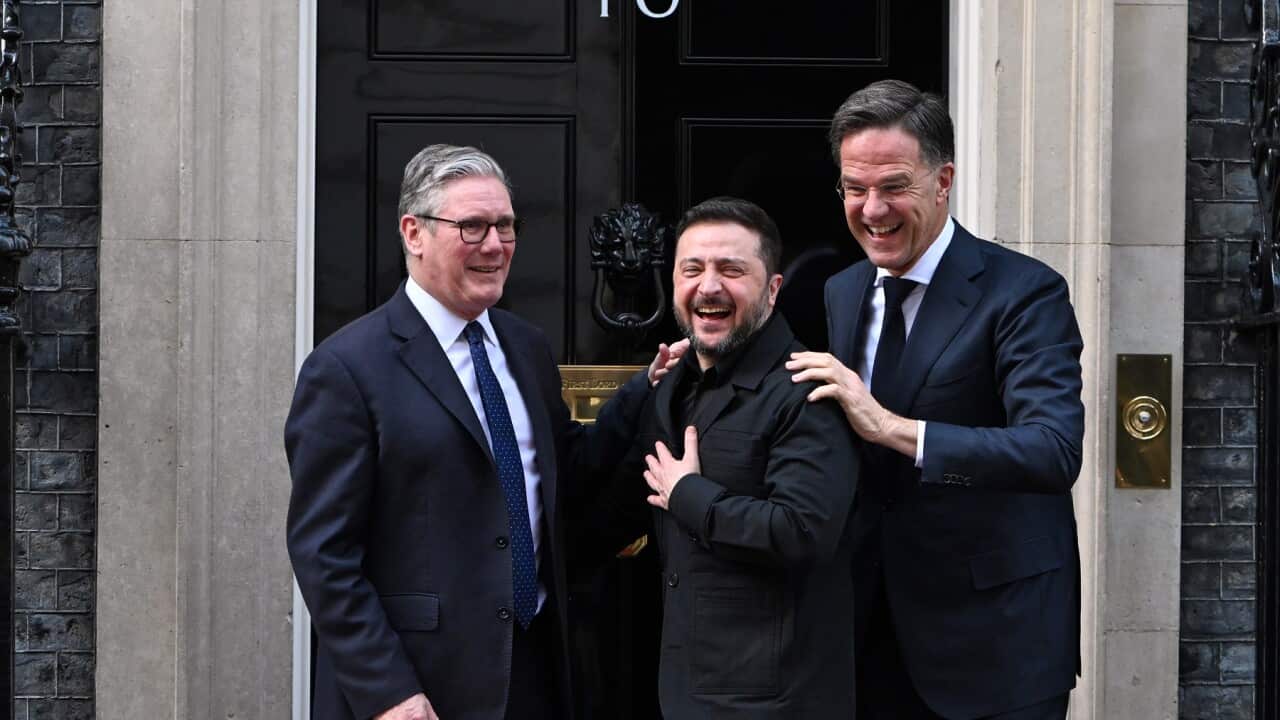
That warning set the tone for high-level talks just hours later at Downing Street, where British Prime Minister Keir Starmer has reaffirmed the United Kingdom’s long-term commitment to Ukraine, describing support as unwavering.
“Volodymyr, let me welcome you back to Downing Street. It's really good to have you through today. And let me start where I must start by paying tribute to the courage and resilience of the Ukrainian people over four years of this conflict. They've shown incredible courage both on the frontline and the civilians day in day out and I hope you can convey to them again that the UK stands with them for as long as it may take. Our resolve is unbreakable and will remain that way.”
But Mr Starmer also delivered a strategic warning, that the escalating conflict in the Middle East must not distract from Ukraine.
“I think it's really important that we're clear that the focus must remain on Ukraine. There is obviously a conflict in Iran going on in the Middle East but we can't lose focus on what's going on in Ukraine and the need for our support there. And secondly, it's really important that we're clear and consistent that Putin can't be the one who benefits from the conflict in Iran, whether that's oil prices or the dropping of sanctions.”
The two leaders have agreed to expand defence cooperation, particularly in drone production.
But the war is also exposing divisions in Europe’s energy system.
A key oil pipeline supplying Hungary and Slovakia has been offline since January, triggering a political standoff and blocking billions in E-U support for Ukraine.
European Commission Chief Spokeswoman Paula Pinho says Brussels is now stepping in to help restore the flow.
“In view of seeing what could be done to repair the Druzhba pipeline and to basically be able to resume the supplies of oil through the pipeline and we are now pleased to say that indeed also the Ukrainian authorities are welcoming the technical support that we offered, that we put on the table, technical and financial support.”
She says work is already underway, with European experts ready to assist on the ground.
“And in this sense, an expert is available to go to Ukraine, and things are happening as we speak, indeed, to make sure that we can, all the necessary work is done in terms of reparation, in terms of restoration of the pipeline so that oil supplies are eventually resumed.”
The EU hopes restoring oil flows will ease tensions and unlock delayed funding Ukraine says it urgently needs.
This comes as US actor Sean Penn returns to Ukraine, where he was presented with an award made from a railcar damaged in a Russian strike.
Ukrainian Railways chief Oleksandr Pertsovskyi says it reflects the country’s resilience.
“Ok, so you're missing Oscars, so we made, and plus, you gave some ones to the President (Volodymyr Zelenskyy), so we made this one. This is from the railcar that was damaged by the Russians. You said the metals survived, so we put some words here, very special to us. It's not golden but it's very real from the bottom of our hearts.”
Mr Penn was visibly moved by the gesture.
“Thanks, these are all treasures, thank you.”
Mr Penn has produced a documentary on the war and has continuously voiced public support for President Zelenskyy.
From the evolution of drone warfare to disputes over energy supply, and moments of cultural solidarity, the war in Ukraine is continuing to shape global security, politics and public consciousness.