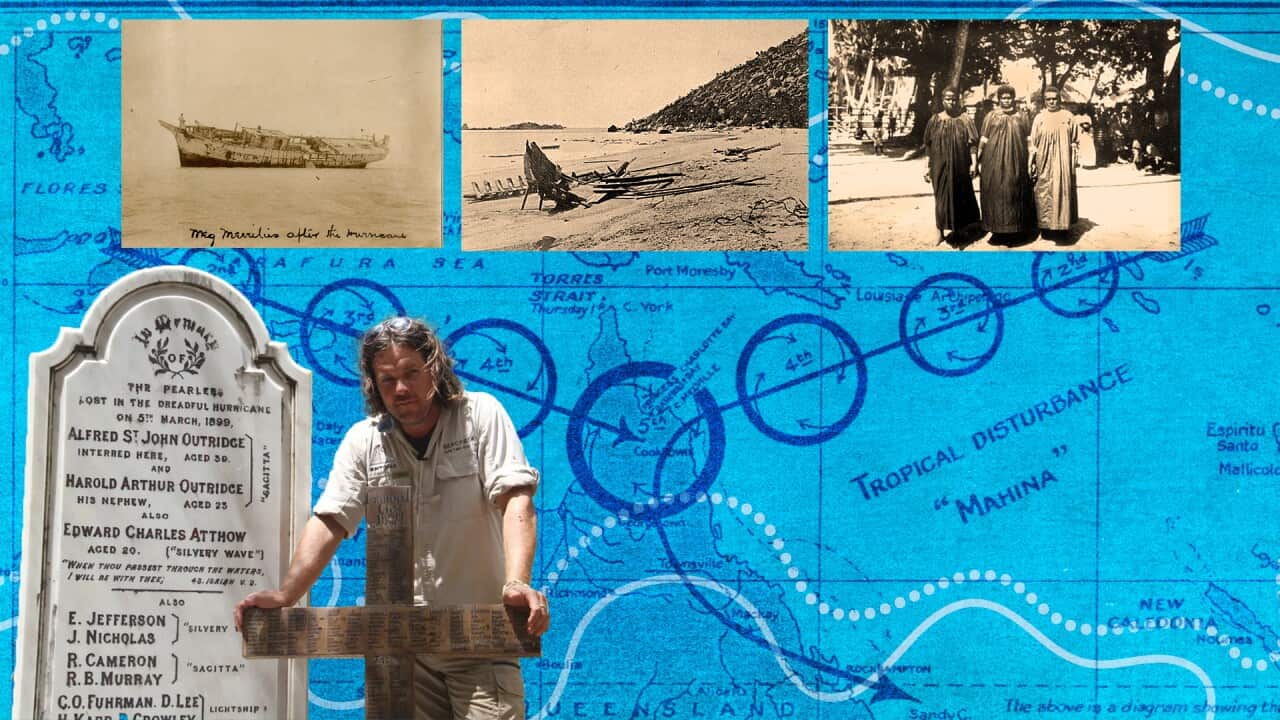
127 years ago, the most devastating tropical cyclone in Australia’s recorded history struck the eastern coast of Far North Queensland with catastrophic force.
On the evening on 4 March 1899 and into the early hours of the next day, Cyclone Mahina, a Category 5 storm tore across the remote and rugged coastline of Bathurst Bay near Cape Melville on the Cape York Peninsula.
That night, more than 100 vessels consisting of luggers, schooners, ketches, and cutters from the Thursday Island pearling fleet were anchored in the usually calm waters of Princess Charlotte and Bathurst Bays.
On board were around 1,000 men, women and children - divers, crew and families - drawn from across the globe.
They came from the Torres Strait, Japan, Jamaica, Malaysia, Indonesia, the Philippines, China, the South Sea Islands and Singapore.
The pearling industry of the north was built on this multicultural workforce, many of them First Nations and Asian seafarers whose labour powered a booming trade.

When Cyclone Mahina struck, it did so with sustained winds estimated at around 260 kilometres per hour and a storm surge exceeding 10 metres.
The sea rose violently, lifting vessels and hurling them kilometres inland.
Entire fleets were obliterated in the darkness.
By morning, more than 300 people were dead and at least 54 pearl luggers, four schooners and countless smaller boats were destroyed.
It remains the worst maritime disaster in Australia’s history and the most devastating cyclone ever recorded to make landfall in this country.
Yet the tragedy was not only measured in lives lost at sea, but also in how those lives were remembered.
In June 1899, a memorial to the disaster was erected at Cape Melville. It lists just the names of nine Europeans who perished.
Beneath them, a single line noted simply that "300 coloured men also drowned".
Why has this disaster not been positioned as a national tragedy and overlooked in discourses on Australian disasters?
According to author and broadcaster Ian Townsend - who wrote The Devil’s Eye, a 2008 historical novel based on Cyclone Mahina - the pearling disaster occurred during heightened political discourses across the Australian colonies about race and labour.
As Federation approached and the ideology that would become the White Australia Policy gathered momentum, the loss of so many foreign workers received little sustained national attention.
“The media shaped the way in which the pearling disaster was framed and reported, and in which the federation of Australia’s colonies and a White Australia Policy was also being debated,” he wrote in his 2019 thesis, The Bathurst Bay Hurricane: Media, Memory and Disaster.
“The social, political, and cultural narratives at the time of the pearling disaster were framed by the White Australia debates, which included a fear of ‘aliens’.
"They were described at the time as 'alien', which framed the disaster as a mostly foreign event and played a key role in forgetting.”
In his assessment, the disaster exposed not only the vulnerability of those labouring on the colonial frontier, but also the racial hierarchies embedded in Australia’s emerging national identity – the White Australia Policy.
Bravery in the face of death
In the Cyclone’s aftermath, one young Torres Strait Islander girl showed extreme valour and bravery in the face of death.
Mohara (Moira) Newi from Erub Island was 15 or 16 years old and onboard the cutter Rattler with her older sisters Louisa and Mary and their relative Geba (or Gebbie) from Masig Island.
(Mohara later married William Wackado (Wacando). William was also known as William Lifu).
As the Cyclone intensified, the Rattler was pushed five kilometres out from where it had anchored. The apocalyptic winds pushed the Rattler under the waves, and it sank with 11 people aboard.
Four crewmen drowned in the ensuring chaos and the surviving members were forced to swim for shore – some 19 kilometres away.
Mohara helped and supported her sister Louisa and cousin Geba who couldn’t swim for the 10-hour swim to shore - arriving exhausted on land on the Sunday night.
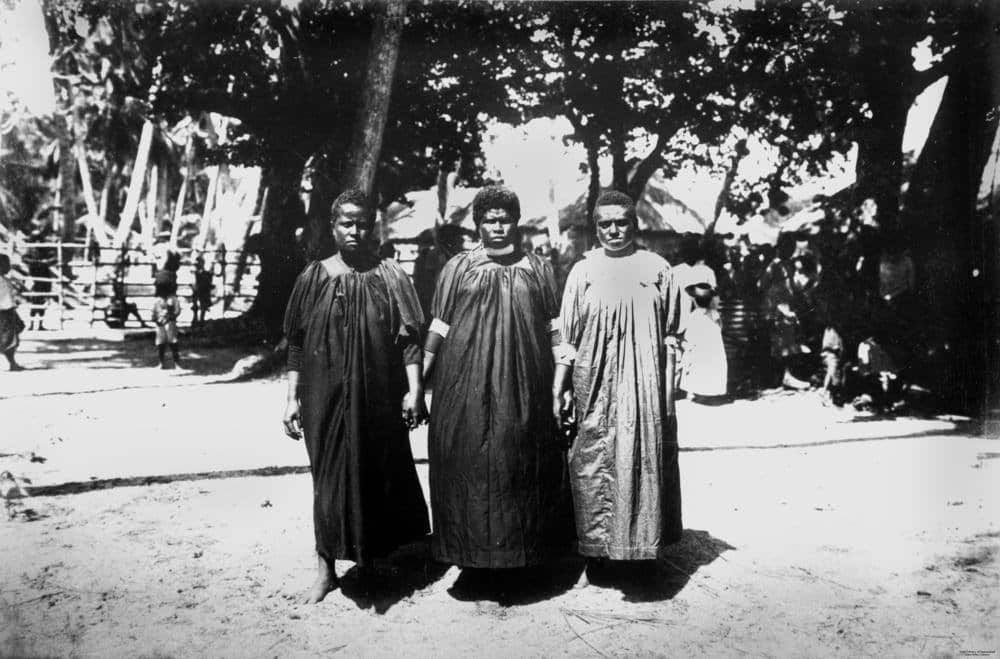
Her story of heroism on that day caught the attention of the Protector of the Torres Strait on Thursday Island, the Hon. John Douglas, who wrote to the Queensland government seeking official recognition for her bravery.
“Sir... I have the honour to bring under your notice the meritorious and heroic conduct of a girl at Darnley Island named Mohara who displayed great presence of mind and cheerful alacrity in saving life on the eventful night of March 4-5 last.
Mohara, a girl of 18 and unmarried, being in the company of two other women, her married relatives, and happening to be in a boat that foundered at sea at Noble Island on the south of Cape Melville, they all had to swim for their lives in a raging sea. Being expert swimmers they were at last to reach the shore, after battling with the storm for many hours. Two of them - the married women - would certainly have failed to do so, had it not been for the sustained assistance offered them by Mohara.”
The Queensland government agreed, and a specially struck medal was presented to Mohara at the Erub Island Court House, Friday, November 17, 1899.
Mohara died on December 2, 1929, and is buried on Thursday Island.
Recognising the ‘Coloured crew’
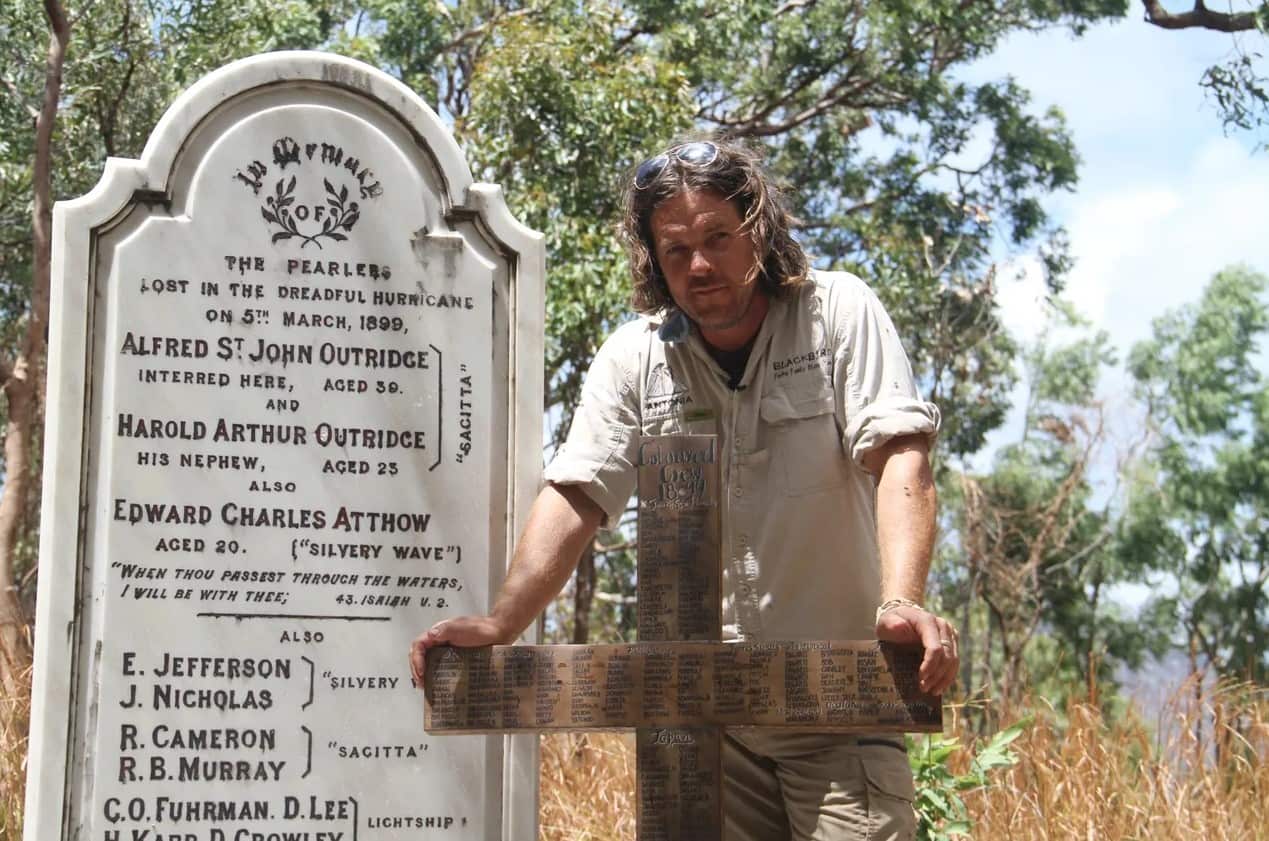
There are two memorials to the disaster - one at Bathurst Bay and the other at All Souls and St Bartholomew’s Church Quetta Precinct on Thursday Island.
Yet since 1899, the so-called “coloured crew”, some 300-odd souls, remained largely anonymous, denied name, story and identity in the official record.
Their lives were reduced to a racial descriptor common to the era, reflecting the hierarchies and prejudices embedded in colonial Queensland’s pearling industry.
On Thursday Island, it was only in March 2023 that a memorial to all who died was erected at All Souls and St Bartholomew’s Church - prior to that the church memorial just listed the names of 'seven white men' who drowned, and only a line referencing the “295 coloured men” who also died.
At Bathurst bay, it was not until 2015, after extensive historical research and community advocacy, that many of their names were brought back into public view.
Supporters installed a temporary cross listing those lost, a symbolic act of remembrance aimed at ensuring their deaths were formally recognised and acknowledged as part of the nation’s history — not as a footnote, but as human lives cut short in one of Australia’s worst natural disasters.
Editors note: this article was amended on 6/3/2025 to include details about a memorial being erected to all victims of the disaster at the All Souls and St Bartholomew’s Church on Thursday Island in 2023.