Controversial proposals by the New South Wales government to the management of Crown lands have been put on hold, following intense opposition by the state's Aboriginal land councils.
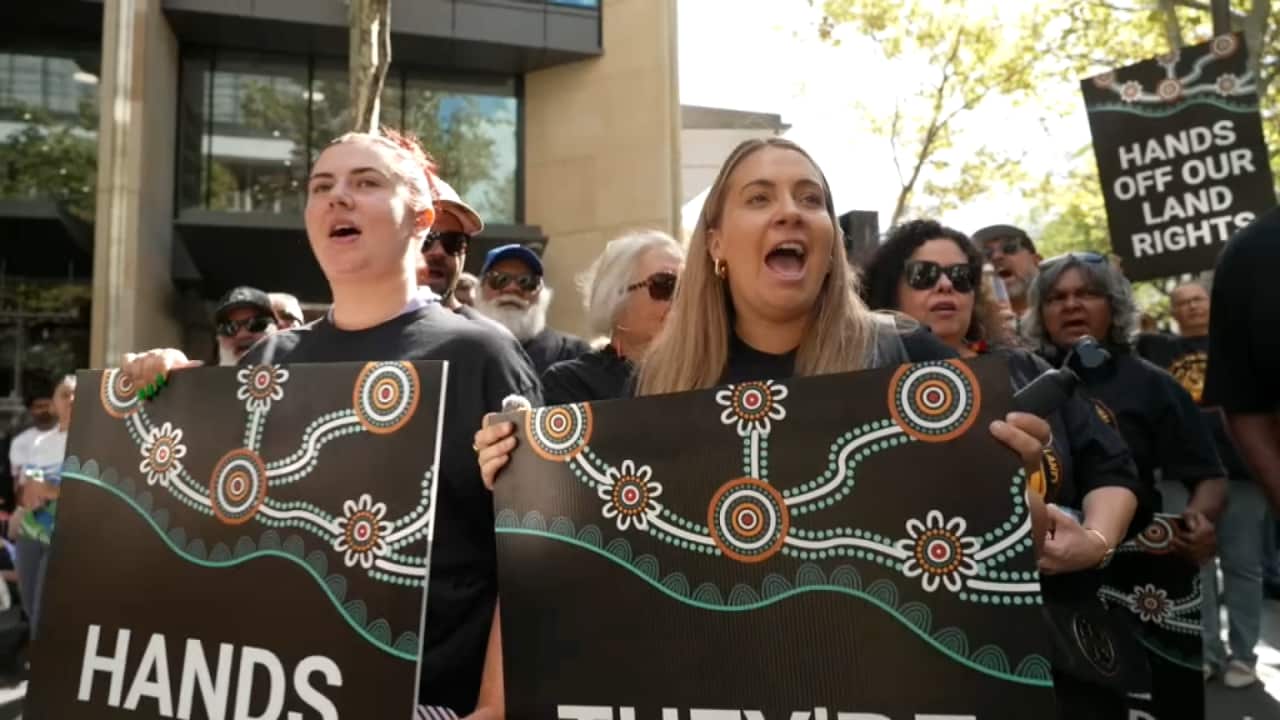
A coalition marched on the New South Wales parliament on Tuesday in protest against proposed amendments to the management of Crown lands.
Opponents of the measures decried them as an "attack by stealth" on the Aboriginal Land Rights act.
Due to be debated in the lower house, the amendments could have had significant impact on some of the tens of thousands of land claims that are currently unresolved.
"What it could mean is that substantial [amounts] of Crown Land could be removed from the Crown Land register, which could have major effects of some of the local land councils," Dr Raymond Kelly told NITV, before news of the backflip.
The Dhangatti Gumbayngirr man is the Chair of the NSW Aboriginal Land Council, and addressed the assembled protesters on Tuesday.
"We've got a minister leading through a reform that we don't believe has been appropriately consulted or communicated, not just for us in the land rights movement, but to all people of NSW."
The Act as it currently stands allows land councils to claim land if it is unused or has been improperly leased.
One of the amendments, put forward in a statutory review introduced to parliament last week, allows for any lease, even those for unused land, to be deemed legal.
The NSW Law Society president Ronan MacSweeney said the provision would have "fundamentally" altered decades-old conceptions of the Aboriginal Land Rights act.
"It is important to note that the ALRA is intended to be remedial and beneficial legislation designed to compensate Aboriginal people for historic dispossession," he said in a statement.
"This legislation fundamentally alters what has been long understood to be land claimable under the ALRA."
MacSweeney also criticised the lack of consultation with the land councils, clear stakeholders in the proposed changes.
On Tuesday morning, the minister for lands and property, Steve King, said the current Land Claims system was "broken".
"The idea was that if there is Crown Land sitting unused, it should be claimable and provided to the Local Aboriginal Land Council. We stand by this principle," he said in a statement.
"The proposed changes we have put forward are there to address edge cases that became claimable due to technical non-compliance, such as an invalid sub-lease.
"These sites are well utilised by the local community. They were never intended to be claimable in the spirit of the Act."
The minister cited three examples (the Talus Street Reserve tennis courts, the Cronulla Marina, and the Matraville Fire Station) as examples of actively-used sites that had fallen foul of technical non-compliance, and which were therefore claimable under the current legislation.
Despite these arguments, it's understood the proposals are now on hold until consultations can take place with land councils next month.
The proposals were also criticised as disregarding a High Court ruling from last year.
That decision, involving the disused Paddington Bowls Club, had validated a long-standing interpretation of the state's Aboriginal Land Rights Act 1983: that a lease alone, without actual physical use of the land, does not constitute lawful use.
Clare McHugh, NSWALC CEO, said the proposed amendments would have been of concern to all residents of NSW, not just the Aboriginal land councils.
"It really is the NSW government seeking to overturn decisions by the High Court, which didn't fall in their favour," the Dunghutti Gamilaroi woman told NITV.
"There are bigger and broader implications that everyone should be concerned about. It might start with Aboriginal people in NSW, but where does it end?
"We're the canary in the coalmine."