Archaeological research in South Australia’s River Murray and Mallee region has confirmed Aboriginal quarrying and tool-making activity at a major chert source dating back at least 7,000 years, highlighting long-term, sophisticated resource use and trade networks connected to the river corridor.
The findings come from excavations at a stone quarry in the Riverland area, where researchers identified repeated flaking of chert—a fine-grained stone valued for its ability to be shaped into sharp tools—across deep archaeological layers.
“This timeline demonstrates both the deep time and long-term connections that our ancestors have maintained with all aspects of our riverscape,” said Sheryl Giles, a spokesperson for the River Murray and Mallee Aboriginal Corporation.
Professor Amy Roberts from Flinders University, who participated in the excavation, said the work focused on establishing a clear chronology for how long the quarry had been used.
“Often we know about these stone sources, but we don't know how long, or approximately how long people may have used them, going back into deep time.”
The excavation involved carefully digging a trench near the chert source to identify evidence of tool production, including flaked stone created when hammerstones were used to shape raw material.
“The lowest that we got in our trench showed that that had been going on for at least 7,000 years,” Prof Roberts said.
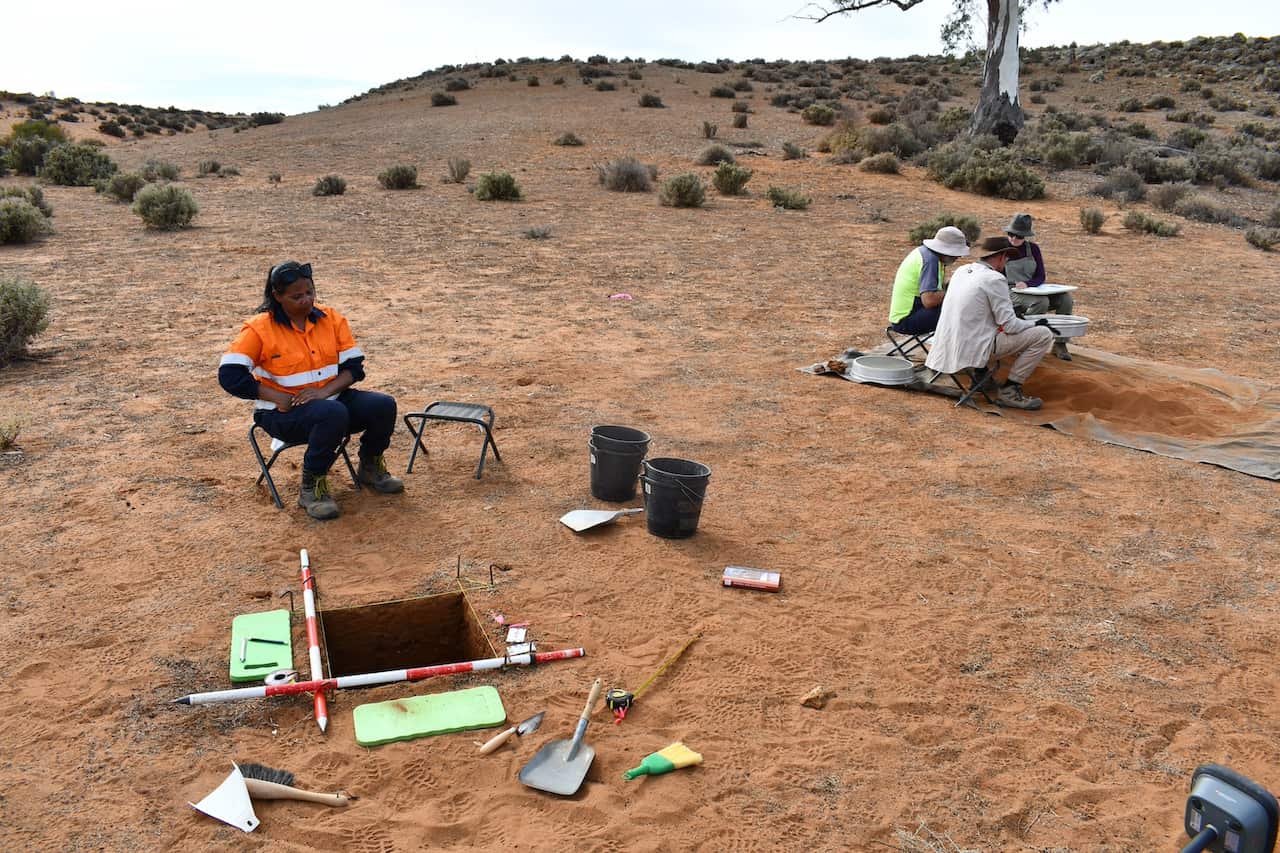
Because stone tools themselves cannot be directly radiocarbon dated, the team relied on associated materials such as freshwater mussel shell and charcoal found within the same layers of excavation.
The study also highlighted how the River Murray functioned as a major trade and exchange route, with chert distributed across wide areas where suitable raw material was not locally available.
“There’s a couple of main quarries that we know about,” Prof Roberts said, noting that material was likely traded along river networks.
“Those trading relationships were really organised and precise … like highways in a sense.”
Researchers say the quarry sites also demonstrate careful selection of high-quality stone, with Aboriginal people targeting the finest material for tool-making.
“Absolutely,” Prof Roberts said.
“Going for something that … is going to be the sharpest and best for tool making.”
The research forms part of a long-running collaboration between Flinders University and the River Murray and Mallee Aboriginal Corporation, spanning several decades of archaeological investigation, oral history, and community-led interpretation.
Professor Roberts said the long-term partnership has been central to understanding the cultural significance of the region’s stone landscapes.
“It’s really interesting to look at places that we know about that are important kind of nodes in the landscape, and to understand how long they've been used over time,” she said.
Broader regional evidence points to complex patterns of Aboriginal occupation along the river corridor, including sites dating back tens of thousands of years in upstream areas, and environmental shifts during the last glacial maximum shaping movement and settlement patterns.
Researchers say the findings add to growing recognition of the River Murray and Mallee as a culturally significant landscape shaped by long-term knowledge systems, trade, and continuous connection to Country.