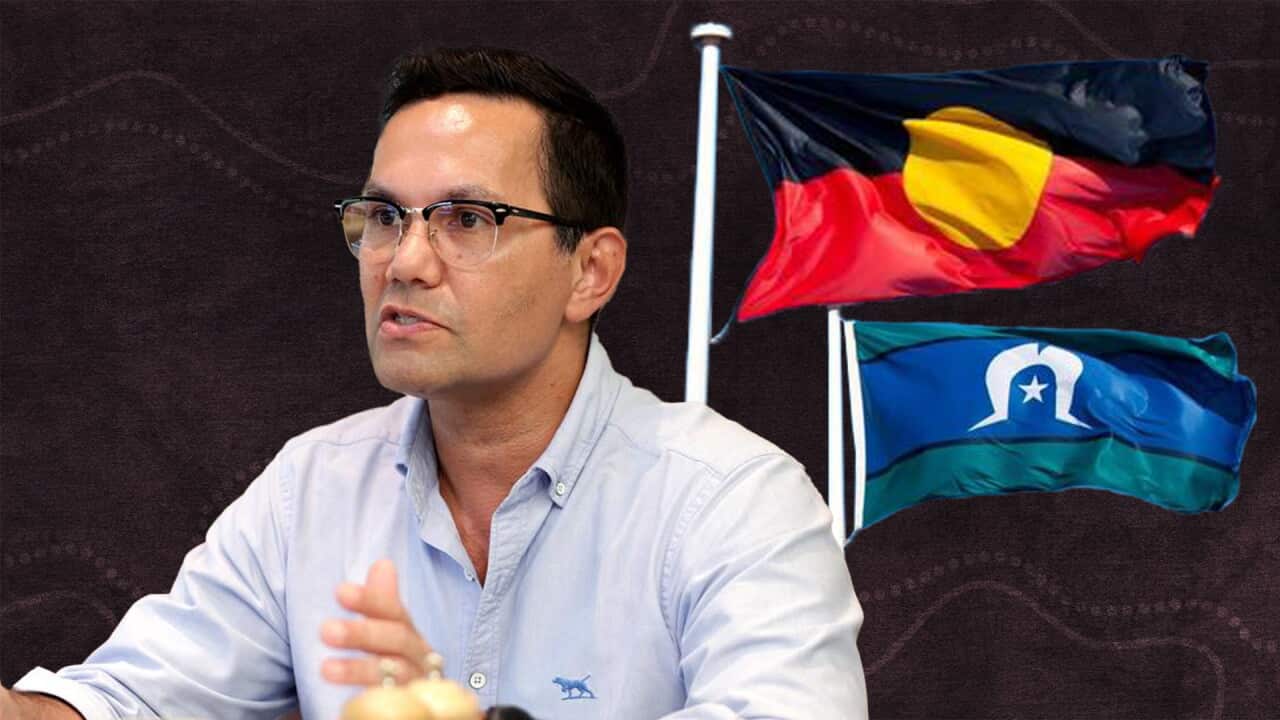
For Gungarri man Selwyn Button, the role of the Productivity Commission's Annual Data Compilation Report (ADCR) is to present "the pieces of the puzzle".
In the latest ACDR, which tracks Australia’s performance on the targets and indicators in the National Agreement on Closing the Gap, the pieces are showing a concerning picture.
Out of 19 targets: 1 has been met, 3 are on track, 5 are improving but are not on track to be met and 4 are worsening.
With the deadline for most targets due in 2031, Commissioner Button says "we are already past the halfway point. Governments will need to redouble their efforts for the promise of the National Agreement on Closing the Gap to become a reality."
Breaking down some key findings
The ADCR incorporates the latest statistics from the Closing the Gap Dashboard, and includes new community-led and governed data.
Those data show only one target that is considered to be met: preschool enrolment (Target 3 - more than 95 per cent of First Nations children enrolled in preschool).
While this is a celebrated milestone, it is contrasted by other disappointments.
Healthy birthweight (Target 2) has deteriorated from ‘improving but not on track’ to ‘no change from the baseline’.
Two out of the four targets that are worsening relate to First Nations children: children are developmentally on track (Target 4) and children in out-of-home care (Target 12).
Responding to the report, the National Indigenous Children's Commissioner said the findings painted "another sombre picture" for Aboriginal and Torres Strait Islander children and young people.
"This data is upsetting, but it is not surprising. Our families already know what it shows, because they live it every day," the Commissioner said.
Ms Hunter said the progress on preschool enrolment demonstrates that improvements are possible when Aboriginal community-controlled organisations are trusted to lead.
"That is not an accident. It is what happens when communities and Aboriginal community-controlled organisations are trusted and resourced to lead. These are the blueprints."
The commissioner called on governments to apply the same approach to the areas where children are "still being removed, still being detained, and still going without", warning that "every year these targets stall or regress, a generation of young people carries the cost".
The only other target that has had no changed from baseline is youth detention (Target 11).
The report found the Australian Capital Territory, Tasmania and the Northern Territory have the highest number of targets showing no change or worsening.
Both the NT and Queensland performed worst in the areas of adult imprisonment, youth detention and children in out-of-home care.
The latest data also shows there has been almost no progress on reaching the nationally agreed target of a 30 per cent reduction in the number of Indigenous children behind bars by 2031.
First Nations children nationally have been held without a sentence on average for 57 days while awaiting trial, sentencing or a bail decision, with the rate increasing from 69 per cent to 76 per cent over the past five years.
Minister for Indigenous Australians Malarndirri McCarthy reiterated her interest in implementing punitive measures against jurisdictions that failed to meet their Closing the Gap targets.
"This agreement doesn't have outcomes where you are measured on it in terms of penalties ... that is a real concern with the agreement," she said on Thursday.
"It's an area that I'm certainly pursuing in terms of our federal funding agreements.
"I've been able to see it implemented in recent months here in the Northern Territory, with the Northern Territory Remote Aboriginal Investment Agreement, ensuring that the Aboriginal organisations are at the table, not just the Commonwealth and the Northern Territory Government.
"And time will tell to see how that agreement goes."
Community-led decision-making critical for success
Closing the Gap targets follow the National Agreement on Closing the Gap, a partnership between all Australian governments (national, state and territory) and peak First Nations community-controlled organisations.
Button says that improvement on targets happens in jurisdictions where "all parties are sitting at the table."
"In this report, the jurisdictions where there are existing relationships between governments and community control services, we're seeing significant differences being made."
In a statement, the minister for Indigenous Australians Malarndirri McCarthy says that meeting Target 3 "is a significant milestone and shows that collective efforts can drive meaningful and lasting change".
"Our government remains committed to Closing the Gap; working in partnership with First Nations communities [and] building on what is working."
Gaps in data preventing assessment of priority areas
For the first time since 2018, new data is available on number and strength of Aboriginal and Torres Strait languages (Target 16).
Finding that 177 Aboriginal and Torres Strait Islander languages are spoken or used in Australia today. The results comes from a survey co-designed with First Nations people to better reflect community perspectives and understandings of language.
Due to a lack of existing data, Target 16 has been marked on the report as "progress can not be assesed".
Button says that often, "the focusing is just on the targets and the data itself doesn't actually get the improvement."
He says improved reporting is critical for identifying where community-controlled organisations and community-led solutions can be involved.
Button explains that it's, "about looking at identifying investment that can transition across to community control, and what investment government is already providing."
"When we invest in community-led decisions through community control services, we get better outcomes."
Prime minister Anthony Albanese defended the government's progress on Closing the Gap despite the latest data showing most targets remain off track, pointing to what he described as unprecedented investment in Indigenous programs.
Speaking after the release of the Productivity Commission's Annual Data Compilation Report, Mr Albanese said the government had made "record investment" in areas including health, education, remote housing and remote employment, highlighting the expansion of the Remote Jobs and Economic Development Program announced in the most recent budget.
He also pointed to "positive signs" in early childhood education, one of the few areas showing sustained improvement, while acknowledging the broader challenge of meeting the National Agreement's targets by 2031.
"The targets are due to be met, of course, by 2031. But we have intergenerational issues. That's the truth of the matter," he said.
Mr Albanese argued the government was focused on "practical" measures, citing the expansion of the remote essential goods subsidy, which caps the cost of items such as fruit, vegetables and basic household products in remote communities, as an example of policies aimed at improving everyday living conditions.