Warning: this article may distress some readers.
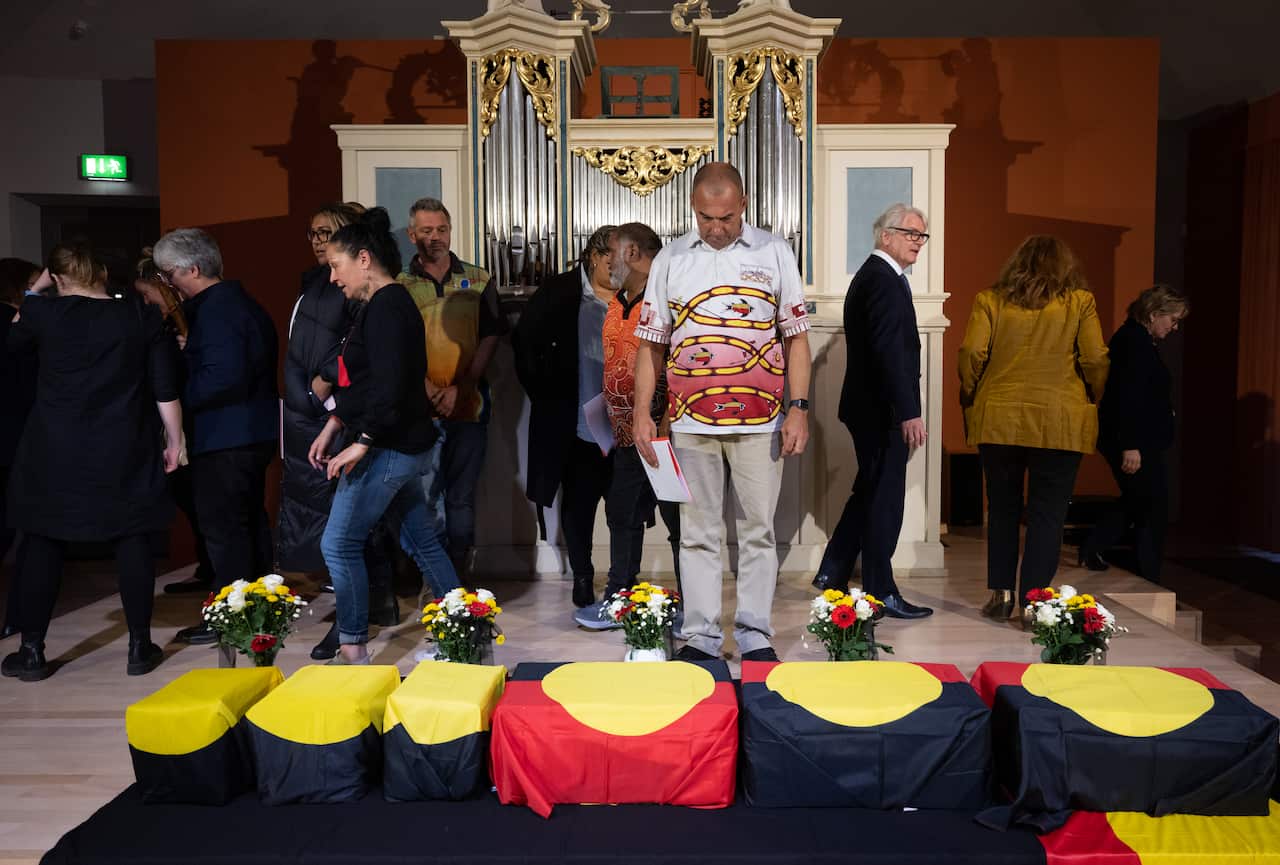
An emotional ceremony has welcomed the remains of an Terramattagal ancestor on to Dharug Country, marking the end of years of advocacy and more than a century away from home.
'Uncle', as the remains have come to be respectfully known, is believed to have been a male whose remains were removed from the area around Berowra Creek, adjoining the Hawkesbury River, sometime in the 1880s.
Last week, an international journey beginning in England made its final stop, with a smoking ceremony accompanying Uncle back to Country.
Nathan Moran, CEO of Sydney's Metropolitan Local Aboriginal Land Council MLALC), said Thursday's events came with mixed emotions.
"Mad, sad, glad and bad," the Biripi Dunghutti man told NITV.
"When addressing decolonisation, in this case getting ancestors returned from institutions ... [it's] a very, very challenging thing.
"It does bring up the emotions of being glad that we're settling this and we're completing it; very sad [about] what occurred, and complete madness as to how people felt it was okay to remove bodies, trade bodies, display bodies."
The remains had been held in Oxford University's Pitt Rivers Museum, which houses the archaeological and anthropological collections of the institution, since the turn of last century.
In 2017, a request from the Australian government on behalf of eight Aboriginal and Torres Strait Islander communities was made for the return of ancestors held by the museum.
20 ancestral remains were part of that claim.
While seven were of known provenance, the Department of Communications and the Arts requested the remaining 13 ancestors also be returned to Australia where further investigation into their origins could be undertaken.
The request noted it was "likely ... that a number of the ancestral remains were removed from Australia without consent" given the common occurrence of such theft.
The long journey home
Mr Moran and the MLALC represented the Berowra Creek community during negotiations.
Following the 2017 request, formal communications with Oxford Uni began; Moran and fellow MLALC officials Alan Murray and Lindsay Munro finally travelled to England in 2023.
"We actually did a smoking ceremony on receiving the ancestor and getting Uncle out of Pitt Rivers," he said.
"We were using Terramattagal local vegetation, taken with us for the journey. So that was ... to let Uncle know we've come from his place, from his home to collect him.
"He's been interred temporarily with the help of the Australian Museum at Rydalmere, we conducted a ceremony upon return in October '23.
"To then bring him back to Berowra Creek to conduct a formal, final smoking ceremony as part of the reburial ... last Thursday.
"To get the ancestral remains returned ... is an epic journey, an absolutely epic journey."
Ancestors from across the continent were being held at Pitt Rivers Museum.
The 2017 request by the government identifies Erub in the Torres Strait, the Ngarrindjeri community of South Australia's Lake Hawdon area, Queensland's Cape York Peninsula and Croker Island, Coburg Peninsula and the Gulf of Carpentaria in the Northern Territory.
The origins of 13 ancestors are hoped to be discovered with further research.
The Ngarrindjeri Regional Authority, the Northern Land Council, Gur a Baradharaw Kod council and MLALC represented the claimant communities.
Moran says MLALC is currently working on dozens of repatriation efforts, and that the return of ancestors and artefacts held in institutions all over the world is "at the heart" of decolonisation.
"Part of our healing is to get them returned, get them back where they belong," he said.
"Because if we don't, there's no real way for us to heal, let alone have a future, unless we can address the horrible, heinous parts of colonisation, whereby our ancestors, our artefacts, have been illegally traded and displayed.
"It's now time to get them returned, get them settled, so we can get on with the healing."