Warning: This articles contains distressing content.
When Aunty Lorraine Peeters was 54, something snapped.
After a month of nonstop crying, her husband bundled her into their family car and took her to the Cairns Aboriginal Health Unit.
"The psychologist that saw me, he said to me, 'Lorraine, I know your story, the Stolen Generations story. But there's not much I can help you with.'
"'The only thing I can offer you is something to help you sleep,'" she recalls him saying.
Aunty Lorraine was four years old when she was stolen from her family at Brewarrina Mission, in western NSW.
She was one of eight siblings. Her brothers were taken to Kinchela Aboriginal Boys Home, while she and her sisters ended up at Cootamundra Domestic Training Home for Aboriginal Girls.
There, Aunty Lorraine was subjected to physical, mental, psychological and sexual abuse and brainwashed to reject her Aboriginality.

Five decades later, Aunty Lorraine began processing what happened to her at 'Coota', and grieved what she had lost as a Wailwan/Gamilaraay woman.
"There was no social/emotional wellbeing workers or anybody in mental health departments that understood the trauma of this. The only way I could get through was to write. I started writing down everything, my feelings and thoughts," she said.
"Writing was my only way of healing, I was releasing and working through all that stuff.
"It took me three years to do it, and then I realised there was a pattern there that others could take."
Her writings became the Marumali Program, a healing program aimed at supporting Stolen Generations survivors and their families - and educating those who work with them.
Three decades of healing help
In the early 1990s, Aunty Lorraine spoke at a mental health conference in Sydney where she presented the Marumali Program model. The first of its kind, the program was funded by the federal government for six years.
"It all happened around the same time as the National Inquiry into the Forcible Removal of Aboriginal People, so it was the first time survivors ever had the chance to tell their stories in 1997," said Aunty Lorraine's daughter, Shaan, who delivers the program alongsider her mother.
While the Commonwealth funding ran out, the Marumali Program continued. Three decades after it began, it's still going strong.
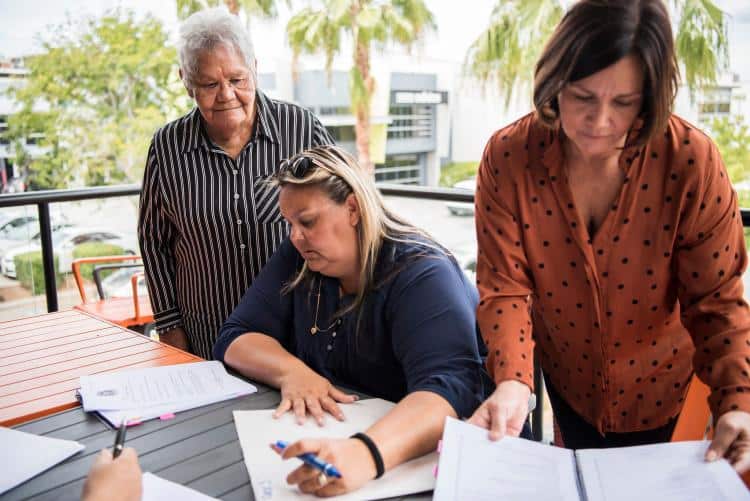
Aunty Lorraine and Shaan deliver the program across the country, not only to Stolen Generation survivors, but to their families, organisations working with them and other people impacted by trauma.
Until recently they also delivered the Marumali Program to men and women incarcerated in Victoria.
Shaan explained it as a "seven-step healing process" that provided tools and resources to participants, empowering them to apply them to their our trauma and healing.
Changing people's lives
The pair are thinking forward too, having recently designed a program for young Aboriginal and Torres Strait Islander peoples. Both are very passionate to get to work, supporting particuarly young people living in the out-of-home-care system.
They realised that they weren't alone. Someone else's story is similar to theirs.
After nearly thirty years, they've accumulated a million moments that they hold close, reminders of why they do what they do.
"There have been a lot of those moments over the years, some happen right before our eyes," said Shaan.
"I remember working with the survivors of institutional child sexual abuse ... people's lives did a complete 360 [and] some went home with a whole new outlook," she said.
"They realised, for the first time, listening to Mum, that they weren't alone. Someone else's story is similar to theirs."
A pillar of the Marumali program is spirituality and connection to Country, something that was crucial to Aunty Lorraine's healing.
"The thing that really sticks with me today and I really teach it and drive it home to our mob is that spirit is from Country," she said.
"Where you're born, it's at the very core of who you are as an Aboriginal person - spirit and Country cannot be separate from each other."
After Coota, Aunty Lorraine returned to her ancestral lands in Warren NSW.
"I went home to Country, to family, and they said 'We'll take you to the old mission where you were born, your birthing tree is still there,'" she recalled.
"That's where I found my spirituality, when I sat under the tree where I was born. I'll never forget it."
On Friday morning, Aunty Lorraine attended the 18th Anniversary of the National Apology to the Stolen Generations at Parliament House, among many other Stolen Generation survivors - some of who she's helped.
Reflecting on her life, Aunty Lorraine said she's incredibly proud of the Marumali Program and how it's empowered all sorts of people to live a life beyond trauma.
"I lived my life one way, until bang - trigger. Suddenly there was this Aboriginal person screaming to get out of my body, to get to know me and I had to adjust between Black and white," she said.
"The hatred for white comes up, and then the hatred for your own for letting it happen. You have to find the balance between Black and white, because that's exactly who you are. You have to come to terms with it, it's a lot of work but that's healing.
"Everyone has a story to hand out to their children, no matter how ugly or happy that may be, that story belongs to that person and when it's told, that when healing happens.
"Nobody can tell you your story, your story belongs to you, your kids, your grannies and great grannies. You have to be strong in that story."
1800RESPECT (1800 737 732)
13YARN 13 92 76
Aboriginal Counselling Services 0410 539 905
1800 RESPECT (1800 737 732)
Lifeline 13 11 14