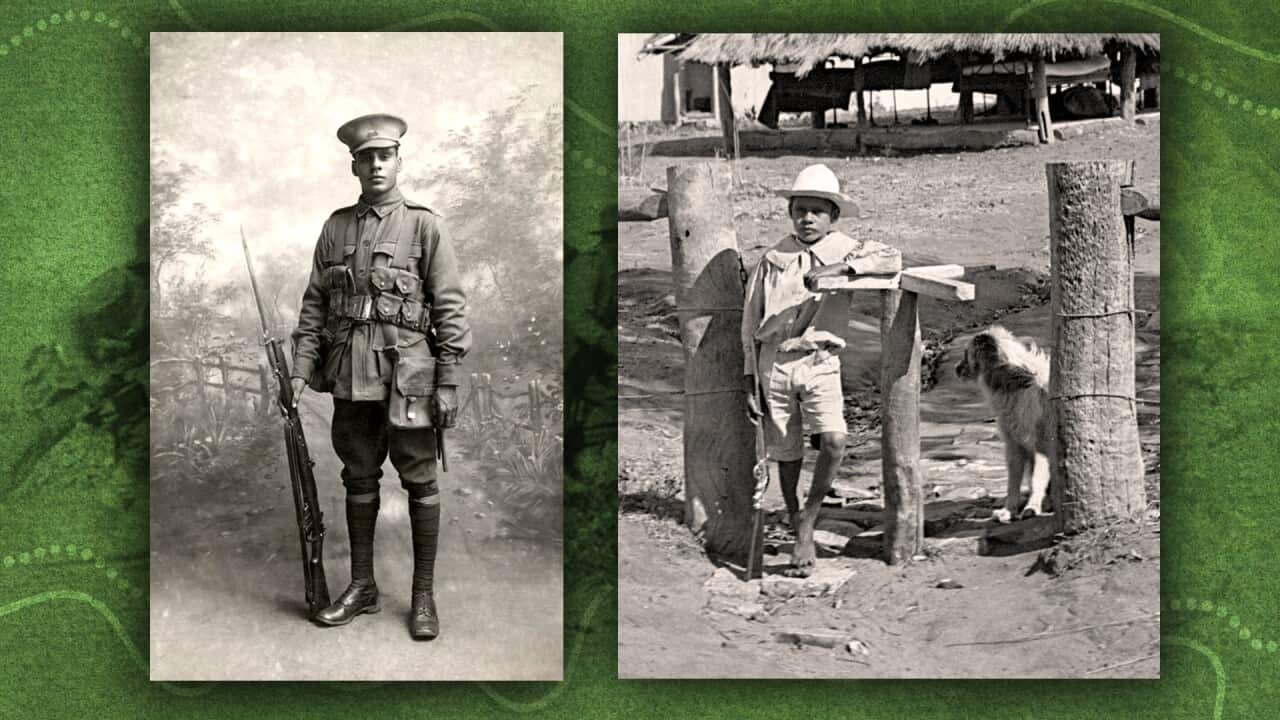
In 1901, anthropologists Baldwin Spencer and Francis James (F.J.) Gillen travelled through Central Australia along the Overland Telegraph Line, documenting Aboriginal life at remote stations between South Australia and the Gulf of Carpentaria.
Their journey took them through Powell Creek Telegraph Station in the Northern Territory, where they spent several days recording local Jingili people, the landscape, and daily life through photographs, notes, and early audio recordings.
Powell Creek—known as Bamayu in Jingili - was one of several stops along their route, and a place where Indigenous camps were located near the station.
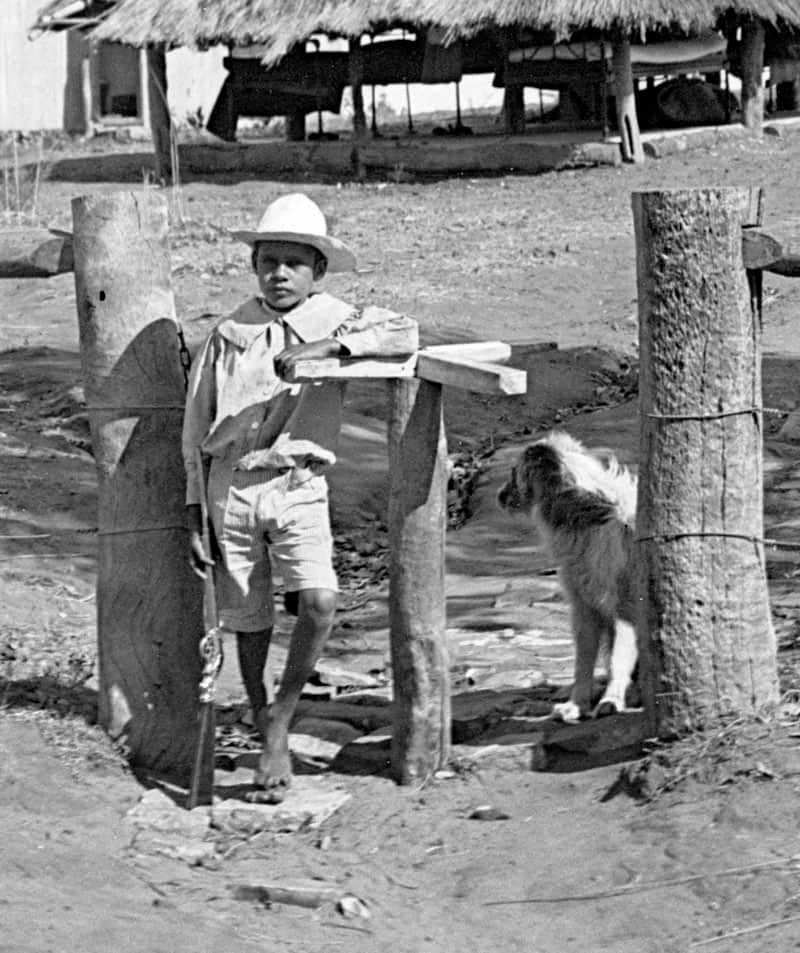
While at Powell Creek - known as Bamayu in Jingili - they photographed a seven-year-old Aboriginal boy who had been adopted by the stationmaster Walter ‘Dan’ Kell and his wife Isabella, a nurse at Palmerston Hospital.
That boy was Frederick Prentice - the son of a Jingili woman and Alfred Leslie Prentice, a Justice of the Peace at Powell Creek. The Kells, who had no children of their own, also adopted another Aboriginal child, a girl they named Isabel Jane Kell.
In 1905, when Frederick was 11, the Kell family returned to Adelaide with their two adopted children. Dan Kell took up a position as senior telegraphist in the suburb of Unley.
Frederick attended Kyre College (a predecessor of Scotch College) in Unley, where he excelled in athletics and music. After finishing school, he worked as a station hand.
At the age of 21, he enlisted in the Australian Imperial Force (AIF) on 7 May 1915 in Keswick, an inner south-western suburb of Adelaide.
At that time, AIF regulations barred the enlistment of anyone ‘not substantially of European origin or descent’, effectively excluding Aboriginal men. Despite this, some were able to enlist - passing as Italian or Māori, or through local connections that allowed them to bypass the rules.
Frederick was assigned to the 12th Battalion, 8th Reinforcement. In August 1915, the unit departed Adelaide aboard HMAT Morea, a P&O Line troop transport. After a four-week voyage across the Indian Ocean, he arrived in Egypt.
On 13 March 1916, Prentice transferred to the 1st Pioneer Battalion. Later, on 1 August, he was promoted to Lance Corporal while serving in France.
He soon moved with his unit to the Somme, near the French village of Pozières. There, as part of one of three Australian divisions, he took part in a series of nine attacks against German positions between 8 August and 3 September 1916.
Just north of Pozières lay Mouquet Farm, positioned near the high ground of Pozières Ridge.
The fighting there was devastating: the 1st, 2nd, and 4th Australian Divisions suffered more than 11,000 casualties. In just a few weeks, the AIF lost as many men as it had during eight months of fighting at Gallipoli.
Awarded the Military Medal for bravery
On 19 July 1916, during the fighting at Mouquet Farm, Frederick displayed exceptional courage. Under heavy enemy bombardment, and in darkness over shattered terrain, he successfully transported machine guns and ammunition to the front line.
For these actions, Private Prentice was awarded the Military Medal.
His battalion continued to see heavy fighting throughout 1917, including at Bullecourt, Ypres, Polygon Wood, and Passchendaele.
After receiving his medal, Frederick sent it back to Australia for his sister to collect. Tragically, it was lost when the SS Mongolia was sunk by enemy forces on 23 June 1917.
Frederick returned to Australia on 12 May 1919, holding the rank of Corporal.
On 6 March 1920, he was re-awarded his Military Medal in Adelaide by General William Birdwood, commander of the ANZAC forces during the Gallipoli campaign.
He resumed work as a station hand at Manunda Station in South Australia.
By 1930, he had moved to Kalgoorlie, where he worked as a miner for the next thirteen years.
He later travelled to the Pilbara region, working at Marble Bar and Nullagine, before eventually returning to the Katherine region in the 1950s.
On 22 November 1957, aged 63, Frederick Prentice died of a heart attack while sitting alone by a campfire.
He was buried in Katherine in an unmarked grave, without known family or friends present.
In 1991, following a Kell family reunion, descendants began researching the lives of the two Aboriginal children adopted by Isabella Kell. In doing so, they uncovered Frederick’s military service and the circumstances of his death.
In 2013, members of the Katherine Stolen Generations Group discovered that an ‘Aboriginal soldier’ lay buried in Katherine.
They made it their mission to have him properly recognised.
After years of advocacy, a headstone and plaque were installed at his gravesite - more than a century after his acts of bravery on the Western Front.
Frederick Prentice’s Military Medal is now held by the Australian War Memorial in Canberra - one of only a small number awarded to Aboriginal soldiers who served in the First World War.
The medal had been rediscovered in 2016 by a fossicker near Kalgoorlie, close to the site of a former hotel on the road to Coolgardie.
By the end of the war, an estimated 800 to 1,000 Aboriginal men had served in the AIF.
Their service reflects a profound contradiction: Aboriginal soldiers fought with courage and loyalty for a nation that, at the time, denied them full citizenship and basic rights.
On distant battlefields, they stood alongside other Australians, earning respect through resilience, skill, and sacrifice. Yet many returned to lives shaped by exclusion rather than recognition.
Today, their stories endure—powerful reminders of both injustice and strength. They are the stories of men who answered the call to serve, and whose legacy continues to reshape how Australia understands its history, honour, and identity.
This article acknowledges the extensive research of Philippa Scarlett (Indigenous Histories), John Richards (Northern Territory Library), and Eric Catterall and Christine Cramer, descendants of the Kell family.