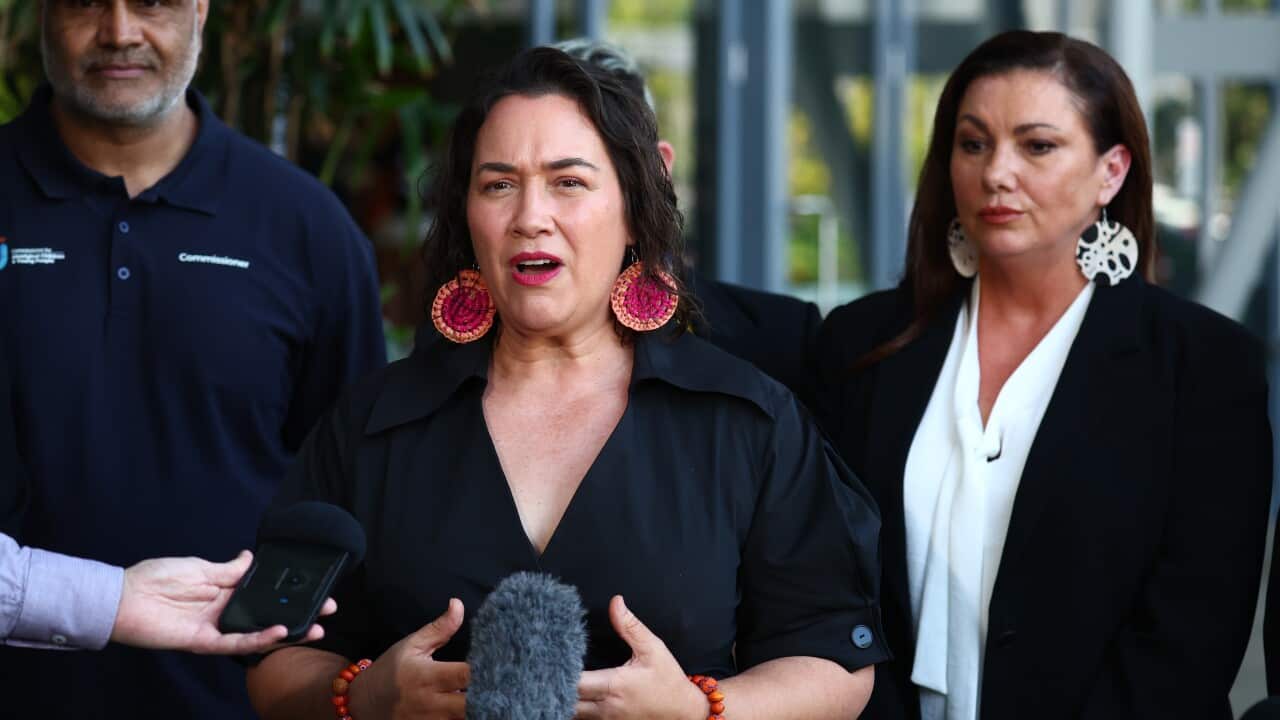
Child protection advocates gathered at Parliament House, calling for investment in community-controlled responses to reduce the rising rate of Aboriginal and Torres Strait Islander children in out-of-home care.
Allies for Children, which represents 15 per cent of the child and family services and care for around 1,900 First Nations children, gathered to advocate for system reform grounded in First Nations leadership and focused on practical, systemic change.
Currently, around 23,000 Aboriginal and Torres Strait Islander children are in out-of-home care in Australia - being ten times more likely to be removed than non-Indigenous children.
Over half of those removed are placed with non-Indigenous, mainstream services, despite decades of research that advocates for them to remain with kin and community.
It's a priority issue for the government, with Target 12 of Closing the Gap seeking to reduce the rate of Aboriginal and Torres Strait Islander children in out-of-home care to 45 per cent by 2031.
The prospect of achieving the target is grim, with progress stalling across the country, and outcomes worsening in some jurisdictions.
The Allies for Children partnership, proposed to government, works in partnership with Aboriginal Community-Controlled Organsations (ACCOs), handing over resources and responsibility in the pursuit of better outcomes and care for First Nations kids.
Secretariat of National Aboriginal and Islander Child Care (SNAICC) CEO, Catherine Liddle said that ACCOs are uniquely positioned to provide appropriate and effective support.
"Where you see high numbers of children removed from their families, you know that the conditions that their families needed are missing. That means they're more than likely to live in an area where there is a lack of jobs, a lack of access to food, a lack of access to health services and other things," she told NITV.
"We know that there has been fundamental failure to invest in the systems that families needed to thrive in the first place, and that's where the ACCOs step in, they understand that that's what the journey is.
"They understand how difficult it is to navigate any service system when you're having or experiencing distress and they do it alongside you. That's why they get different results."
The Arrernte and Luritja woman said there's already proof that it can work.
"One region in Queensland has passed parity so it no longer has any over-representation of children in out-of-home care that delegated authority was handed over two years ago. They did that within two years," she said.
"These changes can happen and they can happen fast, but it takes putting your shoulder to the wheel, it takes working in partnership and it takes look at yourself and saying what can I do differently?"
Ms Liddle said for Target 12 to be achieved, change is crucial.
"It's not moving fast enough, and it's not moving at that system level . . .we know that when we see a transfer of service delivery when we see a true commitment to delegated authority, we get fundamentally different results and we get them at a different speed," she said.
Without dedicated focus on changing the way Aboriginal and Torres Strait Islander children are treated within the child protection system, there is no way of meeting that target.
Allies for Children member and Life Without Barriers CEO, Claire Robbs said Target 12 is achievable if organisations "work together".
"Being an ally means changing ourselves," she said.
"We are examining and dismantling policies, practices and arrangements within our own organisations that contribute to the over-representation of First Nations children in the foster care system, and shifting power, resources and decision making to community controlled and First Nations led solutions."
The Allies for Children partnership, works alongside the First Nations NGO Alliance and SNAICC, driving for the safe return of Aboriginal and Torres Strait Islander children to their kin, the transition of power and support to ACCOs and the commitment of leadership, resourcing and operational change within mainstream systems and responses.
The partnership also advocates for the empowerment of Aboriginal and Torres Strait Islander children's connection to family, culture, community and Country.
"Every child needs to know who they are, that's a fundamental principle of child development," said Ms Liddle.
"When we remove children from their families, often they are never restored. They don't learn who their cousins are, who their aunties are, who their nannas or grandpas are, or what their nation is.
"It's fundamental that Aboriginal and Torres Strait Islander children to understand those things. "