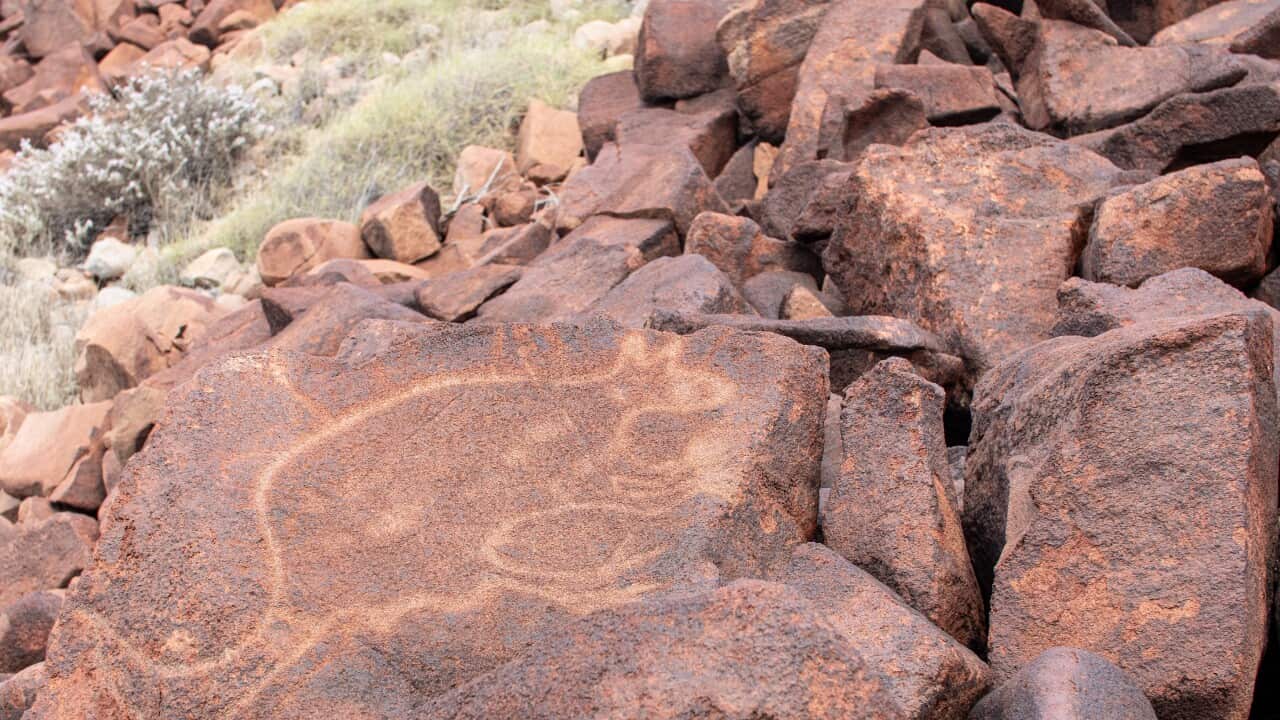
The latest report into conditions affecting the world's biggest collection of rock art has revealed a larger area than previously thought is being degraded.
The degradation, or porosity, of sacred petroglyphs caused by heavy industry at Murujuga Burrup Peninsula in Western Australia has been the subject of a long-running and bitter dispute between state and federal governments and some of the area's Traditional Owners.
The Murujuga Rock Art Monitoring Program (MRAMP), now in its third year, tracks the "air emissions, rainfall chemistry, and other environmental factors" affecting tens of thousands of etchings dating back millennia.
The state's environment minister Matthew Swinbourne acknowledged that the report, prepared by Curtin University and released this week, "identified a larger area of porosity than reported last year".
Mardudhunera woman Raelene Cooper condemned the continued fossil fuel activities in the wake of the latest findings.
"The government is delusional if it thinks industry and culture can co-exist at Murujuga," she said in a statement.
“The WA government’s own report has now admitted that findings of damage to Murujuga’s World Heritage-listed rock art are increasing.
“The Minister is in fantasyland if he can’t accept that there is danger to Murujuga’s rock art, danger to the environment and danger to human beings from industry on the Burrup."
The report states that the change in the porosity extent was "due to a correction in the statistical significance level applied, rather than a change in underlying data".
It also attributes the porosity to historical emissions, rather than current industrial activity.
MRAMP is a partnership led by the Murujuga Aboriginal Corporation (MAC) and the WA Department of Water and Environmental Regulation (DWER).
MAC director and cultural adviser Belinda Churnside said that protecting the cultural heritage "remains our highest priority."
"This latest report provides further confidence that the monitoring program is building the evidence needed to support the long-term protection of our rock art and cultural landscape."
Federal approval under scrutiny
The report lands amid ongoing controversy over federal Environment Minister Murray Watt's approval of the North West Shelf Extension, which allows resources bohemoth Woodside to keep operating the Karratha Gas Plant until 2070.
In his approval of the development, Minister Watt acknowledged that MRAMP had not assessed what increased porosity could mean for the rock art itself, but that harm was likely.
"[This has] the potential to diminish the values of the rock art which relate to the preservation of detail of the precise and intricate engravings," the statement of approval reads.
"Specifically, there is evidence that there is a risk that increased porosity leaves the rocks susceptible to other processes."
Ms Cooper said this showed a gap between the minister's public announcements and official reasoning.
"The federal Environment Minister is saying one thing in his own legal documents and another in public while lobbying for industrial approvals."
Writing in The West Australian, Mr Swinbourne said the report showed no current industry impact had been measured.
"The release of this year's report is an important milestone.
"It shows there has been no measurable impact on the rock art by current industry emissions, the air quality is within the program's interim EQC levels, and there is no current evidence of acid rain.
"While it has identified a larger area of porosity than reported last year, the findings that this is most likely due to historic emissions, rather than current, remain."
Traditional Owners say historical emissions explanation doesn't hold up
Save Our Songlines, an organisation of Murujuga Traditional Owners campaigning to protect the petroglyphs, rejected attempts to pin the damage solely historical emissions.
"The federal Environment Minister had previously tried to blame damage to the rock art on industrial emissions from a small power station that was decommissioned more than two decades ago and had been located more than 10km from the rock art sites showing greatest impacts," they said in a statement.
"Conversely, Woodside's North West Shelf gas plant is situated within the area that the MRAMP report shows greatest rock art damage occurring."
The group also said the report could not rule out a role for current industry, and had not proven its historical-emissions explanation, saying it was "unable to rule out ongoing impact and unable to prove that increased damage is due to historical industrial emissions."
That uncertainty is echoed in the report itself, which states: "While no ongoing damage has been detected, this does not rule out the possibility that current emissions may be increasing porosity at levels too low for current monitoring methods to detect."
The findings of the report have been the subject of controversy in the past.
The former lead statistician on the MRAMP study, Professor Adrian Baddeley, resigned last year after publicly criticising “unacceptable government interference” in the presentation of the scientific findings.
In a statement, Woodside said the latest report showed that "industry and cultural heritage can co-exist on Murujuga."
"They indicate the current regulatory framework and associated management measures implemented at Woodside facilities are appropriate in supporting the protection of Murujuga’s rock art.
"Woodside takes seriously its responsibility to protect and manage cultural heritage in the areas where we operate.
"The company continues to take reasonable and practicable measures across its operations and growth projects to minimise emissions."