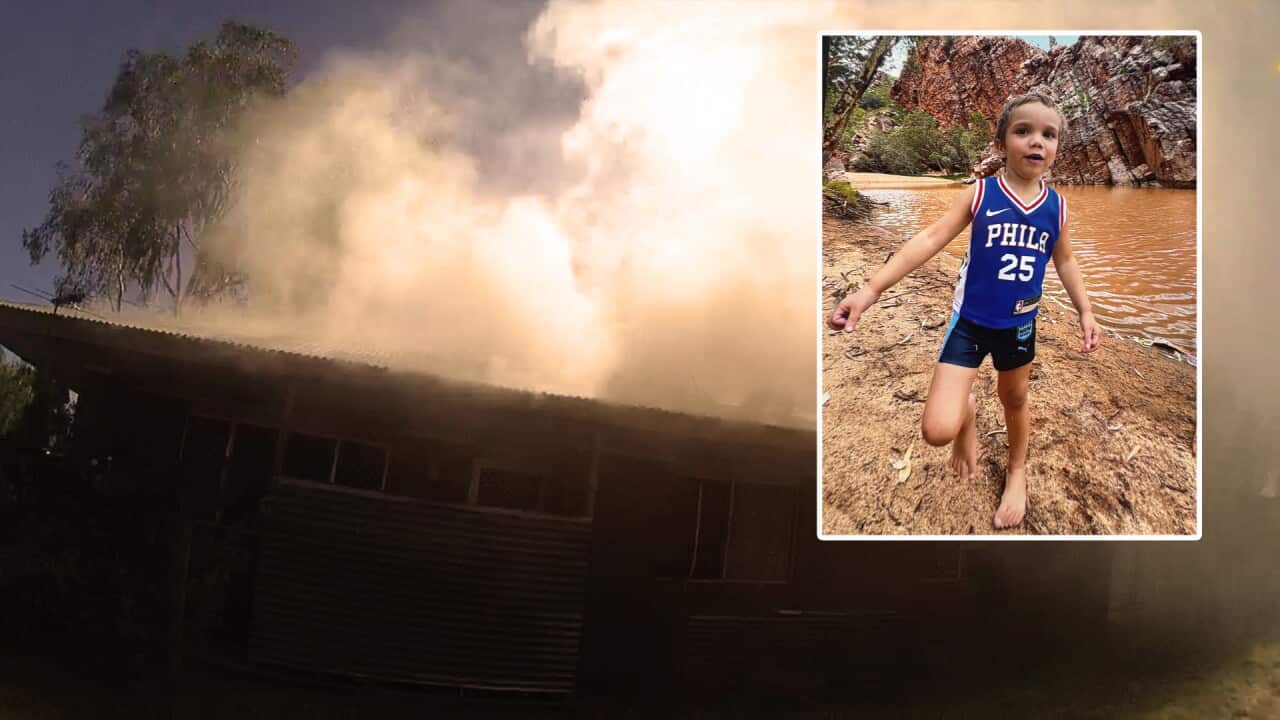
The house fire that killed three-year-old Mitchell Thomas in Alice Springs in 2023 was caused by faulty wiring in the roof of the public housing property, the NT Coroner has found.
When handing down her findings, NT Coroner Elisabeth Armitage expressed her condolences to the family who gave evidence at the inquiry.
"They said that everyone who knew him loved him," Judge Armitage said.
"He brought his family much happiness."
The inquest found the three-year-old's death was caused by smoke inhalation from a fire that started in the roof of the public housing residence where his family were living on 1 June 2023.
The coroner determined the fire was caused by electrical arcing of wires adjacent to the air vent in the ceiling.
Judge Armitage also found that it was possible the lounge room smoke alarm was not functioning when the fire broke out.
"No doubt, this weighs very heavily on [the NT] government which, as owner, is responsible for providing safe and habitable premises," Judge Armitage said.
Widespread issues in NT public housing revealed
Throughout the inquest, concerns were raised over potential widespread dangerous wiring in other public housing leased by the NT government.
Of the more than 10,000 public housing properties across the territory, around half were built around the same time or earlier than the house at the centre of the inquest.
The audit inspected 594 properties constructed in the 1980s across Alice Springs and Tennant Creek, and a smaller sample of homes built after 2000.
It uncovered a "significant number" of major electrical faults in older properties.
34 per cent of properties inspected had major electrical faults, 82 per cent had minor electrical faults, and 18 per cent had issues that were not compliant with safety standards.
Key issues included earthing and cabling faults — which can pose risks of electrocution or fire — and smoke alarms either not working or not installed.
"It is concerning that there appear to be a significant level of major faults present, particularly in older homes," Judge Armitage said.
Recommendations for reform
Judge Elisabeth Armitage has made several recommendations to the NT Department of Housing, who is responsible for the repair and maintenance of public housing in the Territory.
Those include greater training for workers conducting housing inspections, and the rectification of all faults identified in the audit.
Judge Armitage has also called for all properties in the NT public housing stock built before 2000 be inspected as soon as possible, and on a 10-year interval thereafter.
Andrew Walder, the Acting Deputy CEO for the NT Department of Housing gave evidence at the inquest and responded to key issues reflected in the findings.
Mr Walder told the inquest that all of the faults identified in the audits have been rectified and the audit results are being used to form a number of additional reforms.
Mr Walder also explained that “safety feature” training was now being provided to Housing Officers.
The training equips Housing Officers — who conduct inspections of social housing — to identify any faults in safety features.
Former recommendation 'long forgotten'
Judge Armitage expressed disappointment after the inquest revealed a key recommendation from a decade-old inquest had been "long forgotten", despite being accepted by the NT government at the time.
"I was told there is to be a re-implementation of a Register of Accidents and Incidents, including fires, damage or injury contributed to by electrical issues," the NT Coroner said.
Establishment of a such a database was one of the recommendations of the inquest into the death of Monica Presley in 2006, which examined the death of a child from an electrical fault in public housing.
"It is deeply disturbing that lessons learned from that tragedy have been forgotten and it is hard not to feel cynical about commitments to recommendations moving forward," Judge Armitage said.
In response, the coroner has called for the NT Department of Housing to establish a senior level mechanism for the ongoing tracking of recommendations from coronial inquests and their implementation.