WARNING: Aboriginal and Torres Strait Islander viewers are warned that the following article contains images of deceased persons.Republished from the Spirit Maps: Cycles of Renewal exhibition at Manning Clark House with permission from Juno Gemes.
Talbot’s work in photogravure was refined in 1879 by Karl Klíc resulting in the process (the Talbot-Klíc Dust Grain Photogravure) that is still used today.
This is the exact same process used by master printer Lothar Ostenberg working in collaboration with Juno Gemes to produce Spirit Maps from dust grain copper plate negatives.
I searched for a printer in photogravure for over 20 years. Finally Chuck Close’s printer, Ruth Linden from Pace Gallery NY, introduced me to Lothar Osterberg in Brooklyn NY, Lothar is a masterprinter.
I sent him digital files from my studio on the Hawkesbury River near Brooklyn and Lothar prepared two copper plate negatives from my digital files.
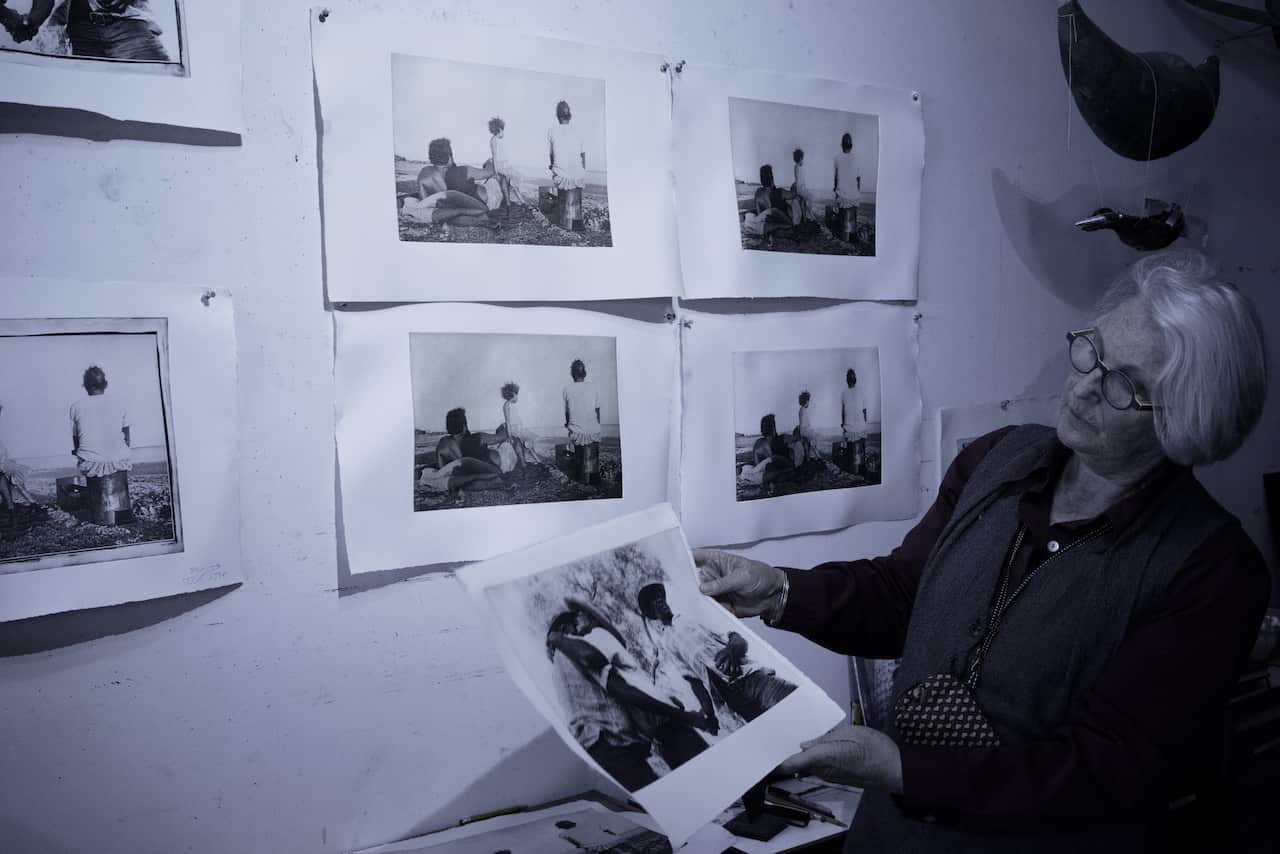
This he assured me was a most difficult process. We reached across the waters to one another—from Brooklyn in NSW, to Brooklyn, New York City.
During ceremony I watched the same dance movements repeated again and again, the dancers feet making ever deeper groves in the soft earth, illuminated by firelight
When I asked Lardil Elders on Mornington Island in 1978, "What images should I make—what do you want your fellow Australians to see?" This was their instruction: "Show them that we are still here, we been here all along. Show them that our culture is still strong. Show them that, my girl".
During ceremony I watched the same dance movements repeated again and again, the dancers feet making ever deeper groves in the soft earth, illuminated by firelight.
The women danced all through the night to make the young men strong for the demands of the ceremony ahead of them. Repeating and remembering, making strong.
Show them that we are still here, we been here all along. Show them that our culture is still strong. Show them that, my girl
These images are etched into my memory for a lifetime.
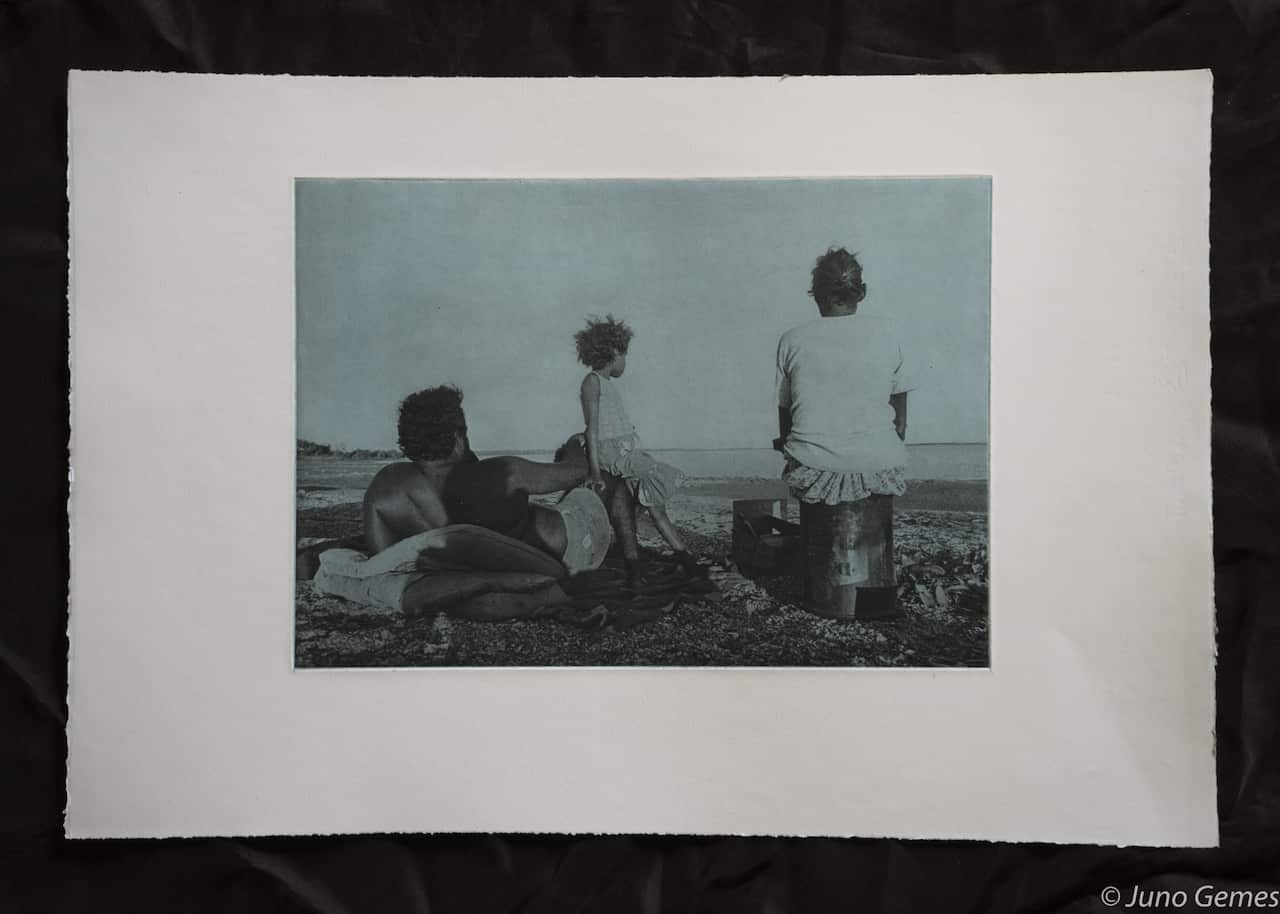
Spirit Maps takes two of my most iconic images from this experience, 'Countrymen' and 'One with the Land' created during a two year period when I worked with Woomera-Mornington Island Culture Collective 1978-1979.
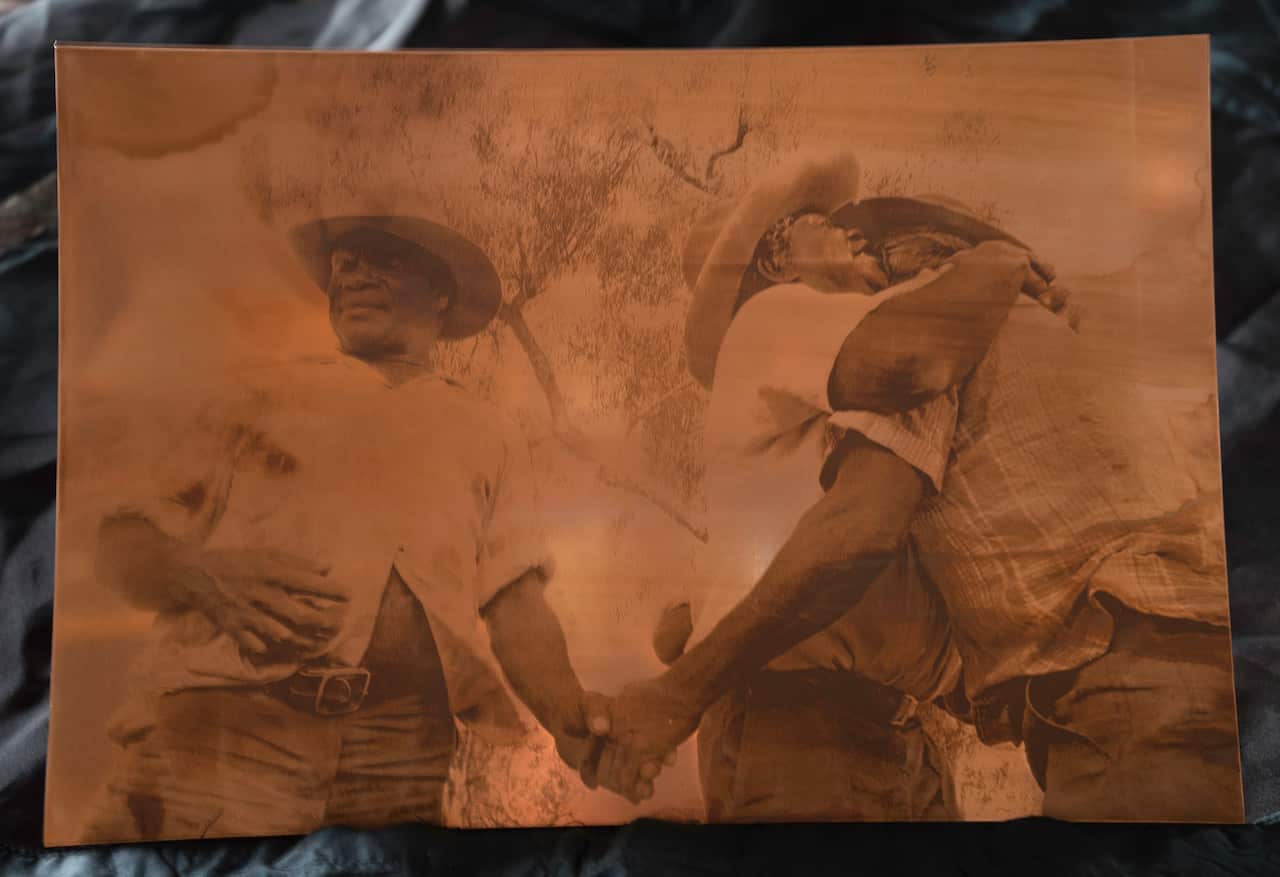
Both images have deep enduring cultural resonances. Silver/gelatine prints of both images are in the Collections of The National Gallery of Australia, The National Portrait Gallery, Macquarie University Art Collection, Kluge Rhule Aboriginal Art Museum at The University of Virginia USA.
We decided to make each photogravure work both a repetition and each print a unique work, echoing one ancient cycle with another, one ancient process with another
Reflecting on my earlier experiences with Lother Ostenberg in his studio in Brooklyn NY, during my residency there in June 2015—we decided to make each photogravure work both a repetition and each print a unique work, echoing one ancient cycle with another, one ancient process with another.
Over the years my work has been a continuous act of advocacy and reciprocity to these instructions
"Over the years my work has been a continuous act of advocacy and reciprocity to these instructions."
I feel honoured and blessed to be entrusted by the people to take this important story of truth, endurance and cultural survival forward. Even during these challenging times for our nation.
Visual advocacy has been the hallmark of Juno Gemes’ artistic practice for more than four decades.
Visual advocacy and photogravure
Juno Gemes' use of creative media to agitate for shared knowledge and cultural understanding has resulted in a body of photographs, film and ephemera that, although superficially disparate, are bound through the common threads of critique and compassion.
Gemes is an observer and a listener. Her images arise from careful conversation, from intuitive felt connections with her subjects and their stories.
This exhibition will bring together interweaving threads of Juno Gemes artistic journey, with two photographic series, a film, and a selection of artists notebooks.
I feel honoured and blessed to be entrusted by the people to take this important story of truth, endurance and cultural survival forward
A series of photogravure meditations reveal fresh nuances through repeated impressions of two of Gemes’ most effecting and memorable photographs.
Countrymen is a timeless, iconic and lyrical image capturing a moment of pure connection, respect, and affection between three Lawmen. One with the land is a quiet family portrait, a celebration of the patience and poetry of traditional hunting and fishing, connection to country.
Both of these images are the product of a privileged intimacy, Gemes and her camera silently witnessing the profoundly personal continuation of ancient culture in contemporary life.
Gemes recently collaborated with master photogravure printer Lothar Osterling at his 3rd St Studio in Brooklyn, NY, producing this group of images that reinterrogate the surfaces and resonances of the photographs.’ Author/Charleyene Olgivie
The life of the artist
Juno Gemes was born in Budapest, Hungary and arrived in Australia in 1949. She studied at Sydney University, worked in theatre and wrote for the International Times in London until 1971.
She became involved in the Yellow House at Potts Point, Sydney and worked in Central Australia on the film Uluru (1978). Her first solo exhibition, We Wait No More was in 1982.
Gemes has spent 40 years documenting the social change of Australia, in particular the lives of Aboriginal Australians.
The exhibition continues at Manning Clark House in Canberra, Australia, until 13 September.