In 1992, the late Australian wildlife documentary film maker, and crocodile hunter Malcolm Douglas travelled three famous outback tracks: the Birdsville, the Oodnadatta and the Strzelecki.
At the end of the Birdsville Track, just above Maree in South Australia, Douglas dropped in to see a well-known local identity and SA outback legend named Talc Alf.
Talc Alf, whose real name is Cornelius Johan Alferink, was born in the Netherlands in 1945 and migrated to Australia aged eight, growing up in Margaret River WA.
In 1974, he moved to Lyndhurst in South Australia – a small town which sits at the crossroads of the Strzelecki and Oodnadatta tracks.
Lyndhurst sits on the lands of Kuyani people and began as a railway siding in 1878.
It's famous for being the birth place George Michael ‘Dollar Mick’ Smith - an Aboriginal stockman and leather craftsman who taught R.M. Williams the skills to make his iconic boots in the Flinders Ranges during the 1930s.
Alferink is widely renowned for his carvings in talc from the Mount Fitton talc mine his Talc Alpha Rink Outback Rep-Public Art Gallery is still a regular stop for anyone travelling the Birdsville Track.
Back in 1988 – Australia’s bicentennial year - Alferink redesigned the Australian flag, replacing the Union Jack with the red, black and yellow Aboriginal flag – designed by Harold Thomas.
He noted at the time that his design was intended to create ‘one nation’ – Australia’s modern Aboriginal symbol combined with the southern cross.
“I stopped having beer in 1988,” Alferink told Douglas, “and I’m not gonna have a beer until that flag reaches Parliament House,” he added.
At the time, Sydney was bidding to host the 2000 Olympic Games and Alferink believed Sydney would only get the Olympic Games if by 2000 the flag he designed was flying over Parliament House in Canberra as our National Flag. (Sydney wasn’t announced as the 2000 Olympic host city until September 1993.)
Douglas recalls in his documentary - Along The Tracks - that Alferink would educate any local or international visitor to the Outback Gallery about his flag design.
Five years later, the ‘one nation’ flag made it to Hollywood when it appeared in the 1997 sci-fi movie, Event Horizon staring New Zealand actor Sam Neill, alongside Lawrence Fishburne and Jason Isaacs.
The movie follows a group of astronauts in the year 2047 who are sent to investigate and salvage a lost spaceship - the "Event Horizon" - after it suddenly reappears in orbit.
Neill played an Australian called Dr William "Billy" Weir, who is the designer of the Event Horizon spaceship.
Neill’s character has a navy-blue uniform that includes the Australian flag designed by Alferink.
“I am not entirely sure whether Dr Weir was originally Australian in the script, but I suspect I asked for him to be Australian because being American is such hard work - being Australian, certainly for me, is an easier call,” he told NITV.
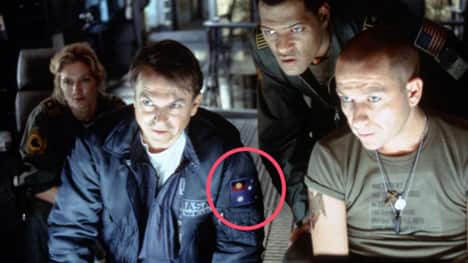
“All of the crew has a flag on part of their uniform that indicated their origins, but they asked me what the Australian flag would look like in 50 years’ time.
“My response was there would be no way that a Union Jack would still be on that flag. That is because I was certain it would be a republic by that time.
“Second, it seemed to me that Australians would have sufficient generosity and common sense to replace that Union Jack with an acknowledgement of Indigenous settlement (Always was, always will be) for at least 60,000 years.
“Both of these issues led me to be wearing a flag that looks the way it is - and it pleases me that I insisted on that,” Neill concluded.
Despite Alferink’s wish, the ‘flag’ was never flown over Parliament House in Canberra.
But when Sydney hosted the 2000 Olympic Games, Alferink’s design appeared on the world stage. Following Cathy Freeman’s gold-medal victory, her mother and hundreds of others waved hand flags bearing the design in the Olympic stadium.