WARNING: This article contains distressing content.
In most Australian jurisdictions, children as young as ten can be subjected to strip searching, with First Nations people significantly more likely to be targeted .
Those findings are part of a new report by the Human Rights Law Centre who are calling for a ban on strip searches in prisons across the country.
Senior Lawyer from the Human Rights Law Centre, Sohini Mehta, says the harms of strip searching are "disproportionately experienced by over-incarcerated communities, particularly First Nations people".
Ms Mehta is among advocates arguing there are safer alternatives available, including body-scanning technology and drug detection methods.
“It is an ineffective and unnecessary practice, with no credible evidence of any relationship between strip searching and contraband detection," Ms Mehta said.
'State-sanctioned sexual assault'
The report, Ending Strip Searching in Australian prisons, compiles lived experience accounts of being subjected to strip searching, alongside national data on the prevalence of strip searching in prisons.
Yuin woman Aunty Vickie Roach is a survivor of the Stolen Generations and has been strip searched.
She said strip searching is akin to "state-sanctioned sexual assault".
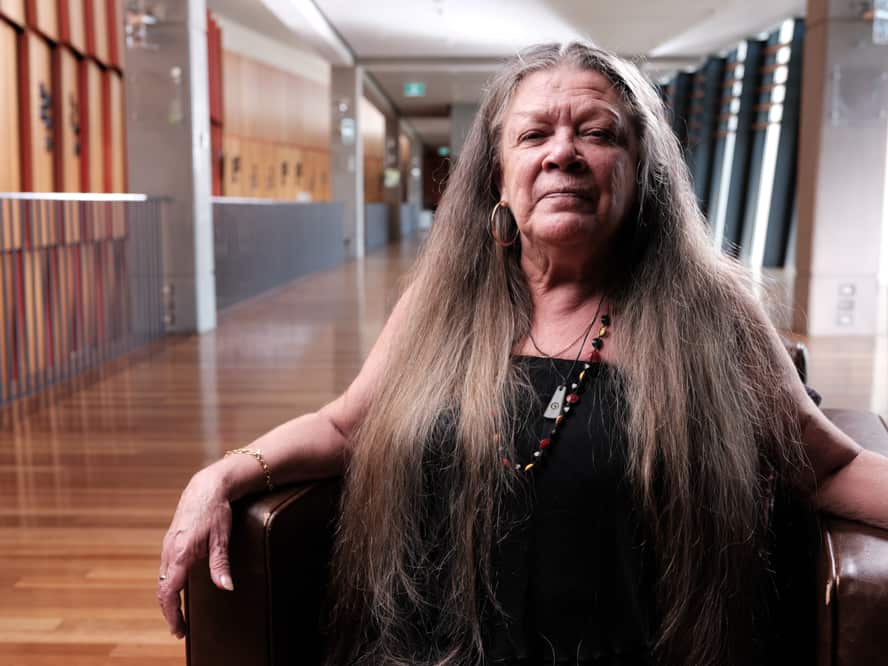
"Strip searching replicates the dehumanising dynamics of abusive relationships," Aunty Vickie Roach said in the report.
"It is akin to being ambushed, raped and forced to strip naked in front of screws dressed in deliberately authoritarian, intimidating uniforms.
"It only serves to degrade, humiliate and allow others to assert control over our naked and vulnerable bodies."
First Nations children impacted
The report estimates, children have been subjected to more than 300 strip searches each month in prisons across seven Australian jurisdictions.
In the month of April 2022 alone, 127 strip searches were conducted on children at two New South Wales youth prisons. Only three searches identified items.
Similarly, in Queensland, over a seven-month period during 2020-2021, more than half of the nearly 700 recorded strip searches at three youth prisons were conducted on Aboriginal and/or Torres Strait Islander children.
The report also found that prison authorities are not transparently recording the number of strip searches, or the reasons for them, increasing the risk of abuse behind bars.
In Western Australia recent data requests were denied on the basis that no central register of prison strip searches exists, according to the report.
In most other jurisdictions strip search records that were maintained were often challenging to interpret because of incomplete or unclear record-keeping.
Karen Fletcher is the Executive Officer at Flat Out — a Victoria based advocacy and support service for women, trans and gender diverse people and their children who have been criminalised.
“In our 38 years supporting women in prison, we have seen strip searching used blatantly by correctional officers to threaten, punish, humiliate and control," she said.
"This was supposed to stop with the introduction of body scanning technology and saliva drug testing... [but] we still see strip searching used to assert power and control.
"This is sexual assault and serious measures are needed... to make it stop."
Calls for nationwide ban
The report calls for all state and territory governments to ban strip searches in prisons and detention facilities by law, alongside broader action to address Australia’s mass imprisonment crisis.
“There is no excuse for governments to continue subjecting people to the trauma of being strip searched when there are less invasive ways of checking for items... like scanners similar to those used at airports and public buildings," Ms Mehta said.
Nina Storey, a member of FIGJAM and Family Violence Justice Project Coordinator at Flat Out, said governments continuing the practice contradicts their commitments to the national plan to end violence against women and children within a generation.
“They continue to perpetrate and normalise sexual violence against incarcerated women by subjecting them to strip searches,” she said.
The report also calls for alternatives to strip searching to be regulated and only ever be used as a last resort in cases of absolute necessity.
1800RESPECT (1800 737 732)
13YARN 13 92 76
Aboriginal Counselling Services 0410 539 905
1800 RESPECT (1800 737 732)
Lifeline 13 11 14