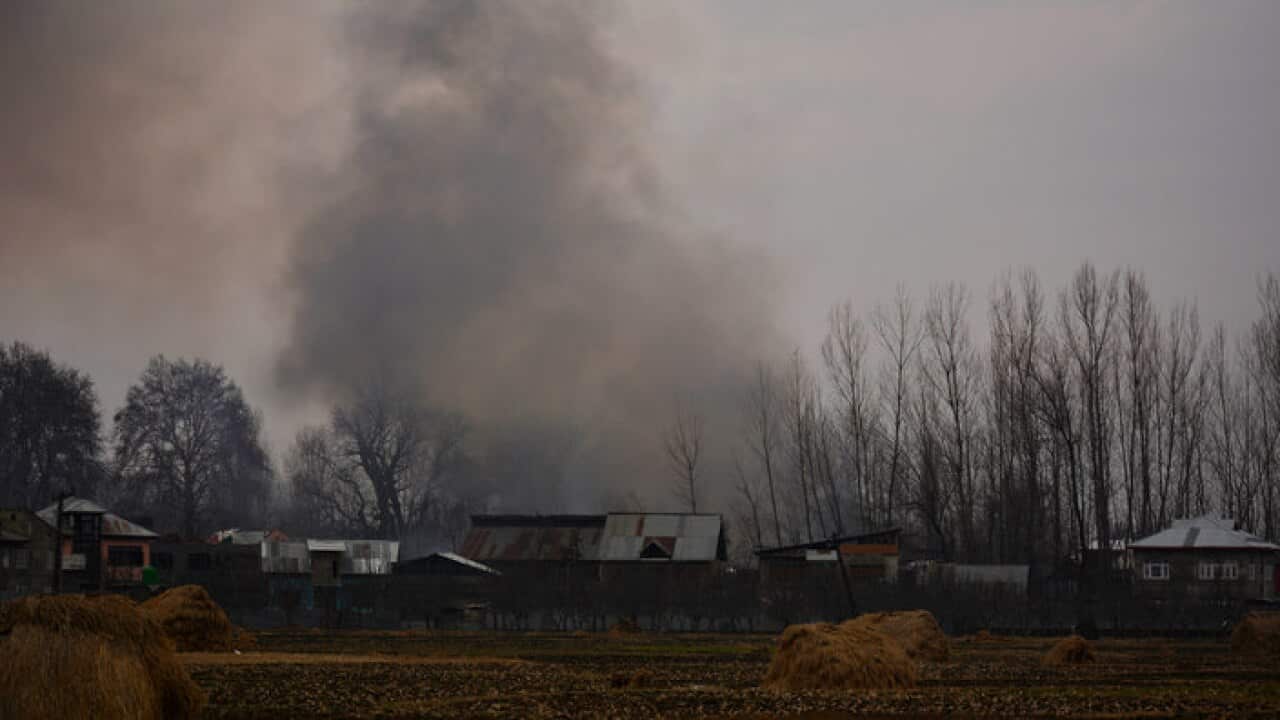

Seven people were killed in a gun battle that broke out as Indian soldiers searched for Islamist militants who'd claimed responsibility for a suicide attack that killed 40 Indian soldiers.
The worst attack on India’s security forces in decades has threatened to spark conflict in Kashmir, fuelling tension between nuclear-armed neighbours India and Pakistan. The suicide bomb attack on a paramilitary police convoy in Indian-controlled Kashmir on 14 Feb killed at least 40 people, the deadliest single attack on Indian forces in 30 years in the Muslim-majority region.
Pakistan-based militant group Jaish-e-Mohammad (JeM) has claimed responsibility for the attack, with India accusing Pakistan of harbouring the group. While searching for militants in the Pulwama area, Indian government forces came under heavy gunfire resulting in a battle that claimed the lives of four soldiers, two suspected militants and a civilian. Indian Prime Minister Narendra Modi says action must be taken to deal with what he called extremists and their supporters.
"The attack in Pulwama (Indian-administered Kashmir) clearly demonstrates that the time for dialogue is long past. Now the whole world needs to work together to take concrete steps to deal with terrorism and their supporters. We should not hesitate to take action against terrorists and their anti-human values, because if we don't do it, it would mean we are encouraging them."
Pakistan has warned India against linking it to the attack without an investigation, in turn accusing India of using it to divert global attention away from human rights violations in Kashmir. Kashmir is at the heart of decades of hostility between the two countries, with India and Pakistan each administering part of the state but both claiming the Muslim-majority region in its entirety.
When the British left the region in 1947, Kashmir was given the choice of aligning with India or Pakistan. Even though most of the region's population was Muslim, the local maharaja at the time was a Hindu and he chose secular India.
Right from the start, some people wished to be part of Muslim Pakistan and the decision has led to decades of violence. Priya Chako, a lecturer in international politics at Adelaide University, says the main issue for Kashmiris since 2014 has been India's military crackdown.
'India has really changed its approach to Kashmir from 2014, taking a much more hard-line approach to militant groups and the civilian population has suffered. It's retaliated as well, through demonstrations, stone peltings things like that. The situation has really deteriorated in the last four or five years."
A two-year war broke out soon after partition in the 1940s and the UN Security Council passed a resolution calling for a referendum to resolve the situation, but it never happened. Since then, conflicts have been a common occurrence, escalating to full-blown wars in the 60s and the 90s.
A 2003 ceasefire was agreed-to by both countries.
The Pakistan-based group who claimed responsibility for the recent attack was established in 2000 and has been attacking security and government targets with the aim of overthrowing India's control of Kashmir. The group has been linked in the past to al-Qaeda and has officially been banned by the Pakistani government but some experts on terrorism believe the group is unofficially being supported by Pakistani authorities. Ms Chako says the current situation looks like history repeating itself for the people of Kashmir.
"I think we have a precursor to what is happening in Kashmir now, it happened in 1989. So in the 1980s India took a similar approach, it was very heavy-handed, trying to integrate Kashmir into the India union by force. And what happened was an insurgency developed. And we are starting to see the same sorts of radicalisation process happen in Kashmir now. So this recent attack launched on Indian soldiers was carried out by local Kashmiris, so that is telling you people are becoming despondent and resorting to more violence."
On the streets of Pakistan Kashmir, protesters took to the streets, alleging harassment and beatings of Kashmiri students in Indian cities after the recent attack in Pulwama. The protesters carried banners and placards with pictures of the Saudi Crown Prince, Mohammed bin Salman, who is on a high-profile state visit to Pakistan, calling on him to support Muslims in Kashmir. Uzair Ahmed Ghazali was one of those protesting.
"We appeal to Mohammed bin Salman to play his role in resolving the Kashmir issue. Today the people have appealed to the Crown Prince, that whenever he meets the Indian rulers, or talks to them, he must discuss the Kashmir issue. We are a part of the Ummah (Muslim diaspora) and we are being crushed under mountains of atrocities. Saudi Arabia and the Muslim Ummah should not remain quiet on this."
With an election due in India by April, there are indications its government will retaliate further but with both parties being nuclear-capable, it's just not known how strong the response is likely to be.
Listen to SBS Punjabi Monday to Friday at 9 pm. Follow us on Facebook and Twitter.