
Gurmeet Kaur’s family story traces more than a century of Punjabi presence in Australia, beginning with her husband’s grandfather Daleep Singh, who arrived in 1898 as a hawker and farmer. He later died in Bombay while travelling back to India, never making it home to his village in Punjab. Today, Gurmeet’s family is part of Australia’s fifth-generation Punjabi community. She reflects on migration, sacrifice, family separation, working on banana farms, rebuilding after Cyclone Larry, and raising children in Far North Queensland.
Sumeet Kaur: I am Sumeet Kaur, bringing you the untold stories of Australia's earliest Punjabi settlers.This podcast series is called Punjabi Pioneers. In its first season, you will hear fascinating stories from Punjabi families who have lived in Far North Queensland for generations. You will also hear directly from women whose struggles and experiences have rarely been documented.
Through these interviews, my colleague Manpreet Kaur Singh has spoken with women living in Cairns, Gordonvale and Babinda, uncovering remarkable personal stories while shedding light on the early history of Punjabi migration to Australia.
Today we hear from Gurmeet Kaur.
Interview
Manpreet Kaur Singh: Gurmeet ji, Sat Sri Akal.
Gurmeet Kaur: Sat Sri Akal, Manpreet ji.
Manpreet: It is a privilege to meet members of our community whose connection to Australia stretches back so many generations. Your family's history here spans five generations. Tell us how it all began. Who was the first member of your family to come to Australia?
Gurmeet: The first person to come here was my husband's grandfather, Dilip Singh. He arrived in Australia in 1898.
Manpreet: So we're talking about a period before Federation.
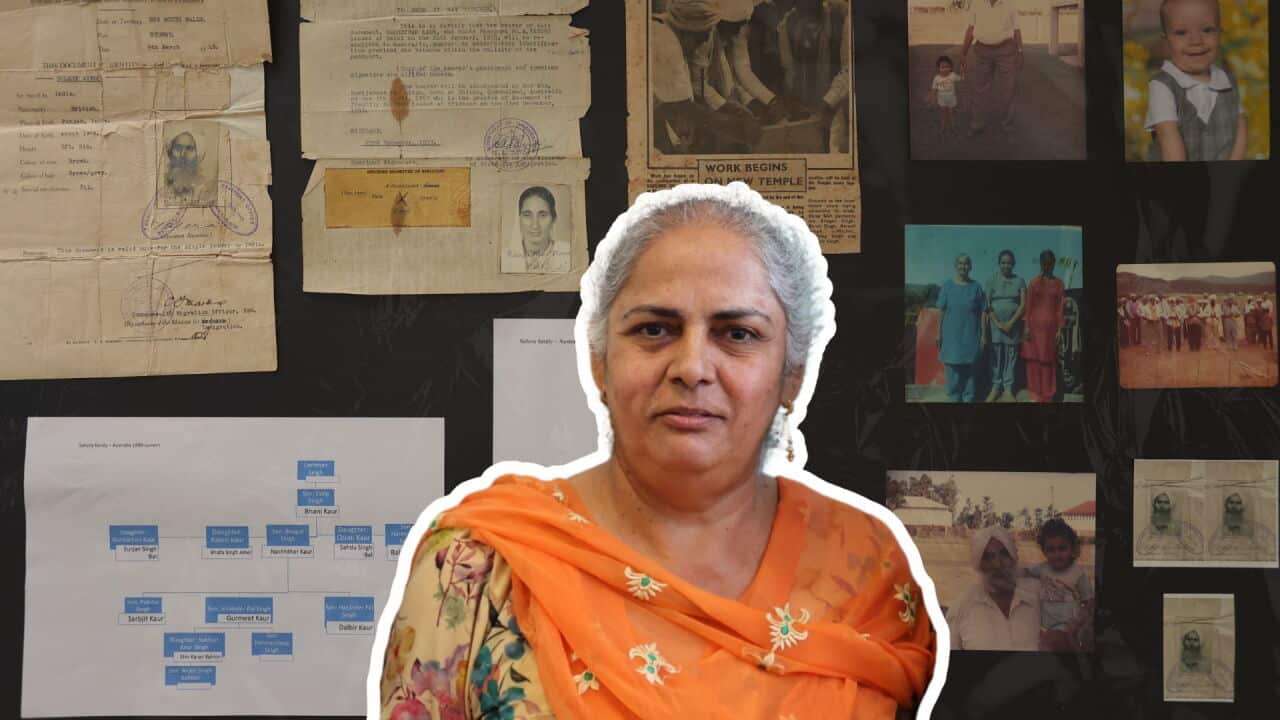
Gurmeet: Yes, before Federation. We still have some of his original documents and immigration records. My father-in-law passed many of them down to us. Over the years, our children have also gathered additional information and records online.
Manpreet: I can see some of those documents here. There are immigration stamps and official records attached to the photographs.
Gurmeet: Yes. These were family documents that we preserved. The additional material was collected later through research.
Manpreet: According to these records, he was born around 1881 and came to Australia at quite a young age. Do you know much about his life here?
Gurmeet: From what we were told, he worked mainly in agriculture. Like many early Punjabi migrants, he also worked as a hawker.
He travelled with horses, carrying goods and supplies to sell in different places. Farming remained his main occupation throughout his life.
Manpreet: So he was part of that first generation of Punjabi settlers who helped establish agricultural communities in Far North Queensland.
Gurmeet: Yes. Later he returned to India and realised that his son was not particularly interested in school. So when my father-in-law was about seventeen or eighteen years old, he brought him to Australia as well.
Manpreet: Did your husband's grandfather return to India often?
Gurmeet: Not really. Perhaps once or twice.
Life was very hard. People worked for years, saved money, returned briefly to India, bought land or supported family, and then came back to Australia to work again. That was the pattern for many migrants of that generation.
Manpreet: It must have been an incredibly difficult life.
Gurmeet: It was. They experienced hardships that are difficult for us to imagine today.
Manpreet: One of the documents suggests he was granted permission to return to India, but only once.
Gurmeet: Yes. Sadly, he never made it home. He became seriously ill in Bombay before reaching Punjab. He passed away there.
Manpreet: So after spending so many years in Australia, he never actually returned to his village?
Gurmeet: No. He never made it home. The authorities found his belongings and, through the address they found among his possessions, contacted the family in Punjab and returned his belongings to them. That was how the family learned of his death.
Manpreet: That's heartbreaking. After spending a lifetime working here, he never reached home again.
Gurmeet: Yes. It was a very different era. People accepted hardships that are difficult for us to imagine today.
Manpreet: How large was the family he left behind?
Gurmeet: He had five children, three daughters and two sons. The family tree is still very important to us and we've worked hard to preserve those records. One of the sons became my father-in-law. His younger brother later came to Australia as well.
In those days, women were rarely brought to Australia. Men would come alone, work for years and often return to India. My father-in-law's younger brother eventually returned to India.
Tragically, he died just one day before he was due to leave. His wife and young son were left behind. The boy was only six years old.
Because of immigration restrictions, they could not simply come to Australia. My father-in-law fought for them.
He argued that his brother had died and that his sister-in-law and nephew had no one to support them. But under the immigration rules at the time, they did not qualify to come.
Years later, when the nephew was in his early twenties, he arrived in Australia using unofficial channels. Immigration authorities detained him and held him in Sydney for six months.
My father-in-law travelled to Sydney and spent months there fighting his case. He had limited English, so local friends helped him find lawyers and navigate the system.
Eventually they won. The authorities admitted that a mistake had been made. It was apparently the first immigration case of its kind where the department was forced to reverse its position.
Manpreet: That must have required enormous determination.
Gurmeet: It did. My father-in-law sold land and even sold the dairy farm to fund the legal battle. Everything was done so that his nephew could have a future here.
That generation was extraordinary. They sacrificed everything for family.
Manpreet: Your father-in-law sounds like an extraordinary man.
Gurmeet: He truly was. And he achieved all of this despite having only one leg. When he was a young man, he suffered a serious injury while working with stone.
The injury became infected and eventually his leg had to be amputated. Despite that, he continued working, raised three children and supported the extended family. He never complained.
Manpreet: That's remarkable.
Gurmeet: He worked incredibly hard. My husband was the youngest child. Their mother was often unwell, so much of the responsibility fell on him.
He would take the children to the fields while working. He would move them a short distance ahead, work for a while, then move them again and continue working.
Those are the stories the family still tells today.
Manpreet: And yet he maintained a sense of humour?
Gurmeet: Always. If I tried to help too much with farm work, he would laugh and say, "Your mother never spent her life doing this sort of work and she survived just fine. Let the boys do it." He was always encouraging and supportive.
Manpreet: You came to Australia in 1984, which was also a difficult time in Punjab.
Gurmeet: Yes, it was. My marriage was arranged through family connections. My husband was related to my uncle's family. The discussion about the match actually began when I was still in Year Eight.
At that stage, nobody asked me very much. That was simply how things were done. I completed Year Ten and was married two years later.
Manpreet: Did you meet your future husband before the wedding?
Gurmeet: No. I hadn't seen him. I hadn't even seen a photograph.
Manpreet: Not even a photograph?
Gurmeet: Nothing at all.
Manpreet: Yet you ended up migrating to Australia.
Gurmeet: Yes. The funny thing is that I had always dreamed of going overseas. Among all the cousins, I was the one who wanted to leave and see the world.
My sister had an opportunity to move to England and she didn't want to go. I was the one who kept saying, "I want to go abroad."
Then the reality arrived. Once the wedding took place and I actually had to leave my parents, siblings and extended family behind, everything changed.
When I reached Singapore during my journey, I suddenly realised what separation really meant. I couldn't stop crying. The airline staff had been told that I didn't speak English and might need assistance.
One woman working at the airport was incredibly kind. She spoke Hindi and kept reassuring me. At one point I asked her, "Can you help me get back to India?"
She laughed and said, "No, Gurmeet. We're putting you on a plane to Australia. One day you'll come back and visit us, and then we'll send you home."
I've never forgotten that moment. It remains one of my strongest memories.
Manpreet Kaur Singh: Your father-in-law sounds like he played an extraordinary role in the family.
Gurmeet Kaur: He really did. He was an exceptional man.
He always used to tell me, "I am both your mother and your father here." When I first arrived in Australia, he made sure I never felt alone. He treated me like his own daughter.
I cared for him as best I could, and he was always appreciative. He used to say, "If you had come into this family fifteen years earlier, the atmosphere in the house would have been completely different."
He was always joking and encouraging people.
Manpreet: He sounds like someone who made a real effort to ensure you felt at home.
Gurmeet: Absolutely. He never allowed me to feel like I was a stranger or an outsider. That made a huge difference when I was adjusting to life here.
When I first arrived, he had not been back to India for nearly thirty years. In 1986, I encouraged the family to send him back for a visit.
Everyone said, "He's only just gone after so many years. Why are you already planning another trip?" But I felt it was important. So we sent him to India for three months to spend time with family and reconnect with his roots.
Manpreet: Did you travel with him?
Gurmeet: No. My daughter was still very young at the time, so he travelled on his own. I didn't return to India until about three and a half years after arriving in Australia.
Manpreet: By then had you fully adjusted to life here?
Gurmeet: Not really. Until that first visit home, I constantly dreamed about India. I would wake up in the middle of the night thinking I was back with my parents.
Then I would realise I was still in Australia. It was emotionally very difficult. After that first trip home, things became easier. I had seen everyone again, and I felt more settled.
Manpreet: What was life like on the banana farm?
Gurmeet: Very hard work. My husband and his brothers worked in the banana industry. They would leave home very early in the morning and return late in the evening.
We lived in a very isolated area. There were banana farms and cane fields all around us.
At night, when the wind moved through the crops, the sound frightened me. I wasn't used to rural Australia. Sometimes I would hear the rustling of the cane and convince myself that someone was approaching the house.
Manpreet: You must have felt very isolated.
Gurmeet: I did.
My uncle used to call me every evening. He encouraged me to watch television so I could learn English and become more comfortable with Australian life.
But often I couldn't concentrate. Instead, I would sit on the front steps waiting for the postman. I kept hoping there would be a letter from home. Those letters meant everything.
Eventually children came along and life became busier. Then there was less time to sit and miss home.
Manpreet: Throughout all of this, your husband was supportive?
Gurmeet: Very supportive. He has always been a gentle and understanding person.
He never demanded that meals be ready at a particular time. He never complained if I was busy with the children. Even now, he is exactly the same. That made a huge difference.
Manpreet: Did you ever regret coming to Australia?
Gurmeet: Not really. The hardest moments were family losses. When my father passed away, I felt the distance very deeply.
Living overseas means you cannot always be there when something important happens. You miss weddings, funerals and family milestones.
That is the greatest sacrifice migrants make. Everything else can be managed.
Manpreet: Was there anything about Australia that you particularly loved?
Gurmeet: The kindness of people. Our neighbours were wonderful. Most were Anglo-Australian families.
They treated us with affection and respect. I never felt unwelcome. They were always willing to help. Even when I struggled with English, people were patient.
Eventually I learned through everyday life. After my father-in-law passed away, my husband encouraged me to become more independent. He would ask me to pay bills, attend appointments and handle things myself. That's how my confidence grew.
Manpreet: How important was it to preserve Punjabi language and culture for your children?
Gurmeet: Very important. When I first arrived, I noticed that some children from Punjabi families couldn't speak Punjabi. That worried me.
I felt that if children lose their language and their connection to Sikh history, they lose something important.
So we made a conscious effort. We taught them Punjabi. We taught them the names of the ten Gurus. We taught them about family relationships, respect and tradition. Eventually my children could read and write Punjabi.
They attended Punjabi classes at the Gurdwara after school. It took commitment, but it was worth it.
Manpreet: Did your children ever experience discrimination?
Gurmeet: Not really. The older Punjabi families were well known and respected. We had long-standing friendships with Australian and Italian families. They accepted us completely.
Things changed a little when larger numbers of migrants began arriving. Some people judged the whole community based on the actions of a few individuals. But our friends always defended us.
They would say, "You can't judge everyone by the same standard. Every community has different people." Those friendships remain strong today.
Manpreet: When did Australia start feeling like home?
Gurmeet: Gradually. At first I always thought of India as home.
But once the children arrived, I realised I needed to embrace Australia fully. I couldn't keep living emotionally in two places. This was where my children were growing up.
This was where our future was. Eventually Australia became home. I still missed India, but I no longer felt torn between the two.
Manpreet: Your family still maintained strong connections with India, though.
Gurmeet: Absolutely. My daughter's wedding took place in India in 2016. We spent three months there preparing for it. It was important to us that our children understood their heritage.
But my son has different views. He says he wants to find a partner here in Australia. That reflects the changes between generations.
Manpreet: Is that difficult for parents to accept?
Gurmeet: Sometimes. The younger generation sees the world differently.
Many young women don't want to move to rural communities. My son is a police officer and naturally wants someone who understands life here. So we have to adapt. Every generation makes its own choices.
Manpreet: You continued working long after many people would have retired.
Gurmeet: Yes. Even now I like to stay active. If I stayed home all day, I would spend too much time thinking about the past. Work keeps me connected to people and gives me purpose.
Manpreet: If you had to summarise your migration journey in a few words, what would you say?
Gurmeet: Australia has given us a very good life. There is security, opportunity and freedom here.
The only real hardship is being far away from loved ones. You cannot always be present during important moments.
That is the price migrants pay. Otherwise, Australia has been very good to us.
Manpreet: How do you identify today? As Indian? As Australian?
Gurmeet: Both. When I am in India, I feel completely Punjabi. When I am here, I feel Australian.
I have never thought of myself as only one or the other. I am Indian-Australian. Both identities are equally important to me.
Manpreet: And what advice would you give future generations?
Gurmeet: Pass your culture on. Tell your children the stories your parents told you. Teach them the language, the traditions and the values.
My grandson is only two years old, but he already understands both Punjabi and English. He attends childcare and has even taught Punjabi words to other children.
That makes me very proud. If we continue sharing our language and culture, future generations will remain connected to their roots while being fully Australian.
That balance is very important.
Manpreet: Gurmeet ji, thank you for sharing your family's remarkable story with us.
Gurmeet: Thank you. It has been a pleasure.
Sumeet Kaur: You have been listening to a memorable interview conducted by my colleague Manpreet Kaur Singh. I hope you enjoyed the conversation.
Search for Punjabi Pioneers on the SBS Audio app or wherever you listen to podcasts.
Join me, Sumeet Kaur, throughout this first season as we bring you some of the untold, unheard and deeply moving stories of Far North Queensland's Punjabi pioneers.
Click on the audio icon to listen to the full report and interview in Punjabi.
Find all our podcasts and stories that matter here at SBS Punjabi Podcast Collection.
For news, information and interviews in Punjabi from across Australia and homeland, you can tune in to SBS Punjabi live from Monday to Friday at 4 pm on SBS South Asian on digital radio, on channel 305 on your television, via the SBS Audio app or stream from our website. Also, follow us on Facebook and Instagram.