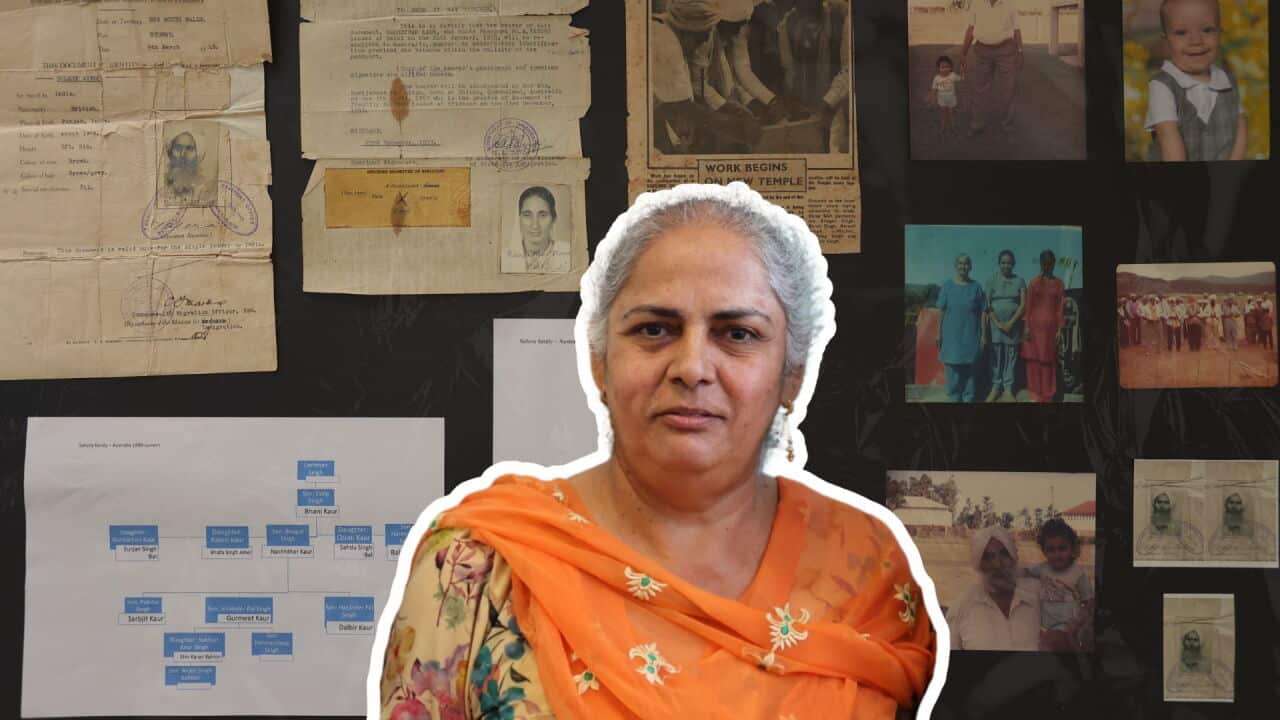


Growing up as a Punjabi in 1970s regional Australia, Narinder Singh reflects on her family’s migration journey that began when her father arrived in 1956. Her parents married in Cairns in 1965, building a life in Far North Queensland while holding closely to their faith, language and traditions. Narinder recalls balancing Punjabi life at home with Australian life at school, saying, 'As children, we were woken up quite early at home to listen to kirtan and paath records,' traditions she came to appreciate more deeply as she grew older. Now a parent herself, she says she has learnt to “merge” both identities while passing on values of community, honesty and Sikh traditions to her children.
Sumeet Kaur: I am Sumeet Kaur, bringing you the untold stories of Australia's earliest Punjabi settlers. This podcast series is called Punjabi Pioneers. In its first season, you will hear fascinating stories from Punjabi families who have lived in Far North Queensland for generations. You will also hear directly from women whose struggles and experiences have rarely been documented.
Through these interviews, my colleague Manpreet Kaur Singh has spoken with women living in Cairns, Gordonvale and Babinda, uncovering remarkable personal stories while shedding light on the early history of Punjabi migration to Australia.
Today we hear from Narinder Kaur.
Interview
Manpreet Kaur Singh: Narinder, welcome. Thank you for joining us as part of this project documenting the migration stories and histories of families who have made their lives in Far North Queensland. Tell us a little about your story and your family's connection to this region. How did your family come to settle in such a remote part of Australia?
Narinder Kaur: My father came to Australia as a 17-year-old in 1956. He was sponsored by family members who were already living here. My mother arrived in 1964 and my parents were married in Cairns in 1965.
My older sister was born in Gordonvale in 1967. In 1969, after obtaining Australian passports, my parents travelled back to India to visit family. I was born there during that visit and returned to Australia with them in early 1972 when I was about one year old.
Manpreet: That's fascinating. Your parents were able to travel back and forth at a time when very few migrants had that opportunity. Your mother also came to Australia before she married. What have you learned about her experience?
Narinder: One story she often tells is that she was woken up one morning and told, "You're getting married today."
She remembers feeling uncertain and overwhelmed. Like many young women, she had imagined what marriage and life in Australia might be like. But the reality was very different.
Life here involved hard work, isolation and struggle. It wasn't the glamorous image she had imagined before arriving.
Manpreet Kaur Singh: That's a perfect segue into your own story. Tell us what it was like growing up in Australia during the 1970s.
Narinder Kaur: One of the things that was very important to my parents was maintaining our religion and culture. I've brought along some records that belonged to them. As children, we were woken up early in the morning to listen to prayers and kirtan. We didn't have Guru Granth Sahib at home, but we listened to recordings like these. They're part of my parents' collection. At the time I probably didn't appreciate them very much, but as I've grown older I've come to value them deeply.
Growing up, there was always a balance between being Punjabi and being Australian. At home we followed Punjabi customs and traditions, but outside the home we were immersed in Australian culture. It was a constant negotiation between the two. On Sunday afternoons we were expected to sit down and learn how to read and write Punjabi. I don't think I ever truly mastered it. At the time it felt like something I was being made to do when I would much rather have been outside playing with my friends.
Manpreet: That's exactly what I wanted to ask you about. You were balancing two identities, the one your parents wanted to preserve and the one you experienced every day at school and with your friends. Was that difficult?
Narinder: Looking back, I don't think I fought against it very much. I was probably quite compliant as a child. My father worked extremely hard. He left early in the morning and came home late in the evening. You wanted to do the right thing because you respected your parents and saw how much they sacrificed.
As I grew older, though, I became a dreamer. I was always imagining different possibilities for my life. I used to write plays and perform them at school or with friends. I always felt there was something bigger waiting for me beyond the life I knew.
Manpreet: Your parents had already expanded the boundaries that existed for them. They were creating opportunities for you that they never had themselves. Did they understand the struggle you faced trying to find your identity between two cultures?
Narinder: I'm not sure they did in the way we understand those conversations today. The relationship I have with my own children is very different from the relationship we had with our parents. There were many topics that simply weren't discussed. We worked within the boundaries that were set for us and occasionally pushed against them, probably not always in the best ways, but in the only ways we knew.
Manpreet: Things like relationships, staying out late or having boyfriends were not really topics of conversation?
Narinder: Definitely not. Those conversations didn't happen. But those experiences shaped how I parented my own children. As an adult, you begin a journey of self-discovery. You start asking yourself who you really are and what matters to you.
My closest friends are still people I met at school and university. They understood both sides of my life. I didn't have to pretend to be someone different around them. Over time, instead of swinging between being Punjabi and being Australian, those two identities merged. They became one identity. That's probably something I only truly understood in my forties.
I also went through a traditional marriage that didn't work out. That experience changed the way I viewed culture, family and identity. It made me question which traditions were essential and which traditions might need to change.
My parents had to rethink certain things, and I had to rethink certain things. Sometimes we hold on to traditions very tightly, but difficult experiences force us to examine what should remain and what can be let go.
Manpreet: Looking back now, how much of your own childhood experiences shaped the way you raised your children?
Narinder: A great deal. I wanted my children to have the freedom to ask questions. I wanted them to understand where they came from, but I also wanted them to think critically and make their own choices. I didn't want them to feel that culture was something imposed on them. I wanted them to understand why it mattered.
They grew up in a different environment from mine. By then we had Gurdwaras. We had a stronger Punjabi community. They had opportunities that simply didn't exist when I was growing up. They understand our religion and our culture, but they also feel very comfortable as Australians.
At times they've questioned religion, culture and identity, and I've encouraged those conversations. I think faith becomes more meaningful when people arrive at it through understanding rather than obligation.
Manpreet: Do you think you've benefited from having both cultures?
Narinder: Absolutely. I think being part of the Punjabi community has given me a strong sense of belonging. There is a village mentality in the best possible sense. People support one another. The relationships formed through family and community are incredibly strong.
At the same time, growing up in Australia has given me opportunities, independence and confidence. I've been able to combine those two worlds.
I've also come to appreciate aspects of Punjabi culture much more as I've gotten older. Things I resisted as a child, I now value deeply. Learning from older women in the community, cooking together, sharing stories, learning traditional skills, those things have become much more meaningful with age.
I think I've probably learned more about being Punjabi in the last ten or fifteen years than I did when I was younger.
Manpreet: That's fascinating.
Narinder: It is. When you're young, you're often trying to fit in. Later, you begin to appreciate what makes you different.
I also think Punjabi culture teaches some important values: community, generosity, resilience and responsibility towards others. Sikh values in particular encourage service, humility and support for people who may be struggling. Those are lessons that have stayed with me throughout my life.
I hope those are the values my children carry with them as well, even if they don't fully appreciate them yet.
Manpreet Kaur Singh: You've grown up in a very close-knit Punjabi community here in Far North Queensland. Do you think your experience would have been different if you'd grown up in one of Australia's larger cities?
Narinder Kaur: That's a really interesting question. I think it probably would have been different. If I'd grown up in a major city, I suspect I would have drifted further towards mainstream Australian culture and perhaps not remained as connected to the Punjabi community.
Living here meant there was a strong sense of responsibility towards each other. Families knew one another. We attended the same community events. We celebrated milestones together. There was a constant reminder of who we were and where we had come from.
I don't think I would have developed that same connection if I'd been living in a larger city where people were more dispersed.
Manpreet: So the community itself played a significant role in preserving culture?
Narinder: Absolutely.
The community provided continuity. It created opportunities to stay connected to language, religion and traditions.
When you're surrounded by people who share those experiences, maintaining culture becomes much easier.
You don't have to actively seek it out because it's already around you.
Manpreet: What lessons do you think people living in larger cities could learn from communities like this?
Narinder: The importance of connection. I think one of the strengths of our community has been the willingness to support one another.
People look after each other. There is a genuine sense of belonging.
That doesn't mean everyone agrees on everything, but there is a shared understanding that we're connected through history, culture and experience.
In larger cities, people sometimes lose that connection because life becomes so busy and fragmented. I think preserving those relationships is really important.
Manpreet: Looking back on your parents' generation, what do you think they gave your generation that perhaps isn't always recognised?
Narinder: Opportunity.
They gave us opportunities they never had themselves.
My parents worked incredibly hard.
They sacrificed comfort, time and often their own ambitions so their children could have choices.
When I think about my mother arriving here and being told she was getting married that very day, or about the hardships they experienced as new migrants, I realise how much courage it took.
They didn't always have the language to explain what they were feeling, but they demonstrated resilience every single day.
That's probably the greatest gift they gave us.
Manpreet: Do you think younger generations understand those sacrifices?
Narinder: Not always.
And that's natural.
When you're young, you don't necessarily see the struggles that came before you.
You simply live the life that's been created for you.
It's only later that you begin to understand what your parents and grandparents endured.
As I've gotten older, I've developed a much deeper appreciation for what they achieved.
Manpreet: If you were speaking directly to younger Punjabi Australians today, what would you want them to know?
Narinder: I would want them to know that identity doesn't have to be a choice between one culture and another.
You don't have to choose between being Australian and being Punjabi. You can be both. In fact, that's where the richness comes from.
For a long time, I thought those identities were competing with each other. Now I understand that they complement one another.
Being Australian has given me opportunities, confidence and independence. Being Punjabi has given me community, culture, history and values. Together they make me who I am.
I would encourage younger people to remain curious about their heritage. Ask questions. Listen to stories. Spend time with older generations. Learn about your family history. You don't have to live exactly as previous generations did, but understanding their journey helps you understand your own.
Manpreet: That's beautifully said.
Narinder: I think every generation finds its own way. My parents' generation had one set of challenges. My generation had another. My children's generation will face different challenges again.
The important thing is to remain connected to the values that matter most while being open to change.
Manpreet: When you think about your own identity today, how would you describe it?
Narinder: I would describe myself as both Punjabi and Australian. Not one or the other. Both.
There was a time when I felt I had to move between those identities, depending on where I was and who I was with. Now I don't feel that way at all. They've merged into one. That's probably the greatest lesson I've learned.
Manpreet: Thank you for sharing your story so openly. I think it's been incredibly insightful, particularly because you've spoken not only about migration but about what happens after migration, how identity evolves across generations.
Narinder: Thank you. I've really enjoyed reflecting on it. Sometimes you don't stop to think about these things until someone asks you the questions.
Manpreet: Thank you, Narinder.
Narinder: Thank you.
Sumeet Kaur: You have been listening to a memorable interview conducted by my colleague Manpreet Kaur Singh. I hope you enjoyed the conversation.
Search for Punjabi Pioneers on the SBS Audio app or wherever you listen to podcasts.
Join me, Sumeet Kaur, throughout this first season as we bring you some of the untold, unheard and deeply moving stories of Far North Queensland's Punjabi pioneers.
Click on the audio icon to listen to the full report and interview in Punjabi.
Find all our podcasts and stories that matter here at SBS Punjabi Podcast Collection.
For news, information and interviews in Punjabi from across Australia and homeland, you can tune in to SBS Punjabi live from Monday to Friday at 4 pm on SBS South Asian on digital radio, on channel 305 on your television, via the SBS Audio app or stream from our website. Also, follow us on Facebook and Instagram.