In brief
- An ANU new report argues departures are being overlooked in Australia's migration debate.
- Long-term departures have not returned to pre-pandemic levels.
Migration has become one of Australia's biggest political flashpoints, frequently at the centre of debates about housing affordability, social cohesion and population growth.
The debate has become increasingly polarised. While experts say migration is essential to Australia's workforce and economy, critics argue it has contributed to pressures on housing affordability and public services, with that narrative driving a wave of anti-immigrant sentiment.
However, a new report suggests an overlooked driver of Australia's high migration figures is not a surge in arrivals, but fewer people leaving.
The analysis from the Australian National University, released on Monday, argues there's a more nuanced puzzle behind the perception that Australia is experiencing an unprecedented level of immigration.
And at the centre of it all, is an official measurement called 'net overseas migration', or NOM.
News that makes sense
Your trusted source for staying up-to-date with the world around you. Get free daily news updates and analysis, straight to your inbox.
What is net overseas migration and why is it important?
Both Labor and the Coalition have vowed to bring migration down, with NOM often used as the headline measure of whether those efforts are succeeding.
NOM measures the number of people who arrive in Australia and stay for at least 12 months, minus the number who leave for at least 12 months.
While NOM has fallen from its post-pandemic peak, delayed departures are keeping the figure elevated.
Contrary to popular belief, stabilising the migration system after the pandemic is not only a matter of cutting arrivals, the co-author of ANU report says.
"It's a matter of managing departures," Alan Gamlen, director of the Australian National University's Migration Hub told SBS News.
What the numbers say
NOM fell to 301,000 in 2025-26, according to the latest data from the Australian Bureau of Statistics (ABS).
That's down slightly from 306,000 in 2024-25, but still above Labor's forecasted figure of 295,000.
The government expects net overseas migration to decline to 245,000 this financial year.
When borders reopened following COVID-19 pandemic closures, Australia saw a surge in arrivals, with net overseas migration peaking at 556,000 in 2022-23.
During the pandemic, the government introduced visa extensions and other concessions to address disruptions caused by border closures and labour shortages.
"Temporary migrants who were caught in Australia needed some kind of relief," Gamlen said.
"Businesses who desperately needed workers needed some kind of relief, and the solution to that was to create all sorts of extensions to temporary visas for people who had a limited amount of stay in Australia."
The changes delayed the normal departure cycle for some temporary migrants.
Arrivals and departures to Australia both plunged during the border closures.
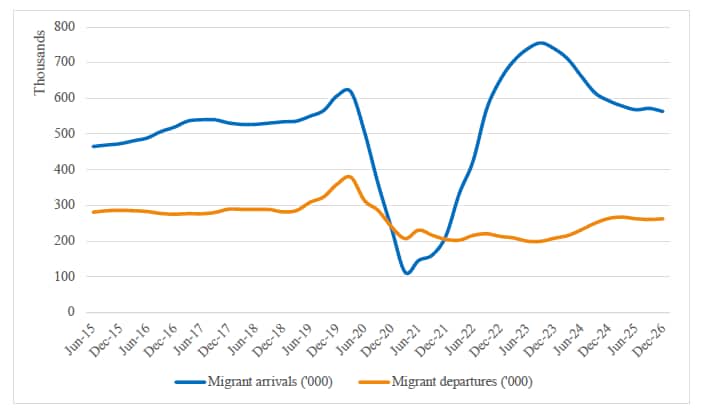
Arrivals rose sharply after borders reopened, before easing back towards pre-pandemic levels.
Departures, however, recovered much more slowly, remaining relatively flat for several years before beginning to tick up.
Because net overseas migration reflects the gap between arrivals and departures, the slower recovery in departures has kept the figure elevated.
Gamlen argued what this figure represents is often misused or misunderstood in political debate.
"The lack of understanding leads to opportunities for political actors to use confusing and misleading statistics to make a point and to mobilise a movement," he said.
The report notes, however, that there is a separate question about whether pre-pandemic levels of temporary migration were too high, too low or just right.
In the years immediately before the pandemic, net overseas migration had settled at levels that were higher than in the early 2000s, though below previous peaks in 2008-09.
Associate Professor Anna Boucher, a global migration expert at the University of Sydney, told SBS News delayed departures were clearly a "part of the story", but not the whole picture.
She said that, viewed in a longer historical context, migration levels remain relatively high even after accounting for the lingering effects of the pandemic on departures.
Why haven't departures recovered at the same pace?
ANU researchers said departures have been slower to recover due to the lasting effects of the pandemic.
Border closures disrupted the normal visa cycle of temporary visa holders, such as international students, working holiday makers and temporary skilled migrants.
Because fewer people arrived during the pandemic, in the years that followed, fewer people reached the point that they normally would have departed.
Relaxed rules and visa extensions also allowed people to stay longer than planned, in some cases enabling migrants to transition onto other visa pathways they might not otherwise have reached.
Gamlen argued the pandemic was one of the biggest disruptions to migration and mobility in history, with many other wealthy nations now following a similar pattern to what Australia is experiencing.
"A drop of migration during the pandemic, and then a big catch-up surge, and now sort of rocking in the wake of it, stabilising things after a massive shock," he said.
Boucher said, however, that a return to more typical departure patterns would depend on temporary migrants choosing to leave rather than pursuing pathways to permanent residency, adding that Australia has become an increasingly attractive place to settle amid growing global uncertainty.
How can Australia achieve sustainable migration levels?
The report's authors argued that the policy changes required to return net overseas migration to normal levels are more complex than public debate often suggests, because it will depend on how Australia manages its temporary migrant population.
They said policymakers should focus on the temporary migrants already in the country in the wake of the pandemic, while also looking at the long-term management of temporary migration.
Some temporary migrants will become permanent residents, some will extend their temporary visas, some will leave voluntarily and some may be required to leave.
How those pathways are managed will shape the impacts on the labour market, education sector and social cohesion.
Instead of talking about net overseas migration, Gamlen said Australia should be debating: "What is the appropriate and desirable size of the temporary migrant population in Australia?"
Deciding the size of Australia's temporary migrant population will ultimately be a political choice rather than a purely technical one, he said.
While economic considerations matter, he said the debate should also consider what kind of migration system Australians want and how it supports long-term settlement and social cohesion.
"So people can see that migrants are coming in, settling, integrating, they become part of the community, and there's no big toxic backlash against migration," he said.
For the latest from SBS News, download our app and subscribe to our newsletter.







