This audio is voiced by AI and may occasionally mispronounce words.
Share your feedback and help us improve this feature. Read more about how we use AI at SBS here.
Stone folds into stone in the Old City of Jerusalem, where light catches on steps worn smooth by centuries of passing pilgrims.
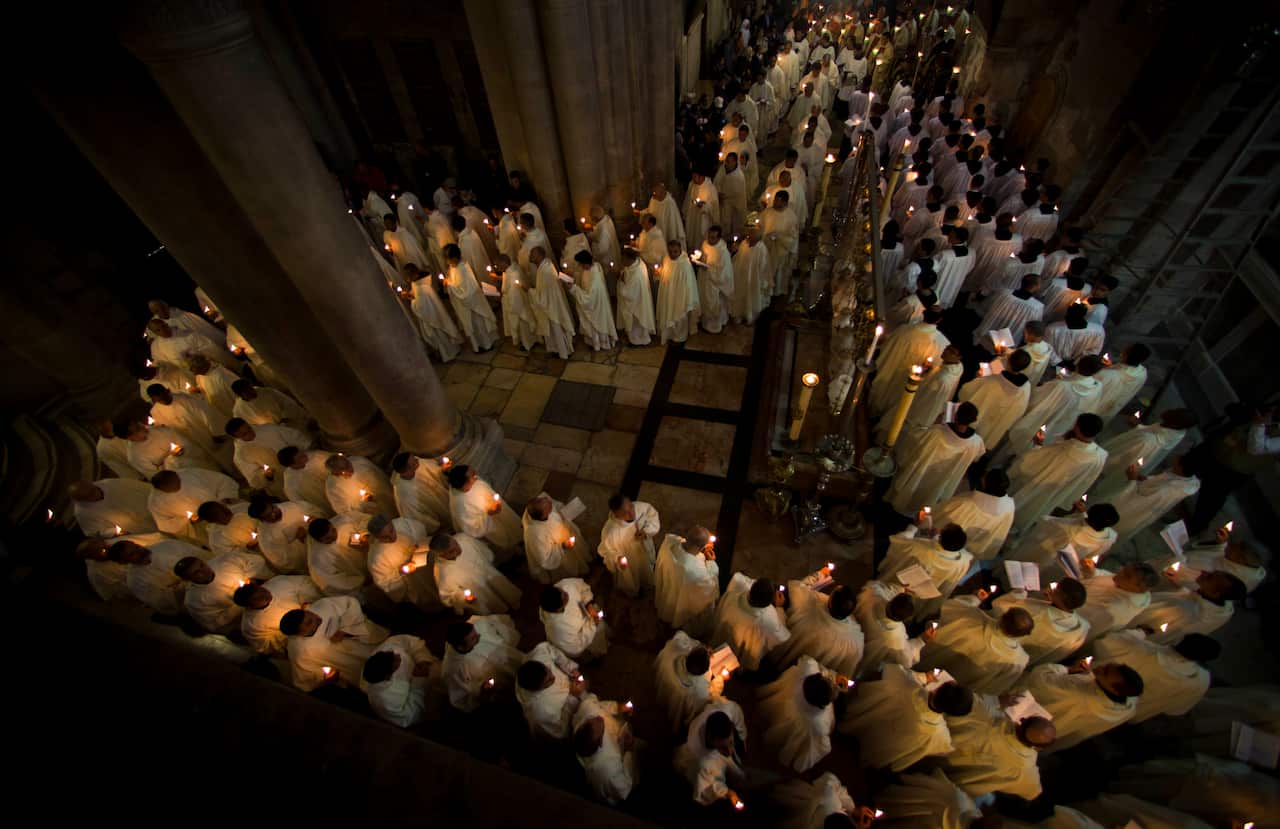
In the week before Easter, these streets typically hum with the voices and footsteps of worshippers, slowly gathering to form their annual processions.
But this year, the streets are hushed.
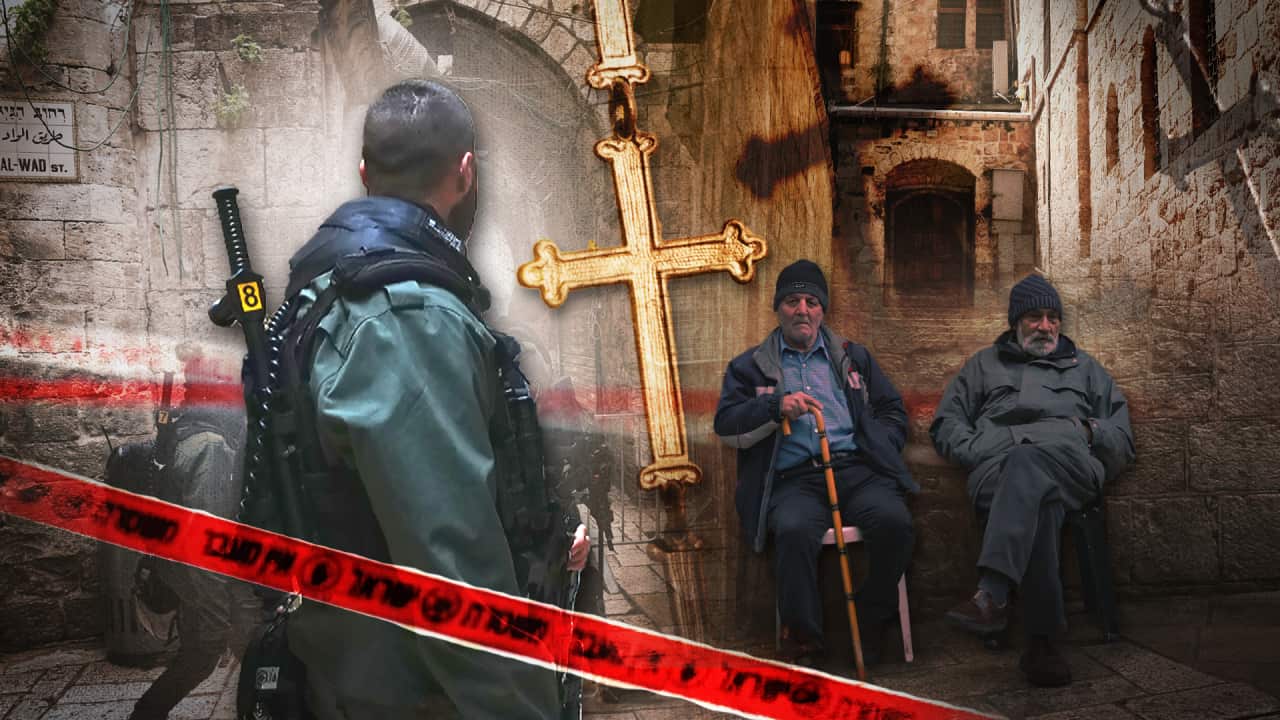
The route towards the Church of the Holy Sepulchre — the site long venerated as the place of Jesus Christ's crucifixion and resurrection — lies largely undisturbed, its usual crowds absent under the watch of security forces.
Even the air seems tense, as if the city is holding its breath.
News that makes sense
Your trusted source for staying up-to-date with the world around you. Get free daily news updates and analysis, straight to your inbox.
Access to the Old City's holy sites has been largely restricted by Israel since 28 February. Authorities say the measures, linked to the ongoing war in the Middle East, are "life-saving", particularly in areas without bomb shelters and along narrow, centuries-old passageways that emergency teams cannot easily reach.
Shrapnel from intercepted Iranian missiles has landed nearby, including on the roof of the Greek Orthodox Patriarchate on 16 March, just metres from the church's main building.
In the days that followed, leading up to Palm Sunday, Israeli authorities tightened restrictions and placed barricades to block clergy and worshippers from entering churches for scheduled services.
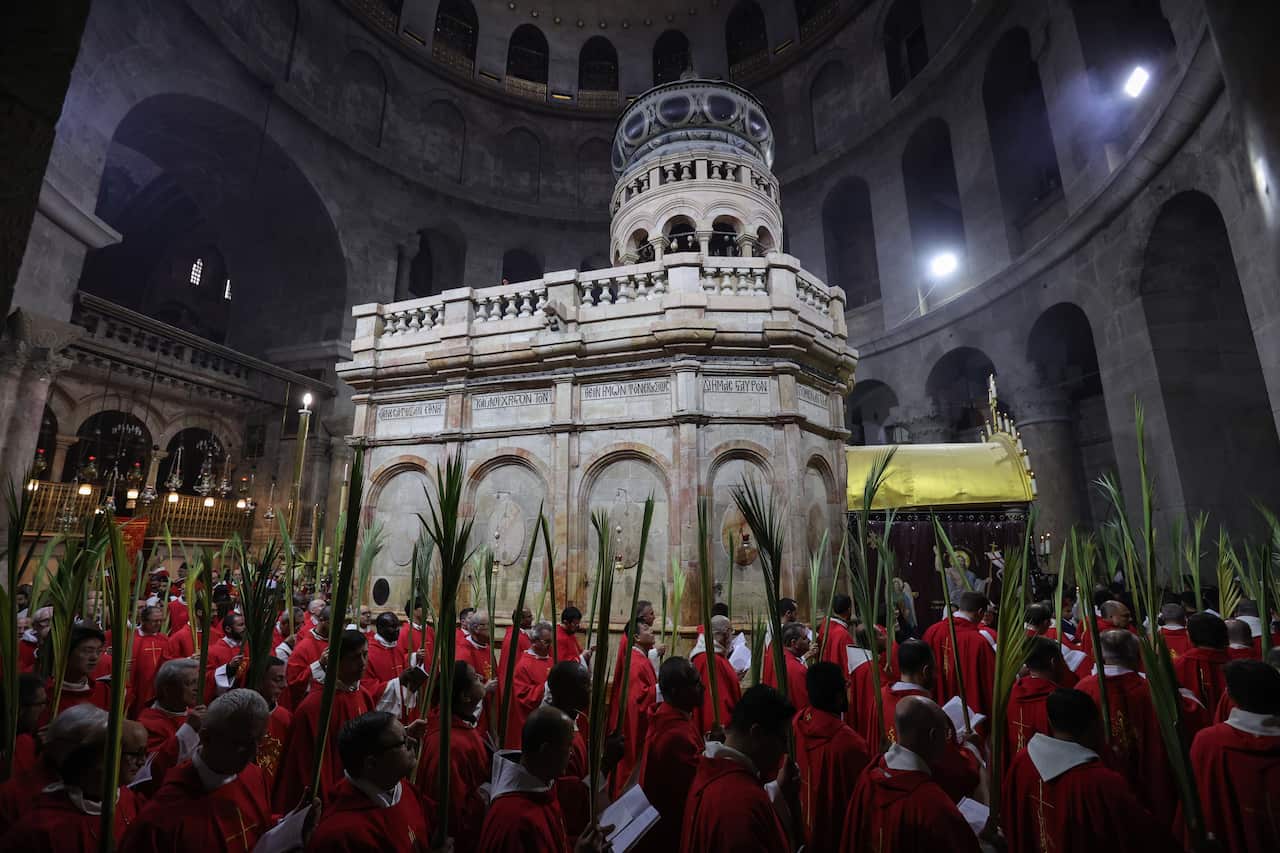
In a formal statement on 29 March, the Latin Patriarchate of Jerusalem announced: "For the first time in centuries, the Heads of the Church were prevented from celebrating the Palm Sunday Mass at the Church of the Holy Sepulchre."
Among those affected, Archbishop Pierbattista Pizzaballa, the highest-ranking Roman Catholic cleric in the Holy Land, was stopped by Israeli police on his way to lead the Palm Sunday liturgy — the opening service of Holy Week, a period tracing Jesus's entry into Jerusalem through to his resurrection. After public outcry, his access was later restored.
Authorities have said broader restrictions will remain in place across all major holy sites.
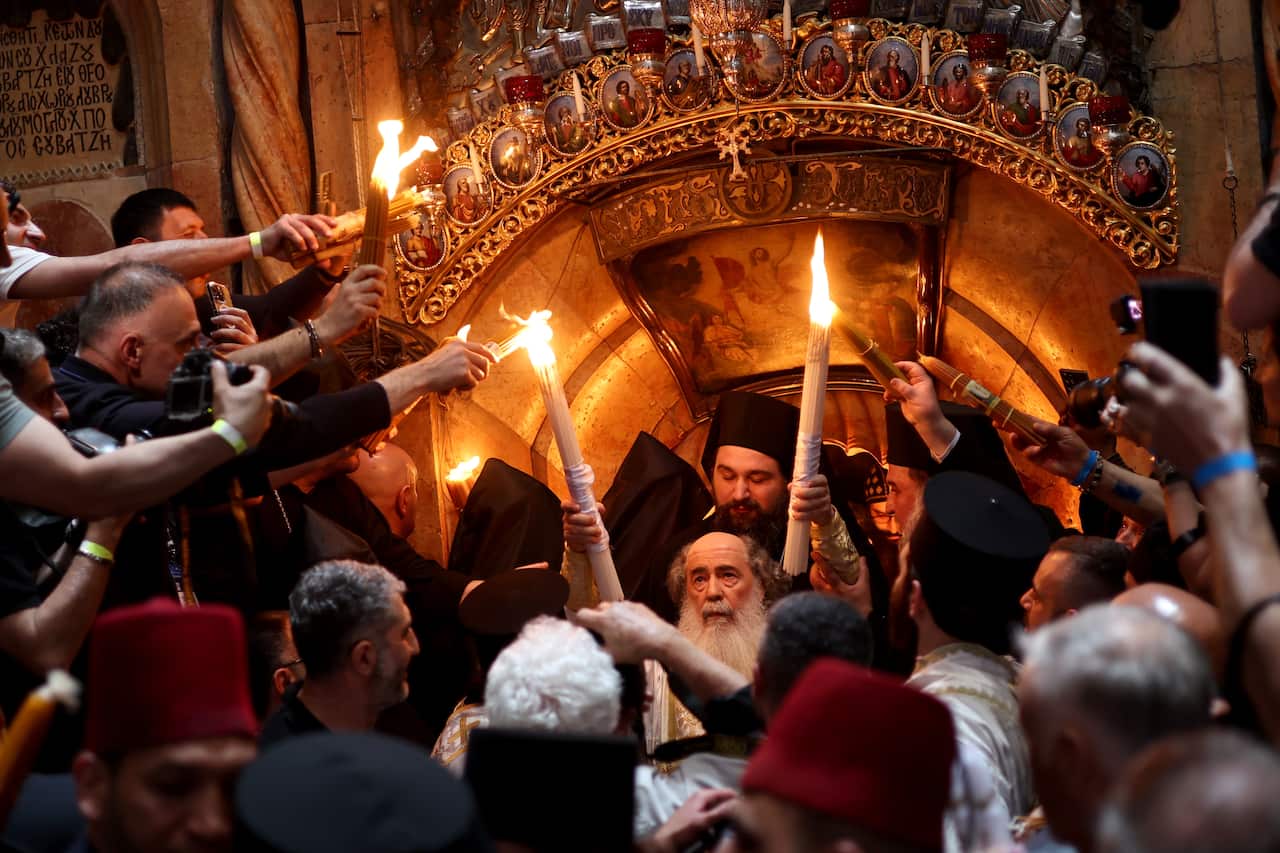
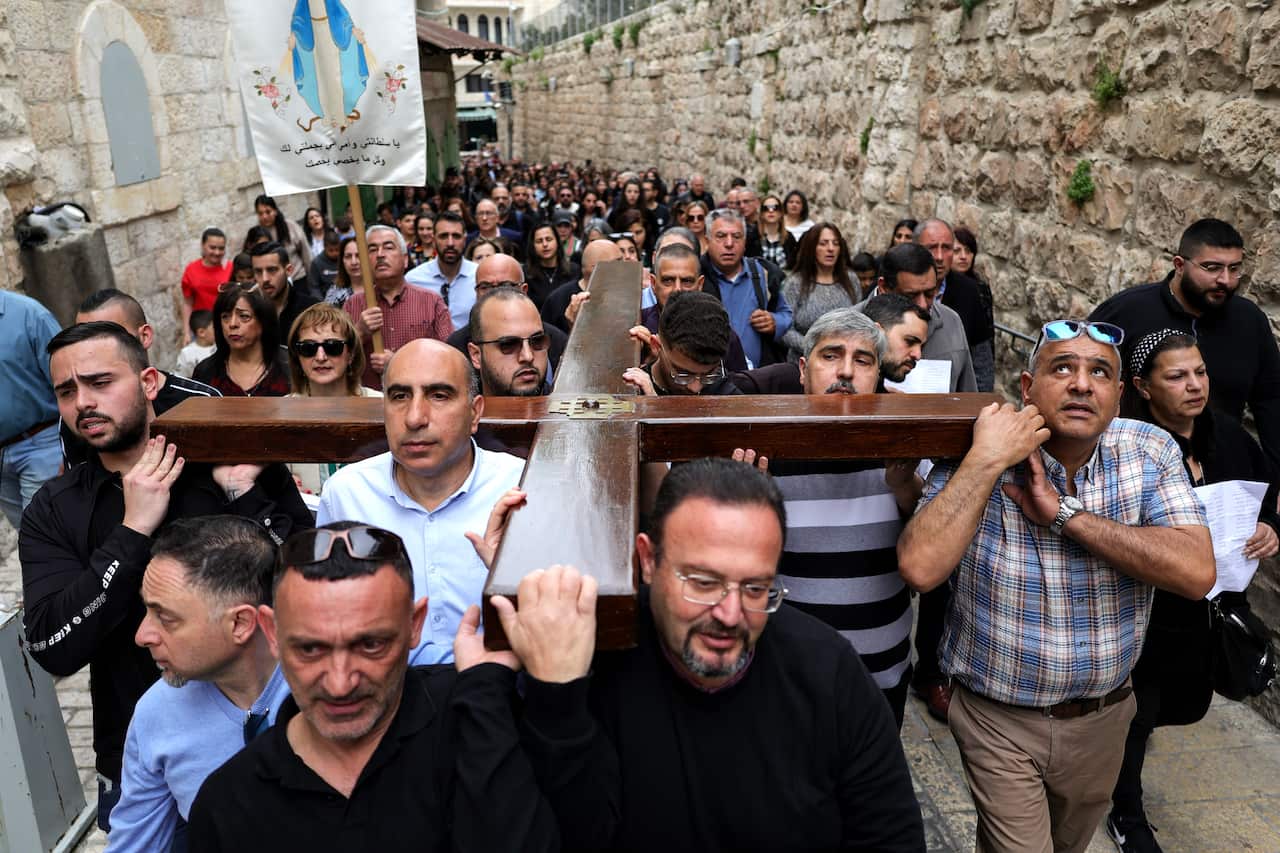
Holy Week is typically one of the busiest periods in the Old City, with tens of thousands of pilgrims and worshippers moving through its ancient streets. During this time, the faithful attend Lenten liturgies, trace the Via Dolorosa (Way of Sorrows) — following the path believed to have been taken by Jesus to his crucifixion — and gather for the Holy Fire ceremony in the Church of the Holy Sepulchre — one of the most sacred and visually striking moments of the year.
As during COVID-19, that vibrancy has again been stymied, with Easter, Ramadan and Passover unfolding under similar wartime constraints.
'Save us from the occupiers'
For Jerusalemite Omar Haramy, the stillness of the Old City this Easter mirrors a familiar reality.
"That's our church, that's our community, that's our people. We've been in the land since the resurrection," he tells SBS News.
Haramy is the director of the Palestinian Christian organisation, Sabeel Ecumenical Liberation Theology Center. He explains that his direct ancestors converted to Christianity on Pentecost, the day traditionally understood as the birth of the Church, roughly 50 days after the resurrection of Jesus Christ.
But despite that history, access to Jerusalem's holy sites has long been uncertain for Christians, particularly Palestinians. Visiting them often requires a permit — granted or denied by military authorities — to pass through checkpoints and enter the city, measures Israeli authorities say are necessary for security.
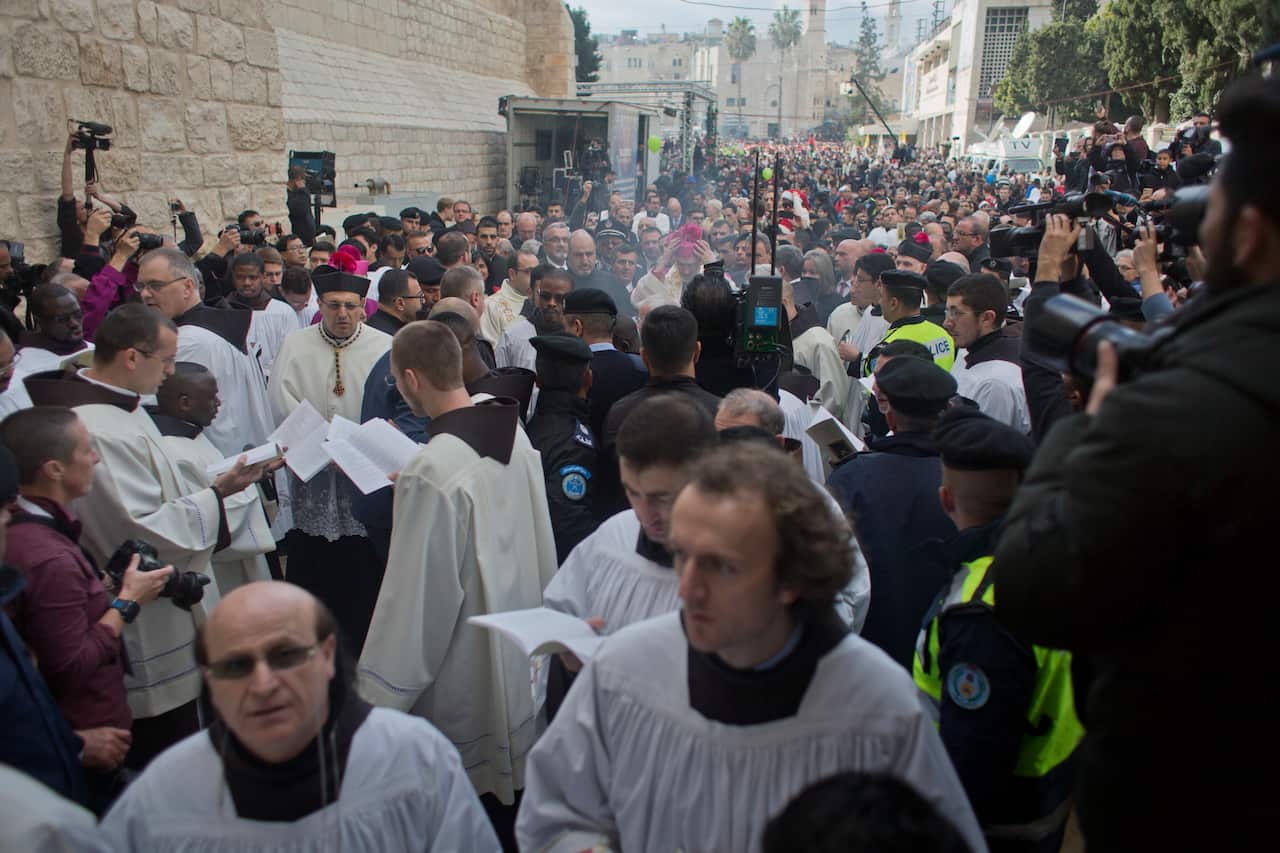
The journey to Jerusalem, even at Easter, is often interrupted or denied.
"With or without war, we've been complaining for many years — lay people, clergy, and also church leaders in different statements — that there have been plenty of restrictions of movement on Palestinian Christians," he says.
This year's closures follow that pattern. The absence of pilgrims and clergy has made visible the underlying restrictions that shape life in Jerusalem and determine who is allowed to remain within its walls during the most important week of the Christian calendar.
For Haramy, the significance of Easter cannot be detached from that reality.
"Palm Sunday was a major demonstration at the time of Jesus. When people said: 'Hosanna in the highest', Hosanna means save us from our occupiers," he says, referring to the nearly 400-year Roman rule over historic Palestine.
"It was a political demonstration. They were telling Jesus, believing that he is the liberating Messiah, 'come and save us from the occupiers'."
A parallel, Haramy argues, continues to this day.
We live under occupation … different from the Roman occupation [during Jesus' time], but very similar, which is the Israeli occupation.
In that context, the focus on access to a single site risks narrowing the frame. The church remains central, Haramy emphasises, but it does not stand apart from the people who sustain it.
"The church is not a building, it's the people," he says.
"The people will continue to meet, to organise, to worship."
Beyond Jerusalem's walls
Beyond the Old City, the consequences of regional war are felt on a far larger scale.
Conflicts across the Middle East have resulted in a large number of deaths in recent months. More than 75,000 people were killed in the first 16 months of the two-year war in Gaza, according to a study published in the Lancet Global Health medical journal, at least 25,000 more than the death toll reported by local authorities at the time.
Israel has questioned those tallies, citing Hamas control of Gaza's health ministry, though a senior military officer told Israeli media in January the numbers were broadly accurate — a view later disputed by the army.
Elsewhere in the region, ongoing hostilities have also caused substantial casualties. In Lebanon, more than 1,000 people have been killed since Israel invaded the country's south in March, while the broader regional war involving Iran and its allies has resulted in further deaths and injuries.
Haramy says the situation inside Jerusalem's walls, while troubling, pales in comparison to what's happening beyond them.
"We should be very worried that there are thousands of graves being opened on a daily basis because of this war — in Iran, in Lebanon, in Gaza and the West Bank. We should focus … on where people are suffering, not on an empty church with an empty grave."
Faith connected to land
The roads north from Jerusalem climb into the Hebron Hills, cleaved by a network of checkpoints that gradually open out into the cities of the occupied West Bank.
Nestled in those hills about 21km away is the city of Ramallah, one of the West Bank's most cosmopolitan centres. As the administrative hub of the Palestinian Authority, its rhythm is shaped as much by movement as by restriction.
Ramallah is home to a small Christian community numbering in the mere thousands — a minority within a predominantly Muslim population — though historically the city had a significant Christian presence, particularly among Greek Orthodox believers.
Even here, the war is felt overhead.
"We are caught between a war … and literally missiles fly over our heads, we hear explosions in the skies," Reverend Fadi Diab tells SBS News.
Diab is the rector of St Andrew's Episcopal Church in Ramallah, part of the Anglican Diocese of Jerusalem, which oversees congregations across Israel, the occupied Palestinian territories — which Australia recognises as the state of Palestine — and neighbouring countries. His parish is close enough to the Old City to feel its pull, but can not always reach it.
"In the Holy Land, Easter is very unique … this is where all the story happened," he says.
But we speak about having the opportunity to visit Jerusalem, something that Palestinians are denied at the moment.
In Eastern tradition, Easter is a celebration that spills beyond the church, into the life of the city itself.
"It's more of a national feast," Diab says.
"You can imagine how devastated Christians in the Holy Land are to learn that the churches are closed for weeks at a time, when everyone looks towards the church."
That connection, he suggests, is not incidental, but foundational.
"Part of our faith and theology is very much connected to the land," he says.
"We live in the land of the very birthplace of the Christian faith, the very birthplace of Jesus. Christianity has been witnessing the love of God in this land for more than 2,000 years, and that is part of our identity — who we are as Christians, but also [who] we are as Palestinians in this land."
Within the Anglican Church, that history takes a different shape. Originally established through British missionary activities in the 19th century, the Anglican presence in the Holy Land has, over time, evolved into a locally led church.
In practice, this involves Palestinian clergy leading Palestinian congregations in their own land, rather than a church directed by foreign leadership.
"We cannot deny that the origin of the establishment of the Diocese of Jerusalem started with both political and religious interests … in the Holy Land; controlling land that was geographically very important for the British empire," Diab says.
But 50 years ago, the church became an indigenous community.
"Now we have a church that is run by a Palestinian leader … and the community takes pride in that indigenisation of the Anglican church."
Under the magnifying glass
The Anglican Church's colonial history, one that is painful and complex for many, has shaped its traditions and influenced how Palestinian Anglicans position themselves within the broader Christian landscape in the Holy Land.
These traditions began to take root in 1976 with the appointment of Archbishop Faik Ibrahim Haddad.
His grandson, John Na'em Snobar, recalls how he would read texts slowly, and never just once.
He describes his grandfather's gesture clearly: a page lifted, a magnifying glass held over the text, each line painstakingly checked before he moved on. It was not about failing eyesight, nor habit; it was caution.
"He had such a sense of mistrust about what he was reading … he knew that the Anglican church was used to help colonise Palestine," Na'em Snobar tells SBS News.
"He was extra sensitive to correspondence, and he really paid attention to every letter and every word."
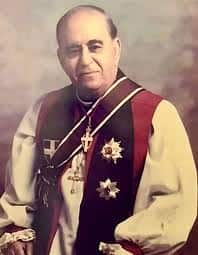
Ibrahim Haddad led the church at a time when its structures were still closely tied to its British missionary origins. His appointment was a turning point, after which local leadership and self-governance became hallmarks of the church.
This year will mark its golden jubilee.
Ibrahim Haddad's daughter, Randa Haddad Snobar, says his legacy stands alongside that history.
"He was a very courageous man … very loving. He loved to serve people, not only his community and not only his church, but everybody," she says.
He experienced being a refugee in 1948 … and that stayed with him for the rest of his life.
"It gave him something to fight for … and he carried that with him in everything he did — as a priest, as a bishop, and as a Palestinian."
In the winter of 1980, under a night curfew imposed by Israeli authorities across Jerusalem, Ibrahim Haddad got into his official car — a vehicle recognised for its ecclesiastical and diplomatic authority — and drove through the city's checkpoints to visit the Sunni Mufti.
The curfew had emptied the streets. He went anyway.
Na'em Snobar describes the moment as a gesture of religious solidarity.
"Recognising the danger that [the curfew] posed to Muslim-Christian unity, my grandfather took a very rare and courageous stand," he says.
There are very few cracks in the solidarity between Palestinian Christians and Muslims. We work hand in hand. We are one people.
In October 2023, Na'em Snobar would make his own break with the institutions he served, resigning from his then-post with Australia's Department of Foreign Affairs and Trade in protest over the war in Gaza — a decision he says was shaped, in part, by the same "spirit" that informed his grandfather's defiance.
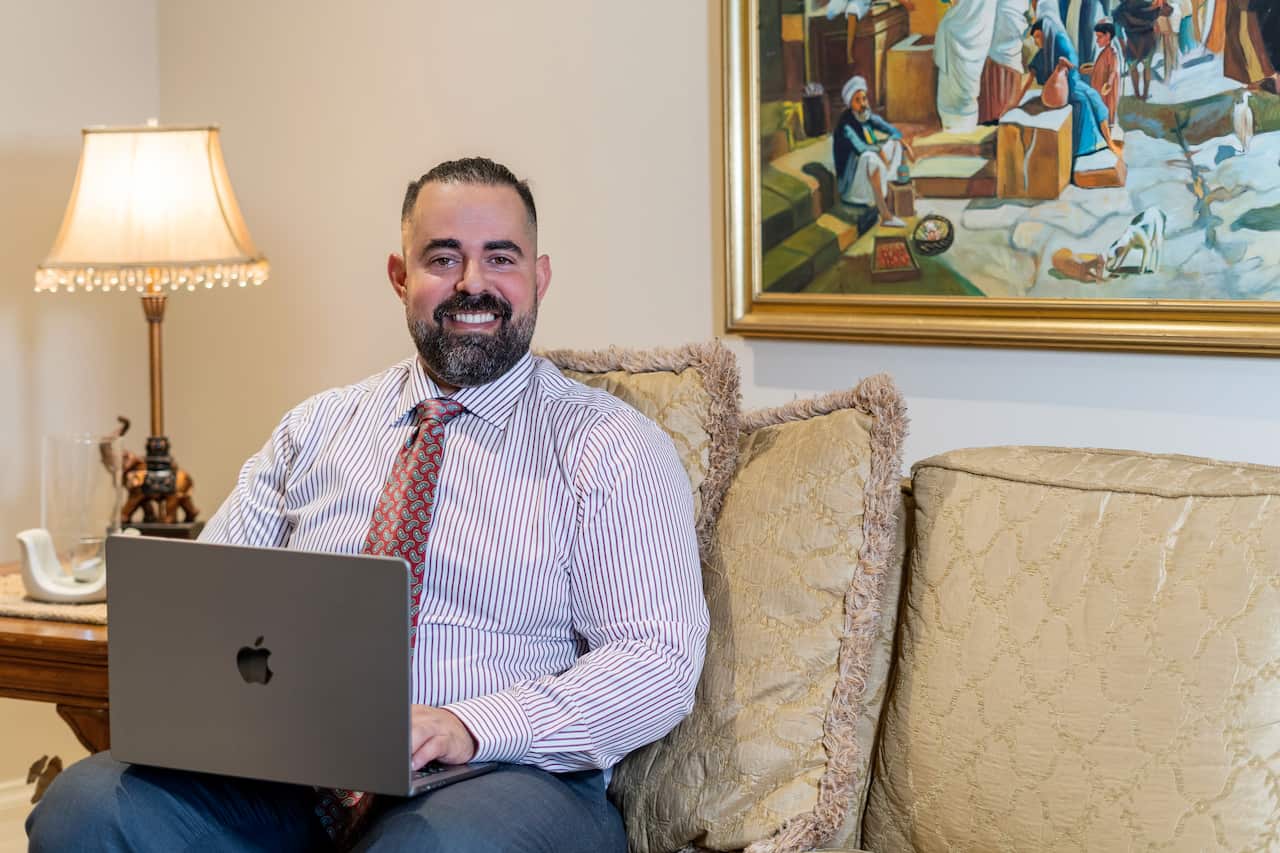
For Randa Haddad Snobar, that legacy of solidarity is also carried in memory. As a child in Jerusalem, she remembers Easter taking shape along the city's hills and stone paths, its rituals, led by her own father, tracing routes long worn into the landscape.
"On Palm Sunday, there were lots of roads that would be closed … everybody was carrying a piece of either an olive tree or a palm," she says.
"We would go down from the Mount of Olives [the site of Jesus' ascension] … lots of people, even pilgrims, it used to be huge."
Even as the crowds thin at Easter this year, the land still holds the story.
For the latest from SBS News, download our app and subscribe to our newsletter.







