In brief
- Four Australians, a New Zealander and a British national are in the Netherlands preparing to be transferred to Perth.
- The Australian government has been given 48 hours by the Netherlands to evacuate the six passengers.
A cruise ship hit by a deadly hantavirus outbreak left Spain's Canary Islands on Tuesday, after the last passengers on board, including four Australians, arrived in the Netherlands to await travel plans to head home.
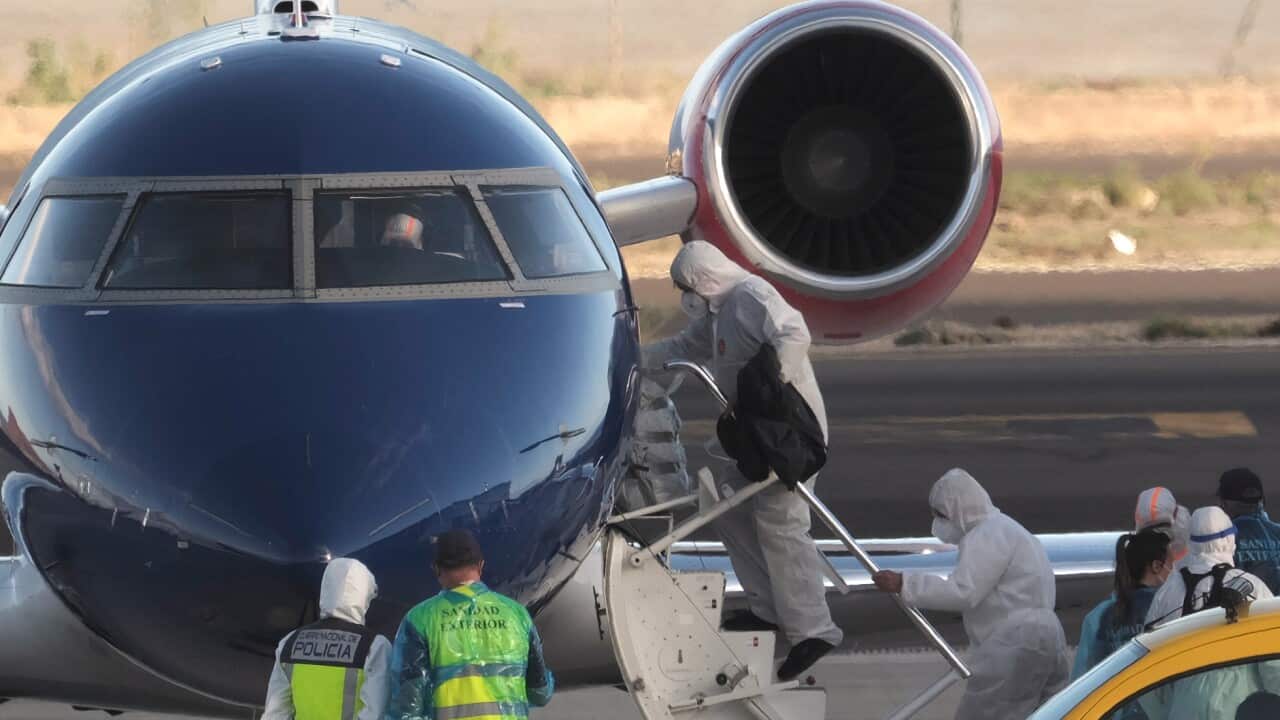
The last two evacuation planes carrying passengers and crew from the hantavirus-hit ship MV Hondius landed in the Netherlands on Tuesday, according to an Agence France-Presse (AFP) journalist.
Travelling in the two planes were 28 evacuees from the ship, according to the Dutch foreign ministry, including passengers, crew, and medical staff.
The first plane to land was transporting six former guests of the Hondius, four from Australia, one from New Zealand, and one British person who lives in Australia.
These six are expected to stay in a quarantine facility close to the airport before being flown to Australia.
News that makes sense
Your trusted source for staying up-to-date with the world around you. Get free daily news updates and analysis, straight to your inbox.
Health Minister Mark Butler told reporters on Tuesday the group was in "good health and relatively good spirits".
The Australian government has been given 48 hours by the Netherlands to evacuate the six passengers, a deadline Butler was "confident" his government would meet, even though a plane and crew were yet to be acquired.
He said that the Department of Foreign Affairs and Trade was in the process of finalising the group's flight details.
"These are complex arrangements, given the distance between the Netherlands and Australia, and also the requirement to find a company willing to charter a flight that will be subject to, obviously, quite strict hygiene requirements ... and for it to be crewed by crew who are willing to undertake isolation," Butler said.
He said the evacuees and crew operating the repatriation flight will land at an RAF base near Perth, and will then be taken to the Bullsbrook Centre for National Resilience for a three-week quarantine.
Butler announced that hantavirus had also been listed under the Biosecurity Act, giving the government the power to mandate quarantine requirements.
The six passengers and repatriation crew would be looked after by staff from the National Critical Care and Trauma Response Centre, a Commonwealth team based in Darwin.
He said WA Health staff would not be involved in their care, unless they were to become very ill and needed to be treated by a Perth Hospital.
Three people died after the rare virus that usually spreads among rodents was detected on board the MV Hondius, sparking a global health scare.
No vaccines or specific treatments exist for the virus, but health officials have insisted the risk to the public is low and dismissed comparisons to the COVID-19 pandemic.
The ship set off from Tenerife on Tuesday after the last 28 people were taken off, according to AFP reporters at the scene.
"It is expected to take MV Hondius six days to sail to Rotterdam," cruise operator Oceanwide Expeditions said in a statement.
"A provisional arrival date is the evening of Sunday, 17 May 2026."
The ship has 25 crew and two medical staff on board, and is also carrying the body of a German passenger who died during the cruise, it added.
The complex evacuation procedure saw 94 people of 19 different nationalities taken from the Dutch-flagged vessel on Monday.
Spanish authorities said the vessel, which was originally only authorised to anchor offshore on health and safety grounds, docked in port due to unfavourable weather.
AFP journalists at the small industrial port of Granadilla on Tenerife saw workers connect a walkway to the ship and people leaving the vessel en route to their repatriation flights.
The central Spanish government has stressed that there would be no contact with the population.
Search for contacts
Among the completed repatriations, a French woman, one of five evacuees from France placed in isolation in Paris, started to feel unwell on Monday, and "tests came back positive", French health minister Stéphanie Rist said.
A Spanish passenger has also tested positive, the health ministry in Madrid said, adding that results for the 13 other Spanish evacuees were so far negative.
On Monday, the US health department said one American national evacuated from the ship had "mild symptoms" and that another had tested positive for the Andes virus, the only hantavirus strain that is transmissible between humans.
Meanwhile, 12 staff members at a Dutch hospital treating an evacuee who tested positive were in preventative quarantine due to procedural errors taking blood and disposing of the patient's urine.
They would be isolated for six weeks as a precaution, "even though the risk of infection is low", the Radboud University Hospital in the east of the country said.
Spain's health ministry defended the rigour of the evacuations, where medical teams escorted passengers from the ship to an airport on Tenerife under close supervision and following health checks.
"From the start, all the measures adopted have aimed at cutting the possible chains of transmission ... all measures for prevention and control of transmission have been applied," it said in a statement.
In all, eight cases have been confirmed in the outbreak, and two more are listed as "probable", according to the World Health Organization and national health authorities, with citizens of six countries affected.
Other suspected cases and potential close contacts with infected people are being investigated, with health authorities in several countries tracking passengers who had already disembarked from the ship, plus anyone who may have come into contact with them.
In a video shared on Tuesday by Oceanwide Expeditions, captain Jan Dobrogowski paid tribute to the "unity and quiet strength" of everyone on board and highlighted the "courage and selfless resolve" of the crew.
The MV Hondius left Argentina, where hantavirus is endemic, on 1 April for a cruise across the Atlantic Ocean to Cape Verde.
The WHO believes the first infection occurred before the voyage started, followed by transmission between humans on board the vessel.
But Argentine health officials have questioned whether the outbreak originated in Ushuaia, based on the virus' weeks-long incubation period and other factors.
For the latest from SBS News, download our app and subscribe to our newsletter.







