IN BRIEF
- Pauline Hanson says Australia should be a "monocultural" society.
- Seventy-five per cent of surveyed Australians said they accept that multiculturalism is good for society.
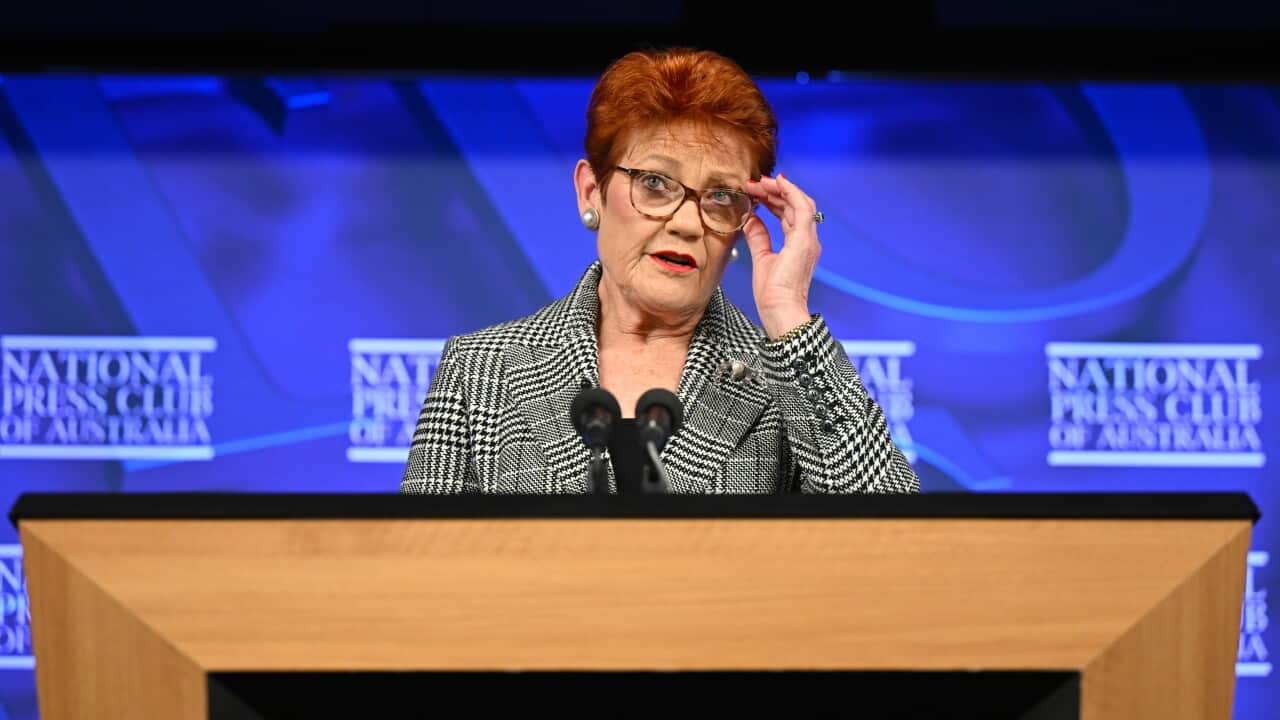
Speaking at the National Press Club on Wednesday, One Nation leader Pauline Hanson called for an Australia that has almost never existed — and that most Australians oppose: a monocultural country.
"We cannot be a multicultural society," she said.
"We are a multiracial society, but we must be monocultural. Australians must live under the one cultural umbrella."
Her vision sets One Nation apart from the policies of both major parties, with Labor and the Coalition not opposing multiculturalism for decades, despite disagreements in recent years over migration.
In response to her speech, Opposition Leader Angus Taylor said One Nation needs to explain why Hanson "wants to judge people based on the colour of their skin or their race".
News that makes sense
Your trusted source for staying up-to-date with the world around you. Get free daily news updates and analysis, straight to your inbox.
Labor frontbencher Murray Watt also criticised Hanson and told ABC News Breakfast that "she only wants a fair go for some of us. That's not the Australian way".
Most Australians are taking an opposing view to Hanson, according to recent polls.
Australians supporting multiculturalism
A recent poll by the Australian Bureau of Statistics (ABS) suggests that in 2025, a vast majority of Australians, 75 per cent, accepted that multiculturalism was good for society. Residents aged 15 and over, across 13,302 households, were involved in the survey.
Experts say that Australia's support for multiculturalism stems from its history of immigration.
"That figure reflects an understanding that most Australians have," Gwenda Tavan, adjunct associate professor of politics at La Trobe University, told SBS News.
"This is the society we live in. This is the culture that we have. Many, many people from different countries have come to Australia over the decades to create the multicultural tapestry we have now.
"There's never been a monoculture in Australia ... the British settlers that came after 1788, they were never a monoculture. They were divided by class, ethnicity, and religion."
Australia's First Nations people have lived on the land for more than 65,000 years. They come from hundreds of different language, social and nation groups.
'Separating truth from fiction'
There are signs this confidence in multiculturalism is under pressure, with support for multiculturalism dropping 10 per cent since 2020, according to the ABS.
"That decline may be partly mixed up with more general feelings, and concerns about immigration numbers at the moment," Tavan said.
"I think people are concerned about the nature and pace of social change, and economic change in Australia, that's partly a reason for that drop."
According to ABS figures published on Thursday, net overseas migration (the number of people arriving to live in the country minus the number leaving) was 301,000 people in the 12 months leading to December 2025. The figure fell about 9 per cent on the previous 12 months, and represents a big decline from its peak of 556,000 people in 2023.
Tavan said the drop in support for multiculturalism is also "part of a much wider movement. It taps into a lot of anxieties across liberal democracies about the nature of politics and the nature of our society".
"There are some interesting questions to be asked about what political movements might be facilitating this resurgence of populist, racist and nativist politics across the globe," she said.
A February report by the Scanlon Foundation Research Institute, which interviewed over 8,000 migrants from rapidly expanding communities, also found that older migrants tend to have a stronger sense of belonging than younger migrants.
"It's for governments to keep explaining, communicating, what it is that their policies do, and it's for people to ask some serious questions about the nature of our society," Tavan said.
"It's a battle that people just have to keep revisiting. We call it a battle because I see it as potentially very dangerous."
"And separating out truth from fiction is a good start."
People who 'build our homes'
In her speech, Hanson claimed "undeniably, immigration or immigration policy" has put Australia in a "state of crisis".
Later, she added that "under the failed policy of multiculturalism, all cultures are allowed equivalence to ours ... we oppose entirely people coming into this country and bringing with them the troubles they have left behind".
"Labor has allowed this immigration catastrophe to happen in the middle of a national housing crisis," she said.
While many experts agree that the level of migration has some effect on housing, they are divided on how significant that effect is.
Matt Grudnoff, senior economist at the progressive political think-tank the Australia Institute, said that "data shows that migrants are not having an impact on the housing affordability issues" and in general they have "a positive impact" on the economy.
"It's very easy to blame migrants, because they're an easy scapegoat," he told SBS News.
"Migrants tend to be more likely to be employed, more likely to be paying taxes, and they contribute to the workforce."
Grudnoff said broadly speaking, migrants supply labour and create more demand for labour because many people who come to Australia are on skills-related visas and " can help build our homes."
"The problem with scapegoating is that it doesn't fix the problem. We're not fixing the problem, and we're actually spending time not making people's lives better."
For the latest from SBS News, download our app and subscribe to our newsletter.







