in brief
- Compared to other developed nations, Australia's government spending differs because each country faces unique challenges.
- Increased defence spending, investment in the energy transition, and rising health costs will lead to cuts in other sectors.
As Australians grapple with cost-of-living challenges, the federal budget has become a balancing act between economic relief and long-term stability.
From housing affordability to healthcare and defence, Australia's budget priorities reveal the issues weighing most heavily on the nation.
So, what are Australia's budget priorities and how do they compare to those of other countries?
Australia's biggest spends are on social and health
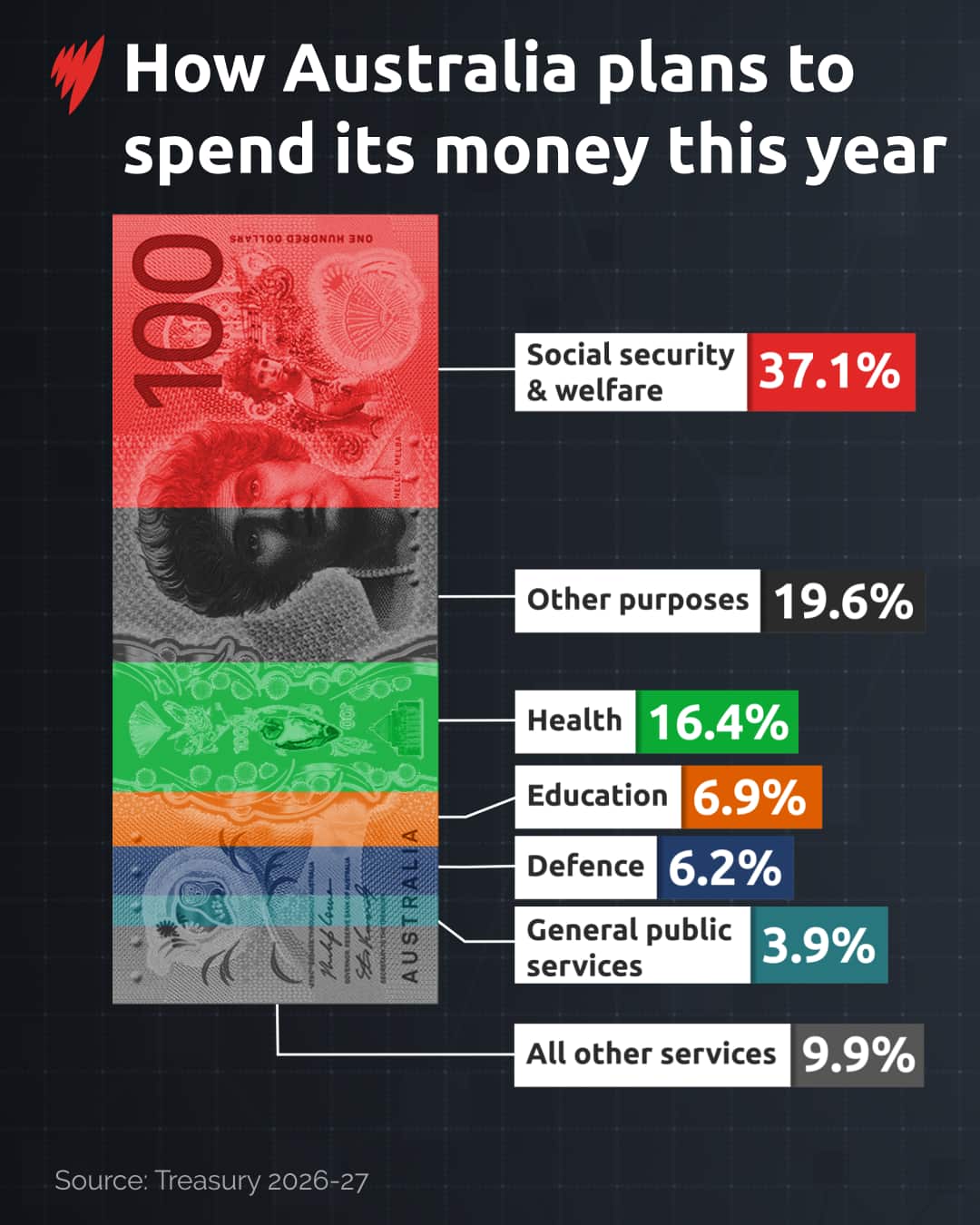
In Australia, the largest portion of government spending goes toward social security, welfare and health — accounting for 53.5 per cent — followed by education, and defence.
News that makes sense
Your trusted source for staying up-to-date with the world around you. Get free daily news updates and analysis, straight to your inbox.
Recent federal budgets have strongly focused on easing cost-of-living pressures through energy rebates, tax relief, housing initiatives, and Medicare funding.
Professor Alan Duncan, the director of the Bankwest Curtin Economics Centre in Perth, said the government is focused on managing the pressures associated with population growth and ageing, housing affordability and the delivery of essential services.
"Health, Medicare, and the National Disability Insurance Scheme consume a growing share of Commonwealth spending, as does broader welfare support," he told SBS News.
"Governments have limited room to constrain these areas because they go directly to community expectations around health, well-being, and access to essential services."
- Why the budget might not 'shift the dial' on home ownership
- Who are the winners and losers of the 2026 federal budget?
- Visas, English tests: How the budget is reshaping migration
- Your five-minute guide to the budget
Duncan said the 2026 budget walked a line between short-term relief and long-term social reform.
"One of the emerging tensions in Australian public finance is that governments are increasingly focused on managing the consequences of economic and social change — through housing, healthcare, defence, and welfare spending — while potentially underinvesting in some of the long-term capability-building sectors that ultimately drive future productivity and national resilience," he said.
How does Australia compare to other countries?
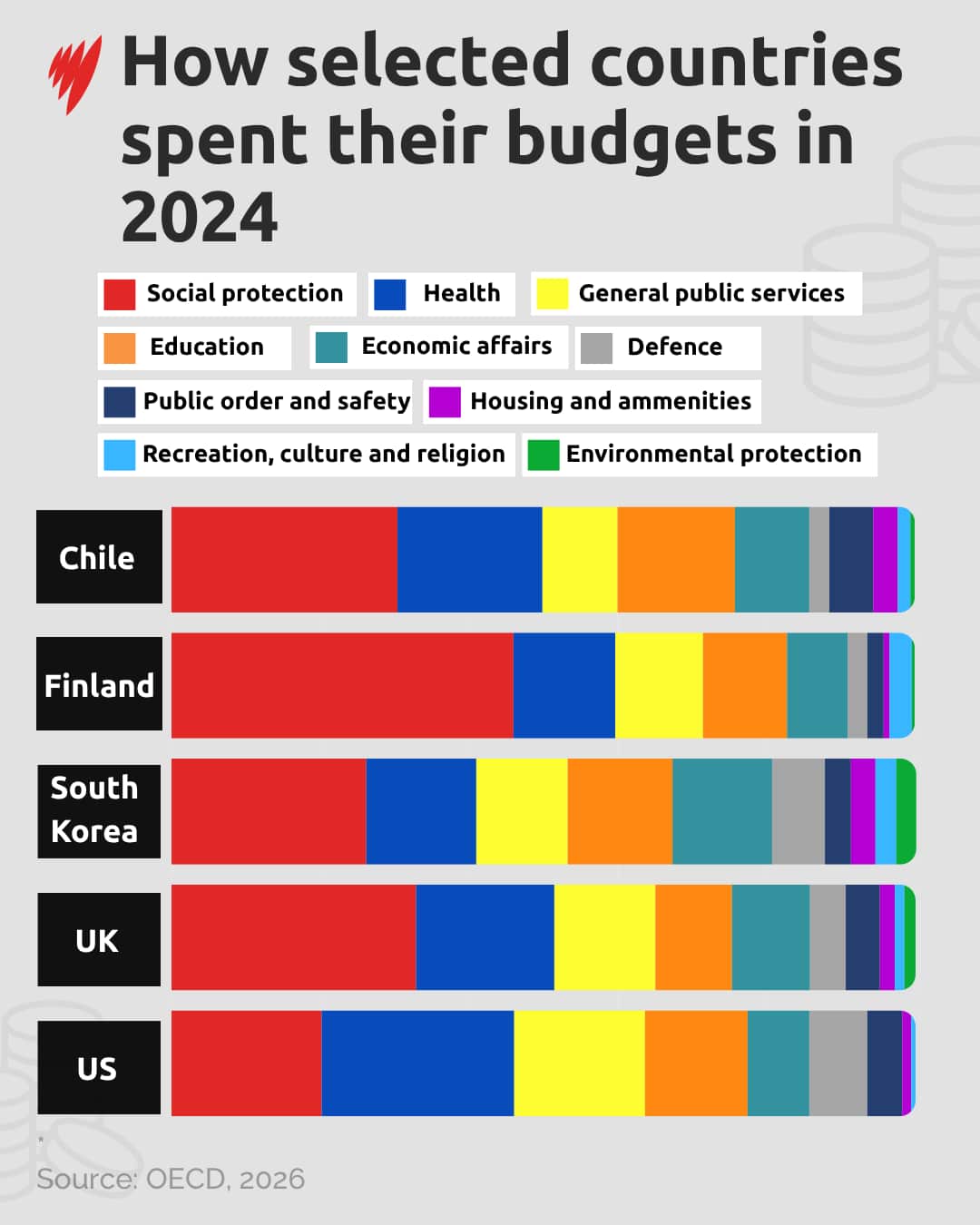
Compared to other developed nations such as the United States, Finland, and Japan, Australia's government spending differs because each country faces unique challenges.
While wealthier economies tend to spend heavily on welfare, healthcare and defence, the proportion allocated to each area highlights different national priorities.
The US differs greatly from Australia because of its enormous defence spending.
The US has the largest military budget in the world, representing about 3.1 per cent of the nation's gross domestic product.
This expenditure accounted for roughly 13 per cent of all federal spending in 2025.
Professor Brenda Gannon, an economist from the University of Queensland, is an expert in health and social policy.
Gannon said Australia and other developed countries spend around 10 or 11 per cent of their GDP on health and social policy.
"So that seems appropriate compared to the US, where it's around 16 per cent and yet people suffer there because they have large out-of-pocket expenses," she told SBS News.
The US healthcare system is far more expensive for patients than Australia's, because it relies heavily on private providers and insurance-based systems rather than universal public healthcare.
One welfare system followed by several European countries, such as Finland, is at times referred to as the Nordic model.
Compared to Australia, Finland spends a much larger proportion of its budget on education, healthcare, childcare, unemployment benefits, and family support services.
Finnish citizens pay higher taxes in return for extensive public benefits, including low-cost university education and strong social safety nets.
"If you think of northern Europe, the tax rates are higher," she said, "but there's enough supply and therefore provision of services making it more efficient."
Spending more on welfare in isolation would not improve access, she explained, as you also need better infrastructure and staffing levels like those in Finland.
Duncan and Gannon said that Australia's ageing population will continue to shape future budgets as demand for aged care and health services increases.
Countries with an ageing population, like Australia, tend to have proportionally higher aged care spending.
Japan has one of the oldest populations in the world, and a large percentage of government spending goes toward pensions, elderly healthcare, and aged care services.
However, some of these pressures could be alleviated thanks to digital technologies and telehealth options, according to Duncan.
Japan, much like Australia, also plans to increase its defence spending in response to rising tensions in the Indo-Pacific.
How could budget priorities change?
Duncan said that budgets inevitably involve trade-offs, and increased defence spending, investment in the energy transition, and rising health costs will place mounting pressure on the expenditure base elsewhere over time.
"I do see risks that higher education and university research become relatively deprioritised," he said.
"And that sits uneasily alongside the government’s broader narrative around innovation, productivity enhancement, and economic transformation."
Environmental programs outside the clean energy transition may also come under increasing pressure, he predicted.
"Governments appear more willing to fund measures tied directly to energy security, industrial capability, and emissions reduction than broader environmental protection or conservation programs that may be seen as delivering less immediate economic or geopolitical returns."
For the latest from SBS News, download our app and subscribe to our newsletter.







