
in brief
- Treasury data shows lower migration barely impacts individual Australian wealth.
- Experts warn smaller migrant numbers increase fiscal burdens for retirees.
Australian living standards would not collapse if population growth targets are not met in the future, Treasury forecasts predict, with households revealed to be just a few hundred dollars worse off even with a drastically different size.
The difference between a high migration and a low migration scenario in the next 40 years, may only pan out to affect GDP per capita by about $400, the figures state.
However, experts caution that governments will need to make "tough decisions" around funding if fewer migrants were to arrive in the country, as a shrinking tax base would have to support a growing dependent population of retirees.
Some of the government's political opponents have cited the results of the Intergenerational Report (IGR) to claim that migration levels need to be cut further than current government projections.
Published by the federal government every three years since 2002, the IGR outlines Australia's economic and budgetary outlook over the next 40 years.
News that makes sense
Your trusted source for staying up-to-date with the world around you. Get free daily news updates and analysis, straight to your inbox.
The forecasts in the reports are predictions, some of which have fallen far off the mark, such as the first report projecting that Australia's population would reach 25 million in 2042 — a milestone reached 24 years earlier in 2018.
Its release comes amid an ongoing public debate over optimal net overseas migration figures, which the Coalition and One Nation parties argue should be reduced.
Treasurer Jim Chalmers has defended the government's forecast that annual migration to Australia will drop to 225,000 people by 2028.
He said migration is "a force for good in our economy and in our society".
"We will continue to make the case for getting that net overseas migration down in the most responsible way, that balances all of the key considerations in our economy and in local communities," Chalmers told the ABC's 7.30 program on Monday.
While fewer people in the country may alleviate some structural pressures on housing, infrastructure, and public services, Dr Liz Allen, senior lecturer in demography at the Australian National University, told SBS News that migration cannot be separated from its broader impacts on society.
"There's no optimal population size. That's just the reality," she said. "We need to look at what's going on underneath."
What the data tells us
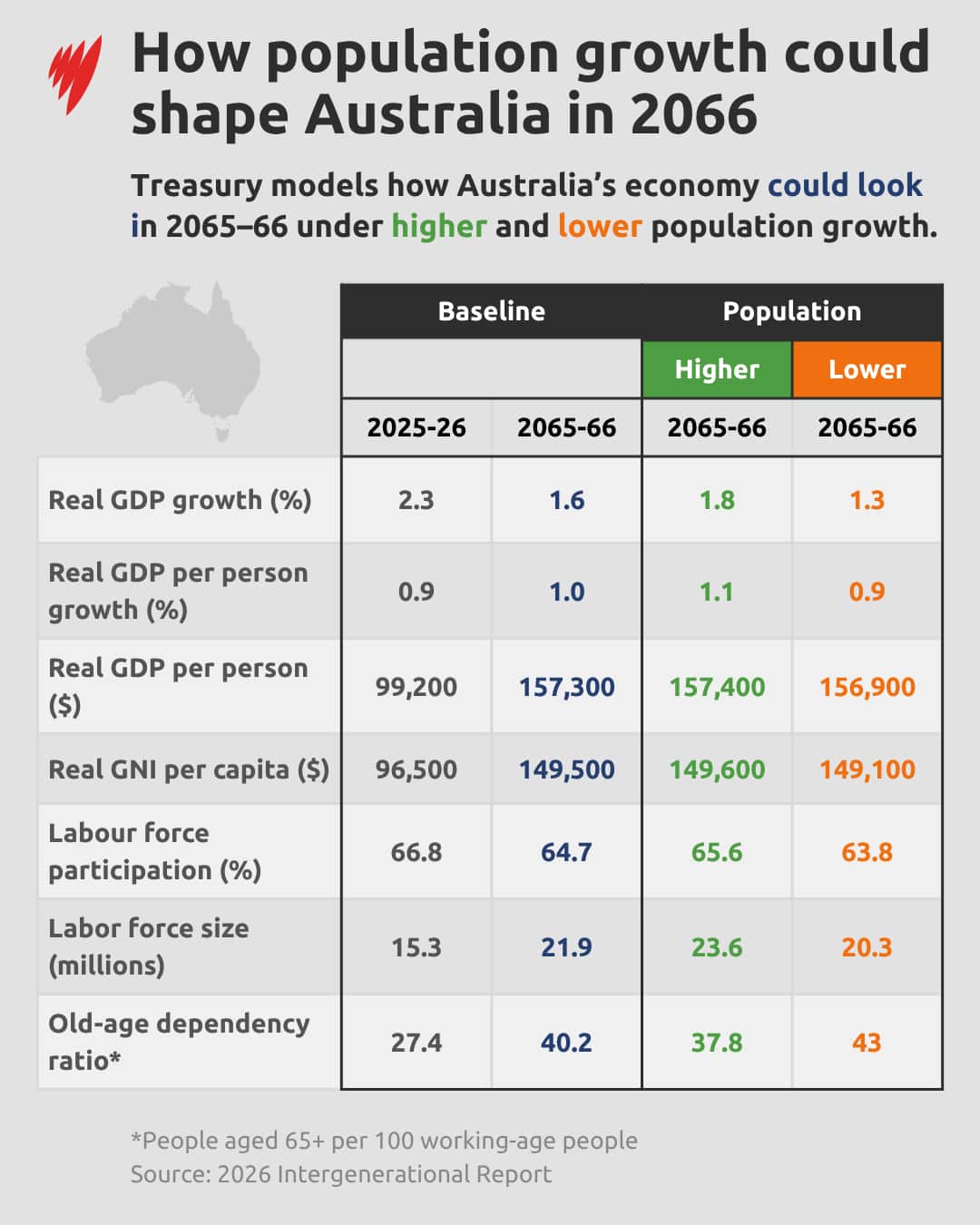
Data in the IGR, released on Monday, shows that under a low migration scenario of 185,000 annually, GDP per capita would shrink by just $400 in 2066, compared with the baseline assumption of 235,000.
Under a higher migration scenario of 285,000, gross national income per capita (GNI) would be just $100 more, despite adding some 2 million people over the 40-year projection period.
GDP per capita refers to a country's total economic output, divided by population. GNI refers to total earnings by a country's people and businesses.
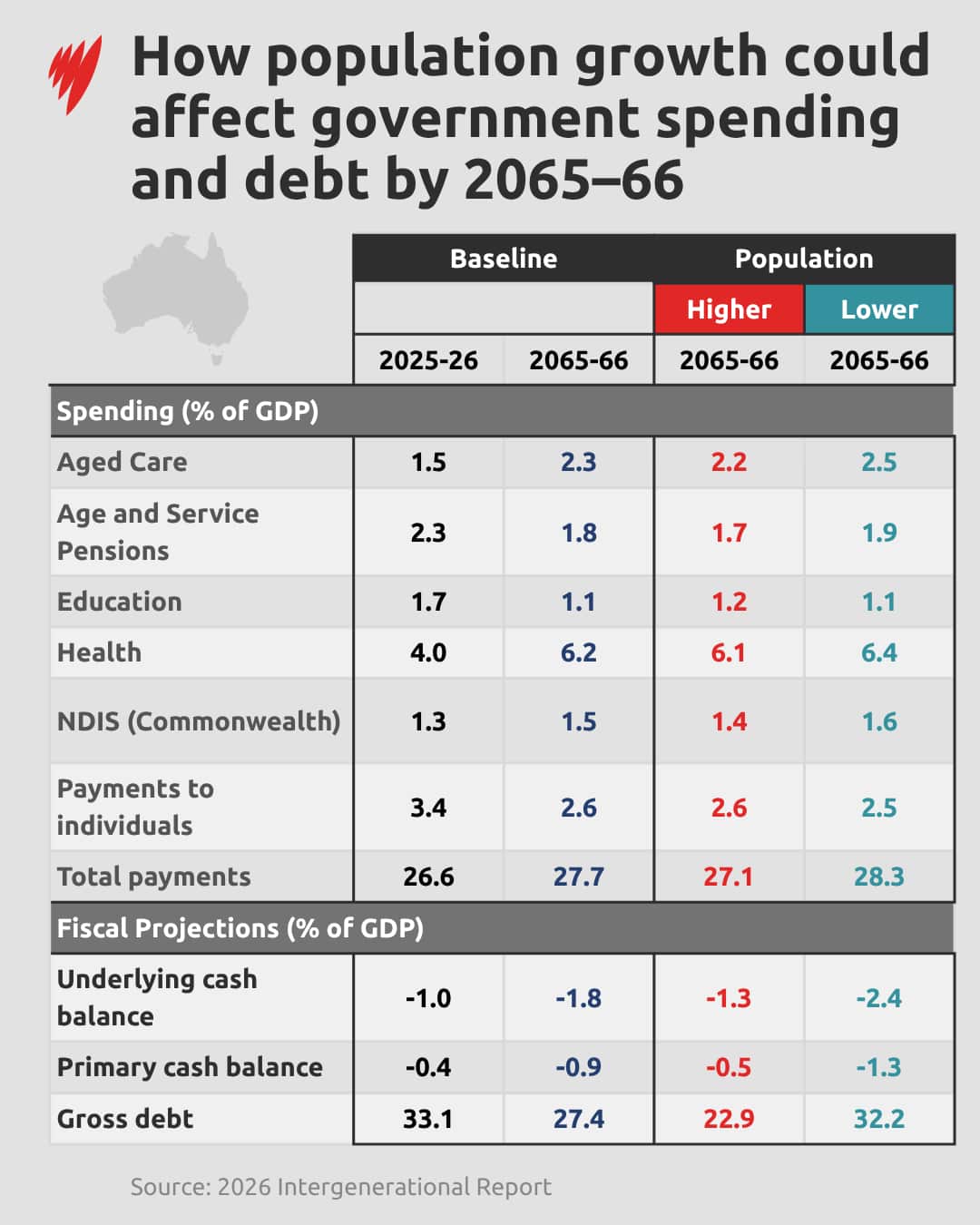
The country's population would climb by roughly 5.5 to 6 million, from around 36 million under a low-migration scenario, to around 42 million in a high-migration scenario by 2066. However Australians would only be $500 better off annually.
Allen said that while individual slices might remain virtually identical, the size of the cake as a whole would be smaller.
"With a shrinking relative working-age population, living standards could go backwards as the government needs to do more with less money," she said.
The fiscal drag of ageing
While per capita GDP and GNI remain virtually identical, national GDP growth drops from 1.6 to 1.3 per cent with fewer migrants as the projections reveal the country would face substantial challenges if migration numbers do not match the forecasts.
Under the low-migration scenario, gross debt as a percentage of GDP would rise by 4.8 per cent while total payments on aged care, the NDIS, healthcare, and other spending would increase by 0.6 per cent.
The old-age dependency ratio — the number of people aged 65 or over for every 100 workers — is projected to rise from 27.4 to 40.2. With fewer migrants, that burden climbs to 43, but with more, it drops to 37.8.
Erin-Lea Brown, economic prosperity deputy program director at the Grattan Institute, said higher migration would help to alleviate issues of an ageing population.
"You have this softening of the ageing population effect," she said. "Our population would still absolutely age over that time period, and it would be a major structural trend in our economy, but it would be to a lesser degree."
Productivity over population
The IGR finds that changes in productivity would be far more significant to national wealth.
The Treasury's baseline productivity is assumed to be 1.2 per cent of GDP, but it also modelled it to be as low as 0.8 or as high as 1.6.
Under a high-productivity scenario, GNI per capita surges from $149,500 to $172,000 in 2066, and gross debt falls from 27.4 per cent of GDP to just 2.4 per cent of GDP.
Labour productivity growth — the ability to "do more with less" — has driven growth in real GDP per person over the past 40 years, Brown said.
As population growth slows and the boost to participation driven by women entering the workforce over the past 40 years levels out, it will become "even more important for labour productivity to do the heavy lifting", Brown said, to "ensure that we continue to have economic growth into the future".
Paying for the future
Australia is far from the only country with a fertility rate — the number of babies born to each woman — below the 2.1 needed to keep the population stable.
More than half of countries have a birth rate below the replacement level, while countries such as Italy, South Korea, China, and Japan have rapidly shrinking populations.
Given that government fiscal policy relies largely on taxing its working population, Allen said a reconsideration of taxation is needed given the long-term demographic shifts Australia is facing.
On Monday, Chalmers ruled out making changes to GST while also rejecting proposals to implement an inheritance tax.
Allen, however, said tax reform can come from elsewhere by "taxing corporates, taxing other entities, and taxing the non-renewable products of the earth from Australia".
"Unless we see some major change to the way that taxation and government funding is conducted in this place, future governments are going to have to make tough decisions."
Intergenerational reports, experts note, are useful because they force governments to "lift their eyes" from the next election to think about long-term planning. Rather than trying to predict the future, they try to capture the impact of present policies in 40 years time if nothing changes.
"In a way, a successful IGR may actually be one whose forecasts never eventuate because it exposed an unsustainable path and forced a change of some kind," Brown said.
Allen added that politicians should not be using the report to "stoke fear" but to rally together to work on the "scary" problems of the future.
"We fix these things by making the future more hopeful, so that folks have greater certainty, and tomorrow looks promising."
For the latest from SBS News, download our app and subscribe to our newsletter.







