
Weeks before Donald Trump launched strikes on Iran that have plunged the Middle East into chaos and sent global markets reeling, a majority of Americans had signalled they didn't want the United States to be involved.
In mid-January, as the US threatened military action against Iran after protesters marching against the regime were being killed, a Quinnipiac University national poll of more than 1,000 respondents found 70 per cent of did not want the US to intervene.
Nonetheless, the US president pulled the trigger last week and along with Israel, launched military strikes against the Iranian regime. Israel argued the move was a "pre-emptive" while Trump has said it was designed to combat Iran's development of a nuclear weapon.
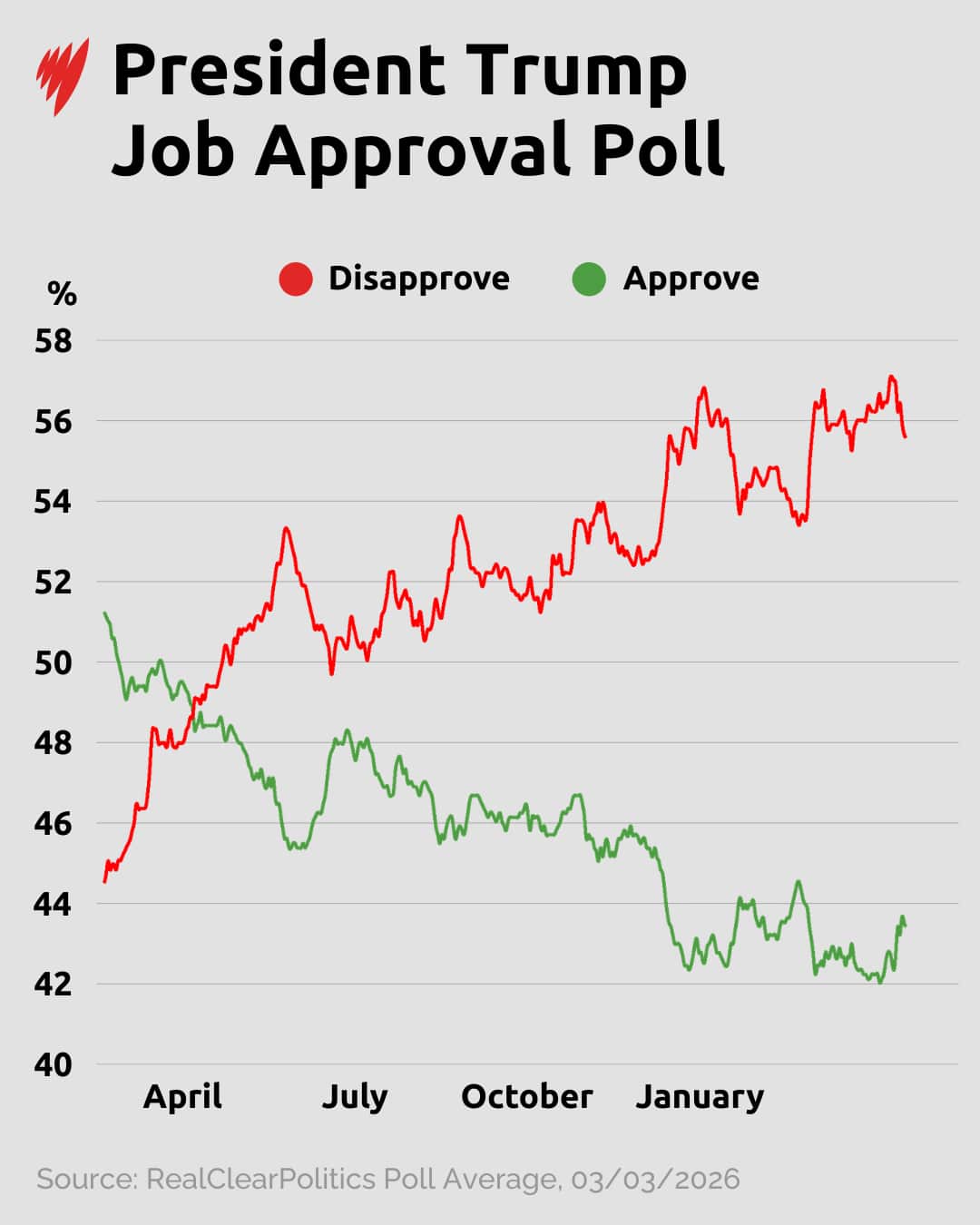
Voter sentiment though, has changed little in the way of support.
News that makes sense
Your trusted source for staying up-to-date with the world around you. Get free daily news updates and analysis, straight to your inbox.
Fresh polling in a Reuters/Ipsos poll shows one in four Americans approve of the campaign. About half — including one in four Republicans — believe President Donald Trump is too willing to use military force.
A separate Washington Post poll of 1,000 Americans found 52 per cent opposed Trump's decision, with almost 40 per cent "strongly opposed". Most of those opposed are "political independents" — not aligned to either the Democrat or Republican party.
Emma Shortis, a US politics expert at the Australia Institute, said Trump was already starting the war from a "low point" in polling.
"Usually ... with these kinds of US military interventions, there's a bump at the start where something might be popular, and then that popularity drops off," she told SBS News.
"But we're not starting from that point this time around. And so that is significant."
The decision to plunge the US into another war has been described as the US' biggest foreign policy gamble in decades — and a major political risk for the Republican Party in November's midterm elections.
Bruce Wolpe, a senior fellow at the United States Studies Centre, said Trump has a few weeks to renew voter confidence in him — and that's amid a risk of unintended consequences like friendly fire incidents and American casualties.
"They're going into a war in which most people don't want," he told SBS News from the United States.
"I think there's a burden on Trump, and he has to do a lot to get a better outcome as far as the standing with the American people."
Midterm elections the key test for Trump
As Iran retaliates against nearby Arab countries hosting American military bases, the reality of the conflict as yet may seem far away for many Americans.
But they will start to feel the war in their hip pockets in the coming months, particularly if the war is a protracted one.
The conflict has already thrown global air transport into chaos and shut down shipping through the Strait of Hormuz, where one-fifth of the world's oil trade skirts the Iranian coast, sending oil prices surging.
Global oil and gas shipping rates also soared, with supertanker costs in the Middle East hitting all-time highs, after Tehran targeted ships passing through the Strait of Hormuz.
Wolpe says the economic impact is the greatest political risk for Trump, with the midterms on the horizon.
Already, polling has shown cost of living is a major issue for voters, and may have an impact at the ballot box in November.
"I think the last thing that Americans insecure about the economy want to hear is, we're in a major war," he told SBS News.
"He cannot solve his economic problem, political problem, by having a war in Iran. But that's where he is, and that's why I do think that the Republican Party will go into the midterms in November with this ... strategic political disadvantage."
The promise of 'no forever wars'
Trump came into office with the promise of an end to America's cycle of forever wars. Before his election, he promised in 2024 to "turn the page forever on those foolish, stupid days of never-ending wars".
Now he's seeking to justify a broad, open-ended war on Iran, though he initially projected the war on Iran to last four to five weeks.
"We're already substantially ahead of our time projections. But whatever the time is, it's okay. Whatever it takes," Trump said at his first public event since the conflict began on Tuesday.
Wolpe said the mood of many Americans he's picking up in Washington DC and other cities is of an anxious populace.
"They don't know where it's going, and they don't see any direct benefit to them," he said.
"I mean, Trump campaigned on saying ... 'I'm not going to have a Forever War. I'm against all these wars. I'm going to be the peacemaker.' Well, that's just not the case, and I think people can understand that, and I think that also hurts his standing with voters."
Wolpe said even with the promise of not committing ground troops in Iran, it's a major political test for Trump.
"It's just very risky. And then you play, oh, 'I didn't put troops on the ground. So it's not a Forever War.' I think people want straight answers to straight problems," he said.
And ongoing coverage of the war will detract from the economic message Trump would want to be projecting, of a healthy economy and cost of living relief, with people more susceptible to doubts about the need for a war on Iran.
"What they really want the president to do is make the economy better, make them more economically secure. And Iran is obliterating all the programs and priorities and announcements that he wants to make," he said.
On the domestic front, Democrats have accused Trump of risking American lives for a 'war of choice' and say Trump should have received Congressional approval for the war.
The decision has also sparked backlash among some MAGA loyalists. Long-time Trump supporter Tucker Carlson said the attack on Iran was "absolutely disgusting and evil", while former Georgia Republican Marjorie Taylor Greene, who recently fell out with the president, on social media posted: "We voted for America First and ZERO wars".
Pro-Trump podcaster Tim Pool and MAGA influencers Keith and Kevin Hodge were also critical of the decision.
But Shortis says Trump's promise of 'no forever wars' tapped into a "deep vein of exhaustion" with the so-called 'war on terror' — and that didn't necessarily mean being anti-war.
"A lot of what Trump tapped into was this mythology, I think, in the United States, not about hating war or not wanting to be involved in war, but a perception that the United States was losing wars because of an internal conspiracy or internal weakness," she said.
"So it wasn't necessarily ever that Trump hated war. It was that he hated losing wars and he was going to win them. And that rhetoric... that sort of mythological take on the United States' role in the world, still has enormous appeal to his base."
What does winning in Iran mean?
Even if Trump navigates the US out of the war successfully, it's unclear what a victory against Iran would look like.
"Trump hasn't articulated a vision for the point of any of this," Shortis said.
"They talk about regime change, then they turn around and talk about obliterating Iran's nuclear capabilities, which they said they'd already done back in June last year, and so it's not even clear, I think, to the administration, let alone the American people, what ... 'winning this' would mean.
"That, of course, is incredibly risky materially for people on the ground, for the United States, for the rest of the world, but it also means that convincing the American people of the worth ... of the need to do this, is going to be incredibly difficult, if not impossible."
— With reporting by the Reuters news agency.
For the latest from SBS News, download our app and subscribe to our newsletter.







